


Economic collapse II
Why the economic collapse is almost unavoidable II?
“I can only say: I’m sorry, America. As a former Federal Reserve official, I was responsible for executing the centrepiece program of the Fed’s first plunge into the bond-buying experiment known as quantitative easing. The central bank continues to spin QE as a tool for helping Main Street. But I’ve come to recognize the program for what it really is: the greatest back-door Wall Street bailout of all time. […] Despite the Fed’s rhetoric, my program wasn’t helping to make credit any more accessible for the average American. The banks were only issuing fewer and fewer loans. More insidiously, whatever credit they were extending wasn’t getting much cheaper. QE may have been driving down the wholesale cost for banks to make loans, but Wall Street was pocketing most of the extra cash,” Andrew Huszar: Confessions of a Quantitative Easer, The Wall Street Journal.
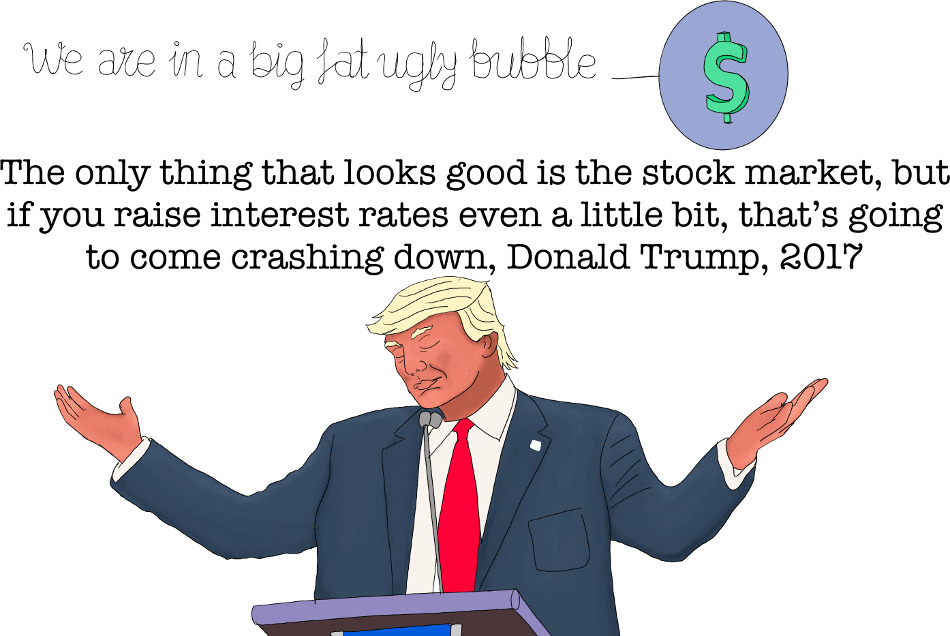
- The “Everything Bubble”. “The Fed responded to the 2008 financial crisis with unprecedented amounts of easy money. Think of the trillions of dollars in money printing programs (QE) […] At the same time, the Fed effectively took interest rates to zero, the lowest they’ve been in the entire history of the U.S. Allegedly, the Fed did this all to save the economy. In reality, it has created enormous and unprecedented economic distortions and misallocations of capital. And it’s all going to be flushed out. In other words, the Fed’s response to the last crisis sowed the seeds for an even bigger crisis. The trillions of dollars the Fed “printed” created not just a housing bubble or a tech bubble, but an “everything bubble.” Nick Giambruno, This Is How the “Everything Bubble” Will End, International Man.
- Unfounded liabilities. “[…] The biggest, more ominous threat facing taxpayers are unfunded liabilities — the difference between the net present value of expected future government spending and the net present value of projected future tax revenue, particularly those associated with Social Security and Medicare,” You Think The Deficit Is Bad? Federal Unfunded Liabilities Exceed $127 Trillion, Forbes, 2014.
This is really terrible news and yet, it is only getting worse. “Your Pension Is a Lie: There’s $210 Trillion Of Liabilities Our Government Can’t Fulfill”, Forbes 2017.
-
Derivatives “[are] a contract between two or more parties whose value is based on an agreed-upon underlying financial asset, index or security. Common underlying instruments include: bonds, commodities, currencies, interest rates, market indexes and stocks. Futures contracts, forward contracts, options, swaps and warrants are common derivatives. The derivatives market is, in a word, gigantic – often estimated at more that $1.2 quadrillion on the high end, " Derivative, Investopedia
“The derivatives genie is now well out of the bottle, and these instruments will almost certainly multiply in variety and number until some event makes their toxicity clear. Central banks and governments have so far found no effective way to control, or even monitor, the risks posed by these contracts. In my view, derivatives are financial weapons of mass destruction, carrying dangers that, while now latent, are potentially lethal”, Warren Buffet on Derivatives, FinTools Software and Consulting.
