
|
 |
 |
|
|
|
|
And yet despite the look on my face, you’re still talking and thinking that I care, Anonymous

The complex plane $\mathbb{C}$ is unbounded, so points can “go or blow off to infinity” in many directions. To study the behavior of functions “at infinity” and to give $\infty$ equal footing with finite complex numbers, we adjoin one extra point and obtain the extended complex plane $\mathbb{C}^* = \mathbb{C} \cup \{ \infty \}$
The stereographic projection maps a complex point z = x + iy, regarded as the point (x, y, 0) to the unique point Z = (x₁, y₁, z₁) on the sphere (other than $N$) that lies on the line through N and z (Figure 2). That ray strikes S at exactly one other point Z = (x1, y1, z1). The map $\pi: \mathbb{C} \to S \setminus \{N\}, (x, y, 0) \to (x₁, y₁, z₁)$ is the stereographic projection. In this way each point on the complex plane corresponds uniquely to a point on the surface of the sphere.
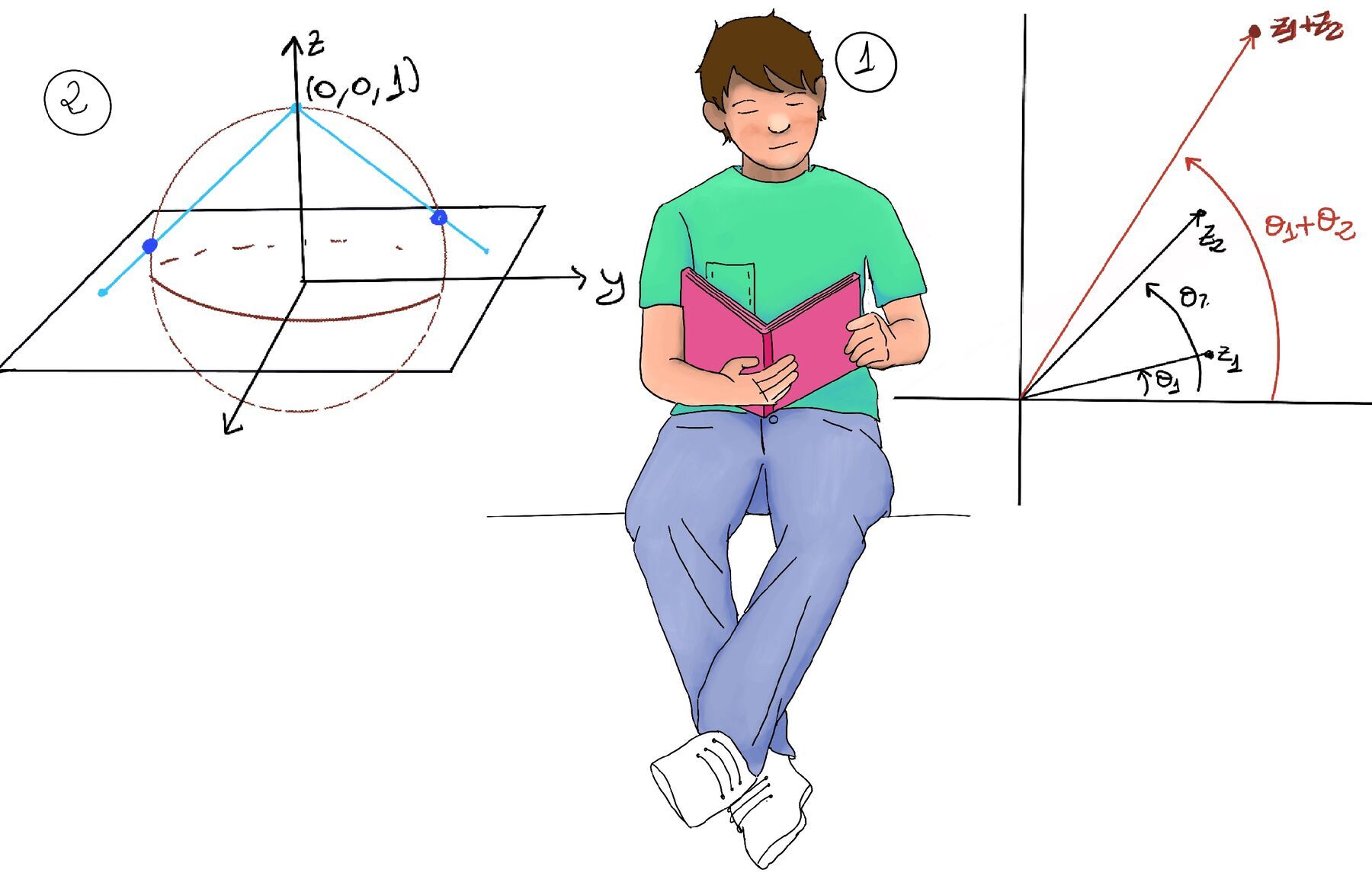
The ray from $N$ through $z$. The line connecting N(0, 0, 1) and z(x, y, 0) can be parameterized as: $\mathbf{L}(t) = tN + (1-t)z = t(0, 0, 1) + (1-t)(x, y, 0) = ((1-t)x, (1-t)y, t), \quad t \in \mathbb{R}$
To find the intersection with the sphere. To find the intersection point, we substitute the coordinates of $\mathbf{L}(t)$ into the equation of the sphere, and we get:
$$ \begin{aligned} (1-t)^2 x^2 + (1-t)^2 y^2 + t^2 = 1 &\implies (1-t)^2(x^2 + y^2) + t^2 = 1 \\[2pt] &\implies (1-t)^2|z|^2 + t^2 = 1\\[2pt] &\implies[\text{Expanding and rearrange to a quadratic in t}] |z|^2(1 - 2t + t^2) + t^2 = 1 \\[2pt] &\implies |z|^2 - 2|z|^2 t + |z|^2 t^2 + t^2 = 1 \\[2pt] &\implies t^2(|z|^2 + 1) - 2|z|^2 t + (|z|^2 - 1) = 0 \\[2pt] &\implies[\text{Solving the quadratic equation}] t = \frac{2|z|^2 \pm \sqrt{4|z|^4 - 4(|z|^2 + 1)(|z|^2 - 1)}}{2(|z|^2 + 1)} \\[2pt] &\implies[\text{Simplifying the discriminant:}] 4|z|^4 - 4(|z|^4 - 1) = 4|z|^4 - 4|z|^4 + 4 = 4 \\[2pt] &\implies t = \frac{2|z|^2 \pm 2}{2(|z|^2 + 1)} = \frac{|z|^2 \pm 1}{|z|^2 + 1} \\[2pt] \end{aligned} $$We have two solutions for t:
Forward projection: $\pi: \mathbb{C} \to S \setminus \{N\}$
Using $t = \frac{|z|^2 - 1}{|z|^2 + 1}$ and $1 - t = \frac{2}{|z|^2 + 1}$, we obtain the projection: $\boxed{\pi(z) = (x_1, y_1, z_1) = \left(\frac{2x}{|z|^2 + 1}, \frac{2y}{|z|^2 + 1}, \frac{|z|^2 - 1}{|z|^2 + 1}\right)}$ (coordinates on the sphere).
In terms of $z$ and $\bar{z}$. Since $x = \frac{z + \bar{z}}{2}$ and $y = \frac{z - \bar{z}}{2i}$, $\pi(z) = \left(\frac{z + \bar{z}}{|z|^2 + 1}, \frac{z - \bar{z}}{i(|z|^2 + 1)}, \frac{|z|^2 - 1}{|z|^2 + 1}\right)$
Inverse projection: $\pi^{-1}: S \setminus \{N\} \to \mathbb{C}$
Given a point $(x_1, y_1, z_1)$ on the sphere S with $z_1 \neq 1$ (other than the north pole with z₁ ≠ 1), we can find the corresponding complex number z in the plane: $\boxed{z = \pi^{-1}(x_1, y_1, z_1) = \frac{x_1 + iy_1}{1 - z_1}}$
Verification: $\frac{x_1 + iy_1}{1 - z_1} = \frac{\frac{z + \bar{z}}{|z|^2 + 1} + i \cdot \frac{z - \bar{z}}{i(|z|^2 + 1)}}{1 - \frac{|z|^2 - 1}{|z|^2 + 1}} = \frac{\frac{z + \bar{z} + z - \bar{z}}{|z|^2 + 1}}{\frac{|z|^2 + 1 - |z|^2 + 1}{|z|^2 + 1}} = \frac{\frac{2z}{|z|^2 + 1}}{\frac{2}{|z|^2 + 1}} = z \quad \checkmark$. This check shows the formula is exactly the inverse of the forward stereographic projection.
The stereographic projection establishes a one-to-one correspondence between the complex plane ℂ and the unit sphere S excluding the north pole N. To complete the correspondence, we add a point at infinity (∞) to ℂ and map it to the north pole N. This extended complex plane ℂ ∪ {∞} is called the Riemann sphere.
In the extended complex plane (the Riemann sphere), we declare π−1(N) = ∞. The resulting bijection ℂ ∪ {∞} ≅ S is the Riemann sphere. Formally, $\hat{\mathbb{C}} = \mathbb{C} \cup \{\infty\}$, where we define $\pi(\infty) = N = (0, 0, 1)$.
Key Properties of Stereographic Projection:
In the extended complex plane (Riemann sphere) $\hat{\mathbb{C}} = \mathbb{C} \cup \{\infty\}$, arithmetic operations involving ∞ are defined to preserve geometric and analytic consistency.
For $a \in \mathbb{C}$:
| Operation | Result | Condition |
|---|---|---|
| $a + \infty$ | $\infty$ | Adding any finite value to ∞ remains ∞, reflecting the unbounded nature of infinity |
| $a \cdot \infty$ | $\infty$ | $a \neq 0$, scaling ∞ by a non-zero finite value preserves infinity |
| $\frac{a}{\infty}$ | $0$ | Dividing a finite value by infinity approaches zero, consistent with limits |
| $\frac{a}{0}$ | $\infty$ | $a \neq 0$ Division by zero maps to infinity, corresponding to poles in meromorphic functions, e.g., 1/z |
| $\infty + \infty$ | Undefined | Indeterminate form as it lacks a unique interpretation |
| $0 \cdot \infty$ | Undefined | Indeterminate form as it lacks a unique interpretation |
| $\frac{0}{0}$ | Undefined | Indeterminate form |
| $\frac{\infty}{\infty}$ | Undefined | Indeterminate form |
The chordal metric (or spherical metric) provides a way to measure distances between points on the extended complex plane $\hat{\mathbb{C}}$ by treating them as points on a physical sphere.
The chordal distance d(z, w) between two points on the Riemann sphere is the straight-line Euclidean distance in $\mathbb{R}^3$ between their projections on the sphere S.
For any complex number $z = x + iy$, its projection $\pi(z) = (x_1, x_2, x_3)$ onto the sphere is given by: $x_1 = \frac{2x}{1+|z|^2}, x_2 = \frac{2y}{1+|z|^2}, x_3 = \frac{|z|^2-1}{|z|^2+1}$. The point at infinity $\infty$ is mapped directly to the North Pole $N(0, 0, 1)$.
For any $z, w \in \hat{\mathbb{C}}$:
$d(z, w) = \begin{cases} \|\pi(z) - \pi(w)\|_{\mathbb{R}^3}, &z, w \ne \infty\\\\ \frac{2}{\sqrt{1+|z|²}}, &w = \infty \end{cases}$
$d(z, w) = \begin{cases} \frac{2|z - w|}{\sqrt{(1 + |z|^2)(1 + |w|^2)}} & z, w \neq \infty \\ \frac{2}{\sqrt{1+|z|^2}} & w = \infty \end{cases}$
Let’s derive why $d(z, \infty) = \frac{2}{\sqrt{1+|z|^2}}$. We calculate the distance between $\pi(z) = (x_1, x_2, x_3)$ and the North Pole $N = (0, 0, 1)$ (the point at infinity ∞ is mapped directly to the north pole N = (0, 0, 1) of the unit sphere S), $d(z, \infty)^2 = (x_1 - 0)^2 + (x_2 - 0)^2 + (x_3 - 1)^2$
Since $x_1^2 + x_2^2 = \frac{(2x)^2 + (2y)^2}{(1+|z|^2)^2} = \frac{4(x^2+y^2)}{(1+|z|^2)^2}$, and $x^2 + y^2 = |z|^2$: $x_1^2 + x_2^2 = \frac{4|z|^2}{(1+|z|^2)^2}$
$x_3 - 1 = \frac{|z|^2 - 1}{|z|^2 + 1} - 1 = \frac{|z|^2 - 1 - (|z|^2 + 1)}{|z|^2 + 1} = \frac{-2}{|z|^2 + 1}$
Therefore, $d(z, ∞)^2 = (x_1-0)^2+(y_1-0)^2+(z_1-1)^2 = \frac{4|z|^2}{(1+|z|^2)^2} + \frac{4}{(1+|z|^2)^2} = \frac{4·(1+|z|^2)}{(1+|z|^2)^2} = \frac{4}{1+|z|^2}$
Taking the square root gives the previous formula: $d(Z, ∞) = \frac{2}{\sqrt{1+|z|²}}$
This correspondence along with the distance is called the stereographic projection.
Key properties of the Chordal Metric:
The Riemann sphere is a compact space (closed and bounded in $\mathbb{R}^3$), so all distances are finite. The maximum distance between any two points on the unit sphere is the diameter, which is 2 (the distance between the north pole N = (0, 0, 1) and south pole S = (0, 0, −1)). For any $z, w \in \hat{\mathbb{C}} $, the chordal distance d(z, w) is the Euclidean distance in $\mathbb{R}^3$ between their projections π(z) and π(w) on the sphere. Since the sphere has radius 1, the maximum Euclidean distance between two points is 2.
The origin z = 0 maps to the south pole S = (0, 0, −1), and ∞ maps to the north pole N = (0, 0, 1). The Euclidean distance between S and N in $\mathbb{R}^3$ is 2, which is the diameter of the sphere.

JustToThePoint Copyright © 2011 - 2026 Anawim. ALL RIGHTS RESERVED. Bilingual e-books, articles, and videos to help your child and your entire family succeed, develop a healthy lifestyle, and have a lot of fun. Social Issues, Join us.
This website uses cookies to improve your navigation experience.
By continuing, you are consenting to our use of cookies, in accordance with our Cookies Policy and Website Terms and Conditions of use.