
|
 |

|
|
|
|
|
|
It ain’t about how hard you can hit. Its about how hard you can get hit, and how much you can take, and keep moving forward, Rocky Balboa

A complex function $f(z)$ maps $z = x + iy \in \mathbb{C}$ to another complex number. For example: $f(z) = z^2 = (x + iy)^2 = x^2 - y^2 + 2ixy, f(z) = \frac{1}{z}, f(z) = \sqrt{z^2 + 7}$.
A contour is a continuous, piecewise-smooth curve defined parametrically as: $z(t) = x(t) + iy(t), \quad a \leq t \leq b$.
Definition (Smooth Contour Integral). Let ᵞ be a smooth contour (a continuously differentiable path in the complex plane), $\gamma: [a, b] \to \mathbb{C}$. Let $f: \gamma^* \to \mathbb{C}$ be a continuous complex-valued function defined on the trace $\gamma^*$ of the contour (i.e. along the image of $\gamma$). Then, the contour integral of f along $\gamma$ is defined as $\int_{\gamma} f(z)dz := \int_{a}^{b} f(\gamma(t)) \gamma^{'}(t)dt$.
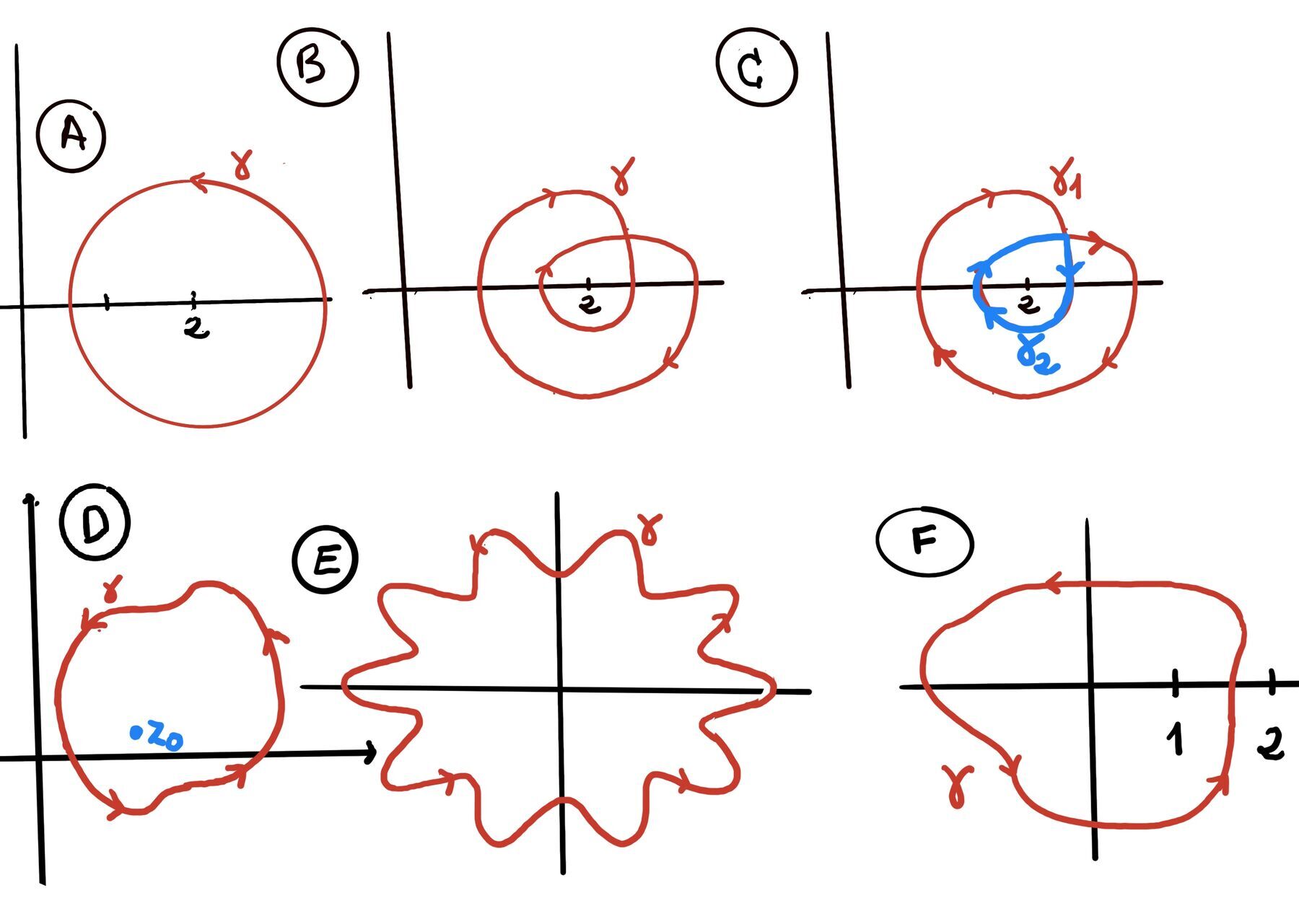
Deformation of Contours. If two contours $\gamma_1$ and $\gamma_2 $ are homotopic (i.e., one can be continuously deformed into the other without crossing any singularities of f) in a domain where f(z) is analytic, then: $\int_{\gamma_1} f(z)dz = \int_{\gamma_2} f(z)dz.$
Fundamental Theorem of Calculus for Contours. Suppose $\gamma$ is a contour (piecewise smooth path) from a to b, f is defined on a domain D containing $\gamma^*$ (the image of $\gamma$) and admits a primitive (antiderivative) F on D (i.e., $F'(z) = f(z)$), then $\int_{\gamma} f(z)dz = F(\gamma(b)) - F(\gamma(a))$. In particular, if $\gamma$ is a closed contour (i.e., $\gamma(a)=\gamma(b)$), this integral evaluates to zero, $\int_{\gamma} f(z)dz = 0.$
Estimation Theorem or the Triangle Inequality for Integrals. The triangle inequality for integrals in complex analysis states thatfor any continuous complex function $f:[a,b] \to \mathbb{C}$ on a closed real interval [a,b] (f(t) = u(t) + iv(t), t a real parameter), the following holds: $∣\int_a^b f(t)dt| \leq \int_a^b |f(t)|dt$.
Estimation Lemma (ML Inequality) for contour integrals. For any continuous complex function $f:[a,b] \to \mathbb{C}$ on a closed real interval [a,b] (f(z) = u(x, y) + iv(x, y)) with f bounded by some constant M along the entire contour, |f(z)| ≤ M for all $z \in \gamma^*$ (the image/trace of the contour in the complex plane), the following holds: $∣\int_\gamma f(z)dz| \leq M \cdot l(\gamma)$ where l(γ) is the arc length of the contour γ given by $\int_a^b |\gamma^{'}(t)|dt = \int_a^b \sqrt{x'(t)^2 + y'(t)^2}dt \text{ where } \gamma(t) = x(t) + iy(t)$.
Morera’s theorem. Suppose that f is a continuous function on an open set $G \subseteq \mathbb{C}$. If the contour integral of f is zero for every closed contour $\gamma$ in G, i.e., $\oint_\gamma f(z)dz = 0$. Then, f is analytic (holomorphic) in G.
Morera’s Theorem is the converse of Cauchy’s (or Cauchy-Goursat) Theorem. Cauchy’s Theorem states that if f is analytic, any closed contour integral having f as an integrand is zero. In other words, analyticity implies vanishing closed contour integrals. Morera’s Theorem flips this logic. It states that if all closed contour integrals vanish and the function is continuous, then the function must be analytic. Together, they provide a complete characterization: a continuous function on an open set is analytic if and only if all its closed contour integrals vanish.
It provides a way to prove analyticity without checking the Cauchy–Riemann equations or computing derivatives directly.
Proof.
The Antiderivative Theorem (Path Independence) states that a continuous function f in a domain G has an antiderivative F in G (meaning F’(z) = f(z)) if and only if the integral of f is path-independent in G (which is equivalent to $\oint_{\gamma} f(z)dz = 0$ for every closed contour $\gamma$ in G).
Triangles suffice. In practice, it is enough to verify that $\oint_T f(z)dz = 0$ for every triangle T in G. The triangle version implies the general version because any closed contour integral can be approximated by sums of integrals over triangles.
Continuity is essential. Without the continuity hypothesis, the conclusion can fail. There exist discontinuous functions for which all contour integrals vanish.
Application: Limits of analytic functions. A classical use of Morera’s theorem: if $\{f_n\}$ is a sequence of analytic functions converging uniformly to $f$, $f_n\rightarrow f$ on compact subsets of $G$, then $f$ is analytic. Proof:
Gauss’s mean value theorem. If f(z) is analytic on and inside a circle $\gamma$ with center $z_0$ and radius R, $\gamma(z_0; R)$, then$\boxed{f(z_0) = \frac{1}{2\pi}\int_0^{2\pi} f(z_0 + Re^{i\theta})\,d\theta.}$
This theorem states that the value of an analytic function at the center of a circle $f(z_0)$ is precisely the average value of $f(z)$ on the circle $\gamma$. This is a purely complex-analytic phenomenon — it reflects the rigidity of holomorphic functions and has no analogue for general smooth real functions.
Proof
We begin with the Cauchy Integral Formula, which is the source and core of this theorem. It tells us the value of an analytic function at a point $z_0$ based on its values on a contour $\gamma$ enclosing it, equals:
$$\begin{aligned} f(z_0) &=\frac{1}{2\pi i}\int_{\gamma(z_0; R)} \frac{f(w)}{w-z_0}dw \\[2pt] &\text{Parametrize the Contour} \gamma(z_0; R): w = z_0 + Re^{i\theta}, 0 \le \theta \le 2\pi \leadsto dw = iRe^{i\theta}d\theta \\[2pt] &= \frac{1}{2\pi i}\int_0^{2\pi} \frac{f(z_0 + Re^{i\theta})}{Re^{i\theta}}iRe^{i\theta}d\theta \\[2pt] &\text{This looks complex, but it simplifies beautifully.} \\[2pt] &=\frac{1}{2\pi}\int_0^{2\pi}f(z_0 + Re^{i\theta})d\theta \end{aligned} $$Let $f = u + iv$ be analytic in a domain D containing the disk $|z - z_0| \le R$, then $u$ and $v$ are harmonic (satisfy Laplace’s equation: $\nabla^2 u = \nabla^2 v = 0$).
For $f$ analytic on and inside the circle $C_R(z_0) = \{z : |z - z_0| = R\}$: $f(z_0) = \frac{1}{2\pi}\int_0^{2\pi} f(z_0 + Re^{i\theta})\, d\theta$. This states that the value at the center equals the average of values on the surrounding circle.
Decompose into Real and Imaginary Parts, $u(z_0) + iv(z_0) = \frac{1}{2\pi}\int_0^{2\pi} \left[u(z_0 + Re^{i\theta}) + iv(z_0 + Re^{i\theta})\right] d\theta$
By linearity of integration and uniqueness of complex decomposition: $\boxed{u(z_0) = \frac{1}{2\pi}\int_0^{2\pi} u(z_0 + Re^{i\theta})\, d\theta}$, $\boxed{v(z_0) = \frac{1}{2\pi}\int_0^{2\pi} v(z_0 + Re^{i\theta})\, d\theta}$
This is the mean value property for harmonic functions, which we encountered earlier. Gauss’s theorem for analytic functions is the complex-valued version that implies it.
Solution.
Remark. The key technique — choosing the radius of the contour to optimize the ML bound — is a standard and powerful method in complex analysis.

JustToThePoint Copyright © 2011 - 2026 Anawim. ALL RIGHTS RESERVED. Bilingual e-books, articles, and videos to help your child and your entire family succeed, develop a healthy lifestyle, and have a lot of fun. Social Issues, Join us.
This website uses cookies to improve your navigation experience.
By continuing, you are consenting to our
use of cookies, in accordance with our Cookies Policy and
Website Terms and Conditions of use.