
|
 |

|
|
|
|
|
|
“When bias narratives, misleading news without context, and blatant lies spread like wildfire, history needs to be rewritten and truth needs to be cancelled”, Anawim, #justothepoint.

Laurent’s theorem. Let $f$ be analytic in an annular region $A = \{z \in \mathbb{C} : R < |z - a| < S\}$, where $0 \le R < S \le \infty$. Then, $f(z)$ can be represented by a unique power series containing both positive and negative powers: $f(z) = \sum_{n=-\infty}^\infty c_n(z -a)^n, \forall z \in A$ where the coefficients $c_n$ are given by the formula: $c_n = \frac{1}{2\pi i}\int_{\gamma} \frac{f(w)}{(w-a)^{n+1}}dw$ and $\gamma$ is any positively simple closed curve in $A$ that encloses the inner boundary (usually taken as a circle of radius $r$ such that $R < r < S$).
Step 1. Simplification: Centering at the Origin
The theorem is true for any center point a. However, carrying the term $(z-a)$ through every single line of algebra is messy, confusing, and indeed quite tiring. Let’s just assume a is at the origin. If we prove it for 0, we can just shift (by a translation) the entire universe back to a at the end by replacing every z with $(z-a)$.
Step 2. The Geometry: The “Cut Donut”
The Annulus is now $R < |z| < S$, i.e., a donut shape defined by an inner radius R and an outer radius S. We pick a specific point z inside this donut and sandwich it between two arbitrary circles: (i) inner Circle ($C_P$), radius P; (ii) and outer Circle ($C_Q$), radius Q, such that R < P < |z| < Q < S.
💡 We cannot simply integrate around the whole donut because the hole in the middle (where the function might blow up) prevents us from using Cauchy’s Formula directly, so we cut the donut in half with two “C-shaped” curves (Figure i):
Curve $\gamma_1$. It goes along or traverses the top half of the outer circle $C_Q$ counter-clockwise. It descends through the ring or annulus (a radial cut), then proceeds along the upper half of the inner circle $C_P$ (in reverse, that is, clockwise), and finally it returns. It cuts the ring or annulus to close the loop. More significantly, this loop encloses our point z.
Curve $\gamma_2$. It traces the bottom halves of the circles and the cut lines in a similar fashion. Notice that this loop does not enclose z, and that the “cuts” (the vertical lines going through the ring) are traversed twice in opposite directions.
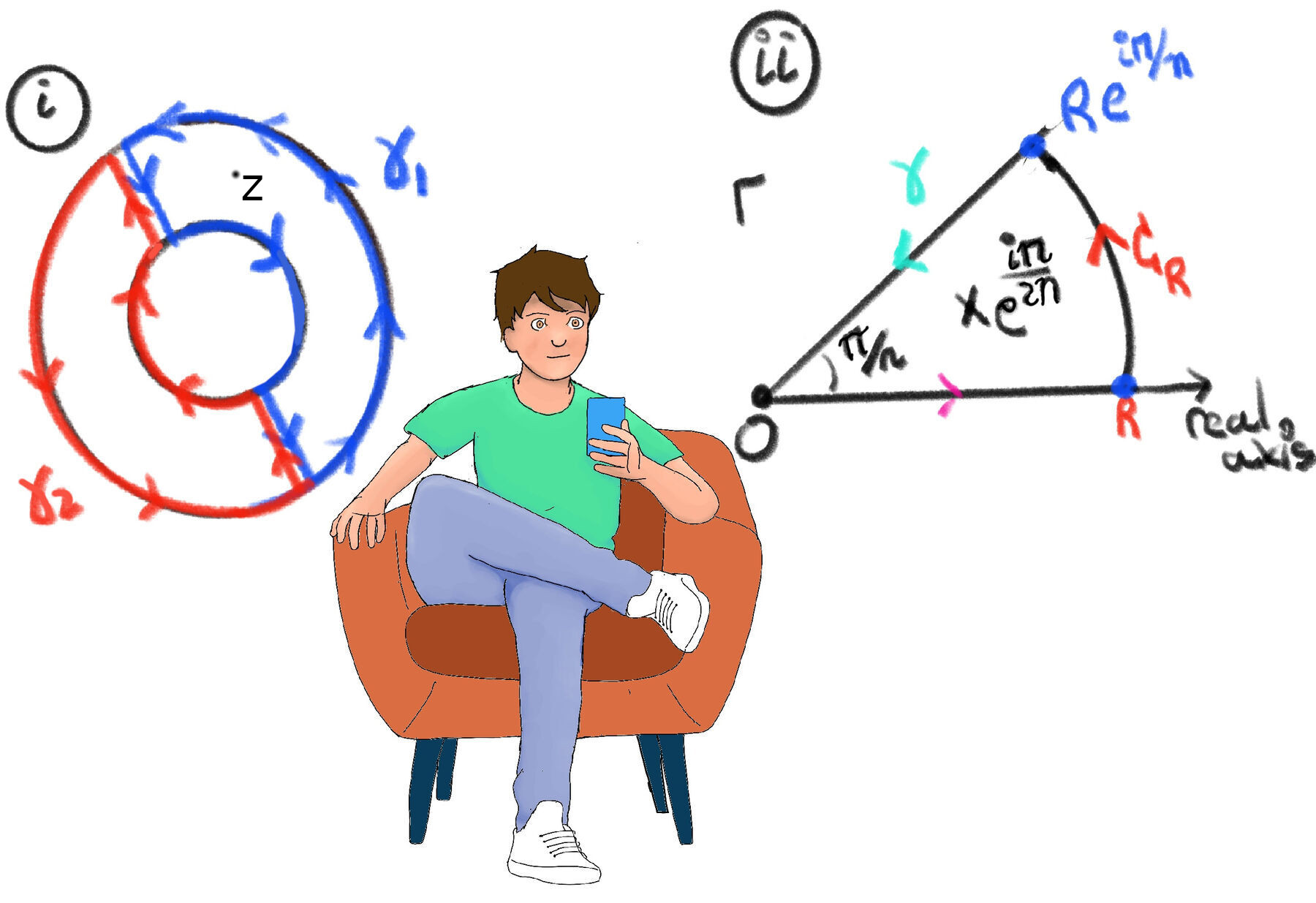
Now we apply Cauchy’s Integral Formula and Cauchy’s Theorem.
$f(z) =[\text{Cauchy's Integral Formula}] \frac{1}{2\pi i}\int_{\gamma_1}\frac{f(w)}{w-z}dw$ since f is analytic inside and on $\gamma_1$ (a simple closed curve) and $z \in Int(\gamma_1)$ (inside this closed loop)
$0 =[\text{Cauchy's Theorem}] \frac{1}{2\pi i}\int_{\gamma_2}\frac{f(w)}{w-z}dw$ since $\frac{f(w)}{w-z}$ is analytic on and inside $\gamma_2$, meaning for $w \in Int(\gamma_2)$ and $w \in \gamma_2^*$, the integral is zero.
Combining both results, $f(z) + 0 = f(z) = \frac{1}{2\pi i}\int_{\gamma_1}\frac{f(w)}{w-z}dw + \int_{\gamma_2}\frac{f(w)}{w-z}dw = \frac{1}{2\pi i}\int_{\gamma_1 + \gamma_2}\frac{f(w)}{w-z}dw = \frac{1}{2\pi i}\int_{C_Q}\frac{f(w)}{w-z}dw - \frac{1}{2\pi i}\int_{C_P}\frac{f(w)}{w-z}dw$ where $C_Q$ is a (outer) circle of radius Q oriented positively and $C_R$ is a (inner) circle of radius R oriented positively, too.
When we add the paths $\gamma_1 + \gamma_2$, the “cuts” (the vertical lines that go through the ring) are traversed twice in opposite directions, effectively cancelling each other out. As a result, only the outer circle $C_Q$ (which is traversed counter-clockwise $\circlearrowleft$) and the inner circle $C_P$ (which is traversed clockwise $\circlearrowright$, so we flip it and add a minus) are left.
Step 3. Expanding the Outer Integral ($C_Q$)
The Outer Integral ($C_Q$). $\frac{1}{2\pi i}\int_{C_Q}\frac{f(w)}{w-z}dw$
$w$ is on the outer circle and $z$ is inside. So $|w| > |z|$. We want a ratio smaller than 1 to use the Geometric Series formula $\frac{1}{1-r} = \sum r^n$. We choose $r = \frac{z}{w}$.
$w \in C_Q \implies \frac{1}{w-z} = \frac{1}{w(1-\frac{z}{w})} [\text{Expand with geometric series}] \frac{1}{w}\sum_{n=0}^{\infty} (\frac{z}{w})^n = \sum_{n=0}^{\infty} \frac{z^n}{w^{n+1}}$.
Substitute this into the integral: $\frac{1}{2\pi i}\int_{C_Q} f(w) \left( \sum_{n=0}^{\infty} \frac{z^n}{w^{n+1}} \right) dw = \sum_{n=0}^{\infty} \left( \frac{1}{2\pi i} \int_{C_Q} \frac{f(w)}{w^{n+1}} dw \right) z^n$. This gives or generates the Analytic Part (non-negative powers), $n=0, 1, 2 \dots$.
Why have we been able to swap sum and integrals? We are allowed to do this because the series converges uniformly. Recall that we expanded $\frac{1}{w-z}$ using a Geometric Series: $\sum_{n=0}^{\infty} \left(\frac{z}{w}\right)^n$. This geometric series converges uniformly if the ratio $|r| < 1$.
The variable of integration $w$ is on the circle of radius $Q$. The fixed point z is inside, so |z| < Q, and the ratio is $|\frac{z}{w}| = \frac{|z|}{|w|} = \frac{|z|}{Q} \lt 1$. Call $\rho := \frac{|z|}{Q}$. Then, $\forall w \in C_Q, |(\frac{z}{w})^n| \le \rho^n$. The bound $\rho^n$ is independent of 𝑤, so by the Weierstrass M-test, the series $\sum_{n=0}^{\infty} \left(\frac{z}{w}\right)^n$ converges uniformly in 𝑤 on $C_Q$.
Step 4. Expanding the Inner Integral ($C_P$).
Here, w is on the inner circle and z is outside it. So $|z| > |w|$. We need a ratio smaller than 1. We must choose $r = \frac{w}{z}$.
$\frac{1}{w-z} = \frac{-1}{z-w} = \frac{-1}{z(1 - \frac{w}{z})} = -\frac{1}{z} \sum_{k=0}^{\infty} \left(\frac{w}{z}\right)^k = -\sum_{k=0}^{\infty} \frac{w^k}{z^{k+1}}$
Substitute this into the integral. Be careful, the integral had a minus sign in front of it and the series expansion also has a minus sign, so they cancel out to become positive.
$+ \frac{1}{2\pi i}\int_{C_P} f(w) \left( \sum_{k=0}^{\infty} \frac{w^k}{z^{k+1}} \right) dw = \sum_{k=0}^{\infty} \left( \frac{1}{2\pi i} \int_{C_P} f(w) w^k dw \right) \frac{1}{z^{k+1}}$
We have a sum of terms looking like $\frac{1}{z^{k+1}}$. We want to make this look like $z^n$ where $n$ is negative. Let $n = -(k+1) \implies n = - k - 1 \implies k = -n -1$. (i) If k = 0, then n = -1; (ii) If k = 1, then n = -2; (iii) The power $w^k$ inside the integral becomes $w^{-n-1}$; (iv) and the term $z^{-(k+1)}$ becomes $z^n$. As $k$ goes from $0$ to $\infty$, $n$ goes from $-1$ to $-\infty$.
This transforms the second sum into: $\sum_{n=-\infty}^{-1} \left( \frac{1}{2\pi i} \int_{C_P} \frac{f(w)}{w^{n+1}} dw \right) z^n$. This generates the Principal Part (negative powers).
Step 5. Final Step: Cauchy’s Deformation.
Since $f$ is analytic in the ring or annulus, Cauchy’s Deformation Theorem says the integrals over $C_Q$ and $C_P$ are actually the same as the integral over any curve $\gamma$ strictly between them (Note 1). So we can just call the path $\gamma$.
$f(z) = \underbrace{\sum_{n=0}^{\infty} c_n z^n}_{\text{Outer Part}} + \underbrace{\sum_{n=-\infty}^{-1} c_n z^n}_{\text{Inner Part}} = \sum_{n=-\infty}^{\infty} c_n z^n$ where $c_n = \frac{1}{2\pi i} \int_\gamma \frac{f(w)}{w^{n+1}} dw$
Note 1. The function we are integrating to find the coefficients $c_n$ is: $g(w) = \frac{f(w)}{w^{n+1}}$
Let f be analytic in the annulus A = $\{ z \in \mathbb{C}: R \lt |z - a| \lt S \}$ where $0 \le R \lt S \le \infty$. Suppose f(z) can be represented by a series expansion: $f(z) = \sum_{n=-\infty}^{\infty} d_n (z-a)^n, \forall z \in A$. Then, the coefficients $d_n$ are uniquely determined and are precisely the Laurent coefficients given by: $d_n = \frac{1}{2\pi i} \int_\gamma \frac{f(w)}{(w-a)^{n+1}} dw, \forall n \in \mathbb{Z}$
The goal of this proof is to answer a quite simple question. If I use algebraic tricks, geometric series, or partial fractions to find a series that equals f(z) in a specific ring, is it guaranteed to be the Laurent series? The answer is a definitive yes. No matter how you arrive at the coefficients, if the series represents the function, those coefficients are the official Laurent coefficients.
Proof.
Part 1: The Setup
We already know from Laurent’s Theorem that an analytic function in an annulus possesses a valid Laurent series with specific coefficients determined by contour integrals. Let’s call these “official” coefficients $c_n$.
Now, suppose you found a series representation with some coefficients $d_n, f(z) = \sum_{k=-\infty}^{\infty} d_k (z-a)^k$. We assume this series converges to f(z) everywhere in the annulus A.
Part 2: The Substitution
We choose a simple, positively oriented circular contour $C_r$ of radius $r$ inside the annulus ($R < r < S$) center at a to integrate over.
We want to isolate a specific coefficient, say $c_n$.
$$ \begin{aligned} 2\pi i c_n &=[\text{Laurent’s theorem}] \int_{C_r} \frac{f(w)}{(w-a)^{n+1}}dw \\[2pt] &[\text{We substitute the series expansion into the integral formula:}]\\[2pt] &=\int_{C_r} \bigr( \sum_{k=-\infty}^{\infty} d_k (w-a)^k \bigl)\frac{1}{(w-a)^{n+1}}dw \\[2pt] &[\text{Bring the denominator } (w-a)^{n+1} \text{ inside the sum.}] \\[2pt] &=\int_{C_r} \sum_{k=-\infty}^{\infty} d_k (w-a)^{k-n-1} dw \\[2pt] &[\text{Swap the infinite sum ($\sum$) and the integral ($\int$).}] \\[2pt] &=\sum_{k=-\infty}^{\infty} d_k \left( \int_{C_r} (w-a)^{k - n - 1} dw \right) \end{aligned} $$Note on the swap: Because a power series converges uniformly on any compact subset strictly inside its region of convergence (like our contour $C_r$), we are mathematically “legally allowed” to interchange the infinite summation (∑) and the integral (∫).
The series we are dealing with, $f(z) = \sum_{n=-\infty}^{\infty} d_n (z-a)^n$, is a Laurent series, which includes negative powers and converges inside an annulus (a ring). To prove we can swap the integral and the sum, we need to guarantee uniform convergence of the series on our contour $C_r$. We can prove this by splitting the Laurent series into two distinct pieces:
The Analytic Part (Non-negative powers)
This piece is a standard power series. Because the whole Laurent series converges in the annulus $R < |z-a| < S$, this standard power series portion converges everywhere inside the outer boundary $|z-a| < S$.
Uniformity: Standard power series converge uniformly on any compact (closed and bounded) set strictly inside their radius of convergence. Our contour $C_r$ is strictly inside this region, so this part converges uniformly on $C_r$.
The Principal Part (Negative powers)
This is the part that makes it a Laurent series. To understand its convergence, we can use a clever substitution.
Let $u = \frac{1}{z-a}$. The principal part becomes: $\sum_{m=1}^{\infty} d_{-m} u^m$
Look closely at this: it is now a standard power series in terms of $u$! We know the original series converges for $|z-a| > R$, which means this new $u$-series converges for $|u| < \frac{1}{R}$.
Uniformity: Just like before, this power series in $u$ converges uniformly on any compact subset strictly inside its convergence zone. Translating back to $z$, this means the principal part converges uniformly on any closed set strictly outside the inner boundary $R$. Our contour $C_r$ fits this description perfectly.
The Conclusion: Because both the Analytic Part and the Principal Part converge uniformly on the contour $C_r$, their sum (the complete Laurent series) also converges uniformly on $C_r$.
In complex analysis, if a sequence of continuous functions converges uniformly on a contour of integration, you are strictly permitted to interchange the limit (or infinite sum) and the integral sign.
Step 3. The filter mechanism.
Now we analyze the integral inside the parenthesis, $\int_{C_r} (w-a)^{k - n - 1} dw$. We know from basic complex integration that the integral of a power function $\int (w-a)^{exponent} dw$ around a closed loop around the origin follows a strict mathematical filter. Let Let m = k −n −1:
Therefore, the integral survives only when the exponent is exactly −1: $exponent = - 1 \implies k - n - 1 = -1 \implies k - n = 0 \implies k = n$.
Part 4: Conclusion
Because every term in the infinite sum evaluates to 0 except the one specific term where k = n, the entire infinite series collapses into a single term:
$\sum_{k=-\infty}^{\infty} d_k \left( \int_{C_r} (w-a)^{k - n - 1} dw \right) = \dots + d_{n-1}(0) + d_n(2\pi i) + d_{n+1}(0) + \dots$
Equating this back to the left side of our initial equation: $2\pi i c_n = d_n(2\pi i)$
Dividing both sides by 2πi yields: $c_n = d_n$
Since n was arbitrary, this holds true for all integers in $\mathbb{Z}$. The coefficients are identical, proving that the Laurent expansion is unique. ■
Laurent’s Theorem is therefore the natural extension of Taylor’s Theorem to regions with holes.

JustToThePoint Copyright © 2011 - 2026 Anawim. ALL RIGHTS RESERVED. Bilingual e-books, articles, and videos to help your child and your entire family succeed, develop a healthy lifestyle, and have a lot of fun. Social Issues, Join us.
This website uses cookies to improve your navigation experience.
By continuing, you are consenting to our
use of cookies, in accordance with our Cookies Policy and
Website Terms and Conditions of use.