
|
 |
 |
|
|
|
|
Assumption is the mother of all screw-ups, Anonymous.

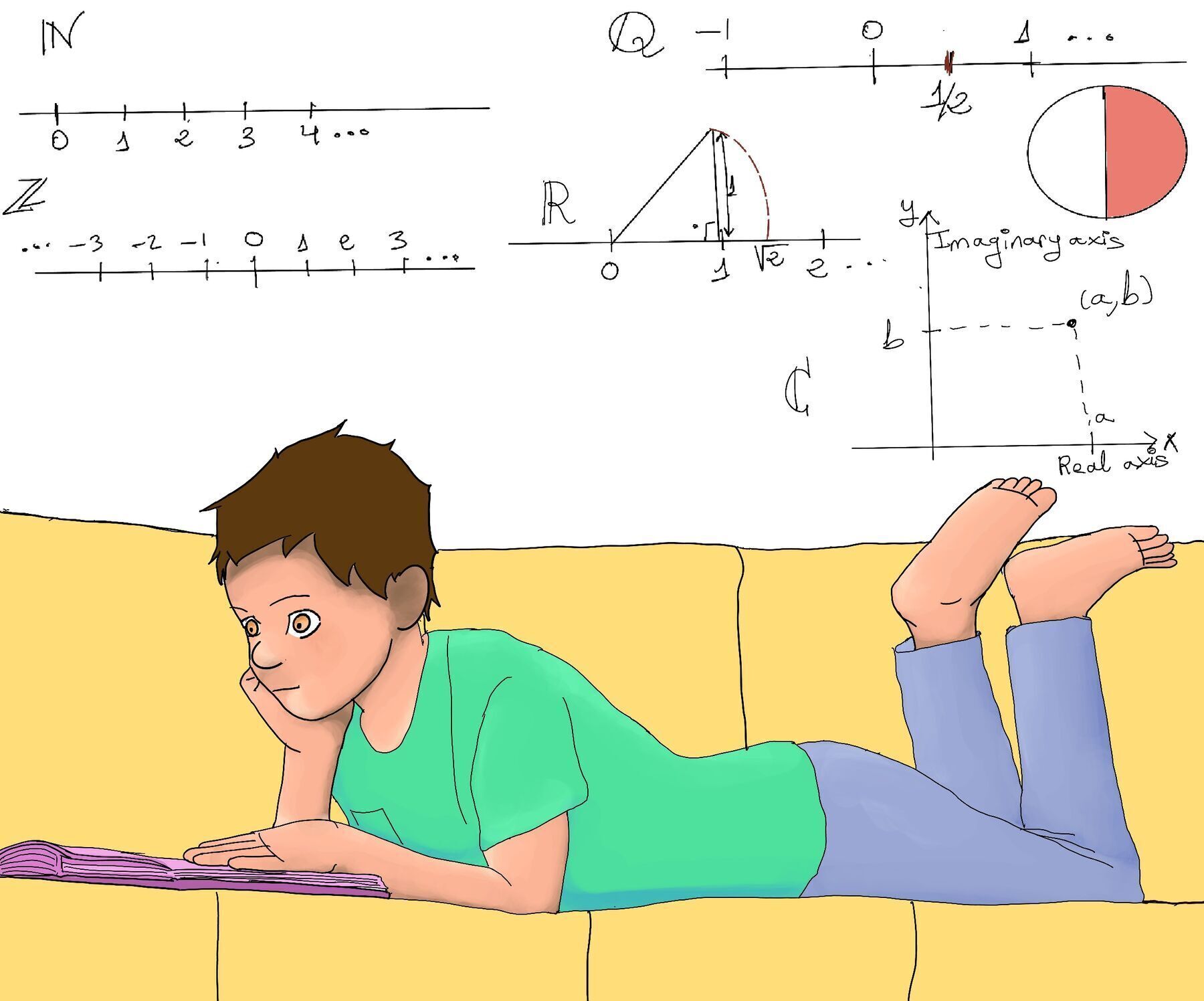
Numbers form the foundation of mathematics, serving as building blocks for counting, measuring, and describing the world around us. They can be categorized into various sets, each extending the previous one to address limitations like negativity, fractions, or incompleteness.
Natural numbers are the most basic numbers, used primarily for counting (“there are six books on the table”) and ordering (“this is the second largest city in the world”). Natural numbers date back to ancient civilizations like the Babylonians and Egyptians, who used them for trade and astronomy. Natural numbers are countable and infinite, as they can be listed in a sequence without end.
A natural number is a mathematical object. It is a number that occurs commonly in nature. As such, it is a whole, non-negative number,that is, a member of the sequence starting from 0 and increasing by 1 each time: 0, 1, 2, 3, and so on. They are obtained by starting at 0 and repeatedly adding 1. The set of natural numbers is denoted by ℕ. In set‐builder notation: ℕ = {0, 1, 2, 3, …}.
Note that the inclusion of 0 is a matter of convention; some texts include it, while others start at 1.
Natural numbers are generated recursively: start with 0, then repeatedly add 1 (the successor function). They are discrete, meaning there are gaps between them (e.g., you can’t find a natural number between 1 and 2).
To handle debts, directions, and other scenarios requiring negatives, we extend natural numbers to include their opposites. An integer number is a whole number that may be positive, negative, or zero, but has not fractional or decimal part. The set of integer numbers is denoted by ℤ. Thus, ℤ = { ···, -3, -2, -1, 0, 1, 2, 3, ···}.
Integers are symmetric around zero, meaning for every integer n, there exists an integer −n.
They are used in contexts like accounting (profits/losses, e.g., -💲15 loss is written as -15, +💲20 profit is written as 20), direction (positive/negative movement, e.g., 3 + 2: start at 3, move 2 units to the right, landing on 5; 3 +(-4): start at 3, move 4 units to the left, landing on -1), and many areas of mathematics (e.g., solving equations like $x + 3 = 0$). This models temperature (e.g., -5°C below freezing), elevations (e.g., -100m below sea level), or timelines (e.g., the Theravada tradition claims that the death of the Buddha occurred in -544 or -543 BCE).
Rational numbers address the need for parts of wholes, such as fractions in measurements or ratios. A rational number is any number that is of the form p/q where p and q are integers and q is not equal to 0. The set or rational numbers is denoted by the doublestruck capital letter ℚ. In set-builder notation: ℚ = {$\frac{p}{q}|~ p, q \in ℤ, q \ne 0$}.
Rational numbers can have either a terminating (e.g., $\frac{1}{2} = 0.5$) or repeating decimal (e.g., $\frac{1}{3} = 0.333...$) representation. Every rational has a unique reduced form, e.g., $ \frac{2}{4} = \frac{1}{2}$.
Rational numbers are used for measurements, ratios, and finance, e.g., a carpenter cuts a plank that is $2\frac{3}{4}$ meters long; a recipe might require $\frac{1}{2}$ cup of oil and $\frac{3}{4}$ teaspoon of salt; a classroom has 12 boys and 18 girls, so the ratio of boys to girls is $\frac{12}{18} =\frac{2}{3} = \frac{2}{3}$; a map uses a scale of 1:100,000, so the ratio “map distance : real distance” is $\frac{1}{100000}$, interest rates (e.g., 4.5% = $\frac{9}{20}$) etc.
Rational numbers fill in “gaps” between integers but still form a countable set. In calculus, ℚ is dense in ℝ: between any two real numbers (even ones very close together, e.g., 1.414 and 1.415 are approximations of $\sqrt{2}$), you can always find a rational number (e.g., 14145).
Not all numbers fit neatly as fractions —some defy exact ratio representation. An irrational number is any number that is not a rational number, i.e., it cannot be expressed as a fraction ratio of two integers. The decimal representation of an irrational number goes on forever without repeating -non-terminating and non-repeating. The following are examples of irrational numbers: $\sqrt{2} = 1.41421356...$ (the first irrational discovered by the Pythagoreans, who were quite horrified by it), $\pi = 3.14159265...$ (the ratio of a circle’s circumference to its diameter), $\sqrt{3}$, e (Euler’s number, the base of natural logarithms), and φ (the golden ration, a number usually found in art, architecture, and nature).
Together, rationals and irrationals form the real numbers ℝ, a complete ordered field It is denoted by ℝ. $\mathbb{R}$ includes all points on the number line: positives, negatives, zero, fractions, and irrationals. It is uncountable and continuous —no gaps.
Complex numbers are fundamental in various fields of mathematics, physics, and engineering. They provide a complete number system where every polynomial equation has a solution.
A complex number is specified by an ordered pair of real numbers (a, b) ∈ ℝ2 and expressed or written in the form z = a + bi, where a and b are real numbers, and i is the imaginary unit, defined by the property $i^2 = -1 \iff[\text{or equivalently}] i = \sqrt{-1}, \boxed{\mathbb{C}= \{ a + bi ∣a, b ∈ ℝ\} }, e.g., 2 + 5i, 7\pi + i\sqrt{2}.$
The powers of $i$ cycle with period 4: $i^0 = 1, i^1 = i, i^2 = -1, i^3 = -i, i^4 = 1$, and so on. Therefore, general formula: For any integer $n$: $\boxed{i^n = i^{n \mod 4}}$, e.g., $i^{23} = i^{23 \mod 4} = i^3 = -i, i^{100} = i^{100 \mod 4} = i^0 = 1, i^{-1} = \frac{1}{i} = \frac{1}{i} \cdot \frac{-i}{-i} = \frac{-i}{-i^2} = \frac{-i}{1} = -i$
ℂ is algebraically closed: every non-constant polynomial with complex coefficients has at least one root in ℂ.
Two complex numbers are equal if and only if their their real and imaginary are equal: a + bi = c + di ⟺ a = c and b = d.
In the complex number z = a + bi: a is called the real part of the complex number, denoted as ℜ(z) = a. b is called the imaginary part, denoted as ℑ(z) = b. Example: For z = 3 +4i, the real part is ℜ(z) = 3 and the imaginary part is ℑ(z) = 4.
Key observations:
Complex numbers can be visualized as points (or vectors) in a two-dimensional plane called the complex plane (or Argand plane).
We often use z, w, ζ to denote complex numbers. Each complex number a + bi corresponds to a point (a, b) in the plane, where the real part “a” represents the coordinate for the horizontal axis (real axis) and the imaginary part “b” represents the coordinate for the vertical axis (imaginary axis).
Therefore, we can identify $\mathbb{C}$ with $\mathbb{R}$ as sets, $z = a + bi \in \mathbb{C} \longleftrightarrow (a, b) \in \mathbb{R}^2$. In this sense: $\mathbb{C} \cong \mathbb{R}^2$, {(a, b): a, b ∈ ℝ} $\longleftrightarrow$ {(a, b) or a +bi: a, b ∈ ℝ}
a + i·0, 0 + i·b, 0 + i·1, 0 + i·(-1), 0 + i·(-b) are often abbreviated (or written) as a, ib or bi, i, -i, and -ib respectively. We embed $\mathbb{R}$ into $\mathbb{C}$ via a ↦ a + i0. In this sense, the real numbers are contained within the complex numbers. In other words, we identify a real number a with the complex number a + i·0. Besides, numbers of the form 0 + ib = ib are called purely imaginary numbers.
The complex conjugate of a complex number z = a + bi is denoted by $\bar z$ and defined by $\bar z = a -bi$, e.g, $\overline{3 + i} = 3 -i$, $\overline{\sqrt{2}-\frac{\pi}{3}i } = \sqrt{2} +\frac{\pi}{3}i, \overline{3} = -3, \overline{2i} = -2i$.
If you plot the complex number on the complex plane, the conjugate is a reflection across the real axis (x-axis) changing (or flipping) the sign of the imaginary component while the real part remains unchanged.
The modulus (or absolute value) of $z = a + bi$ is: $\boxed{|z| = \sqrt{a^2 + b^2}}$, e.g., $|3 + 4i| = \sqrt{9 + 16} = 5, |1 - i| = \sqrt{1 + 1} = \sqrt{2}, |5| = 5, |-3i| = 3$. Geometrically, this is the distance from the origin to the point z = (a, b) in the complex plane (by the Pythagorean theorem).
The modulus of a complex number is the square root of the product of the number itself and its conjugate: $\boxed{|z| = \sqrt{z·\bar z}}$.
$z·\bar z = (a + bi)(a -bi) = a^2 + b^2, ∣z∣ = \sqrt{a^2 + b^2} = \sqrt{z·\bar z}$, e.g., z = 3 + 4i, $z·\bar z = (3 + 4i)(3 - 4i) = 3^2 + 4^2 = 9+16 = 25.$
$|z + w|^2 = (z + w)\overline{(z + w)} = (z + w)(\bar{z} + \bar{w}) = z\bar{z} + z\bar{w} + w\bar{z} + w\bar{w} = |z|^2 + |w|^2 + z\bar{w} + \overline{z\bar{w}} = |z|^2 + |w|^2 + 2\Re(z\bar{w})$
Since $\Re(z\bar{w}) \leq |z\bar{w}| = |z||w|$: $|z + w|^2 \leq |z|^2 + 2|z||w| + |w|^2 = (|z| + |w|)^2$
Taking square roots: $|z + w| \leq |z| + |w| \quad \blacksquare$
By symmetry (swap $z_1$ and $z_2$, and note $|z_1 - z_2| = |z_2 -z_1|$), we also have: $|z_1 - z_2| \ge |z_2| - |z_1|$. Combining these two inequalities gives: $\boxed{|z_1 - z_2| \ge \big||z_2| - |z_1|\big|}$
To divide complex numbers, z2≠0 (x2 and y2 are not simultaneously zero), we multiply both the numerator and the denominator by the complex conjugate of the denominator. $\frac{z_1}{z_2} = \frac{x_1+iy_1}{x_2+iy_2} = \frac{x_1+iy_1}{x_2+iy_2}\frac{x_2-iy_2}{x_2-iy_2}=\frac{x_1x_2 + y_1y_2 + i(x_2y_1-x_1y_2)}{x_2²-y_2²} = \frac{x_1x_2 + y_1y_2}{x_2²-y_2²} + i(\frac{x_2y_1-x_1y_2}{x_2²-y_2²})$
Example: Calculate $\frac{2+i}{1-3i}$
$\frac{2+i}{1-3i}$ =[To simplify the expression, multiply both numerator and denominator by the conjugate of the denominator:] $\frac{2+i}{1-3i}·\frac{1+3i}{1+3i} = \frac{-1+7i}{10} =[\text{Thus, the simplified form is:}] \frac{-1}{10}+\frac{7}{10}i$.
$(2 + i)(1 + 3i) = 2 + 6i + i + 3i^2 = 2 + 7i - 3 = -1 + 7i, (1 - 3i)(1 + 3i) = 1 - 9i^2 = 1 + 9 = 10$
For a non-zero complex number $z = a + bi \neq 0$, the multiplicative inverse $z^{-1}$ is defined by $z^{-1} = \frac{1}{z} = \frac{\bar{z}}{|z|^2} = \frac{a - bi}{a^2 + b^2} = \frac{a}{a^2 + b^2} - \frac{b}{a^2 + b^2}i$
Verification: $z \cdot z^{-1} = z \cdot \frac{\bar{z}}{|z|^2} = \frac{z\bar{z}}{|z|^2} = \frac{|z|^2}{|z|^2} = 1 \quad \checkmark$
Complex numbers form a field under addition and multiplication:
| Property | Addition | Multiplication |
|---|---|---|
| Closure | $z_1 + z_2 \in \mathbb{C}$ | $z_1 \cdot z_2 \in \mathbb{C}$ |
| Commutativity | $z_1 + z_2 = z_2 + z_1$ | $z_1 \cdot z_2 = z_2 \cdot z_1$ |
| Associativity | $(z_1 + z_2) + z_3 = z_1 + (z_2 + z_3)$ | $(z_1 \cdot z_2) \cdot z_3 = z_1 \cdot (z_2 \cdot z_3)$ |
| Identity | $z + 0 = z$ | $z \cdot 1 = z$ |
| Distributivity | $z_1·(z_2 + z_3) = z_1·z_2 + z_1·z_3$ | |
| Inverse | $z + (-z) = 0$ where −z = −a −ib | $z \cdot z^{-1} = 1$ (for $z \neq 0$) |
z = a + ib $\ne 0$ and $z^{-1}=\frac{\bar{z}}{|z|^2}$ (for $z \neq 0$), $z \cdot z^{-1} = 1$.

JustToThePoint Copyright © 2011 - 2026 Anawim. ALL RIGHTS RESERVED. Bilingual e-books, articles, and videos to help your child and your entire family succeed, develop a healthy lifestyle, and have a lot of fun. Social Issues, Join us.
This website uses cookies to improve your navigation experience.
By continuing, you are consenting to our use of cookies, in accordance with our Cookies Policy and Website Terms and Conditions of use.