
|
 |
 |
|
|
|
|
When the world says, ‘Give up,’ hope whispers, ‘Try it one more time’, Lyndon B. Johnson

The equation |z - a| = r defines a circle in the complex plane where the distance between any point z on the circle and the center a is equal to the radius r. Components:
The absolute value |z - a| represents the Euclidean distance between points z and a in the complex plane. This distance formula is: |z - a| = |x + yi - (h + ki)| = |(x - h) + (y - k)i| = $\sqrt{(x - h)² + (y - k)²}$
Setting this equal to $r$: $\sqrt{(x - h)^2 + (y - k)^2} = r$. Then, squaring both sides, we get the familiar Cartesian equation of a circle! $\boxed{(x - h)^2 + (y - k)^2 = r^2}$
| Inequality | Region | Description |
|---|---|---|
| $\vert z - a\vert < r$ | Open disk | Interior of circle (excluding boundary) |
| $\vert z - a\vert \leq r$ | Closed disk | Interior plus boundary |
| $\vert z - a\vert > r$ | Exterior | Outside the circle |
| $\vert z - a\vert \geq r$ | Closed exterior | Outside plus boundary |
| $\vert z - a\vert = r$ | Circle | Boundary only |
| Notation | Region |
|---|---|
| $r_1 < \vert z - a\vert < r_2$ where $0 < r_1 < r_2$ | Open annulus (ring-shaped region) centered at a |
| $r_1 ≤ \vert z - a\vert ≤ r_2$ | Closed annulus |
| $r_1 < \vert z - a\vert≤ r_2$ | Half-open annulus |
| $0 < \vert z - a\vert < r$ | Punctured disk (center removed) |
| $\vert z - a\vert > r$ | Exterior of disk |
Lines in the complex plane can be written as: $\Re(\bar{a}z) = c \quad \text{or} \quad \Im(\bar{a}z) = c$ with $a \in \mathbb{C} \setminus \{ 0 \}$ and $c \in \mathbb{R}$
Write a = u + iv (where u, v are real numbers) and z = x + iy (where x, y are real coordinates). Then, $\overline{a}z = (u -iv)(x +iy)=(ux +vy) +i(uy -vx)$.
In analytic geometry, a line in a 2D plane is defined by the equation: Ax + By = C where (A, B) is the normal vector (a vector perpendicular to the line).
If you have a vector (u, v), rotating it 90∘ counter-clockwise swaps the components and negates the first one.
Half-planes
| Inequality | Region |
|---|---|
| $\Re(z) > 0$ | Right half-plane |
| $\Re(z) < 0$ | Left half-plane |
| $\Im(z) > 0$ | Upper half-plane |
| $\Im(z) < 0$ | Lower half-plane |
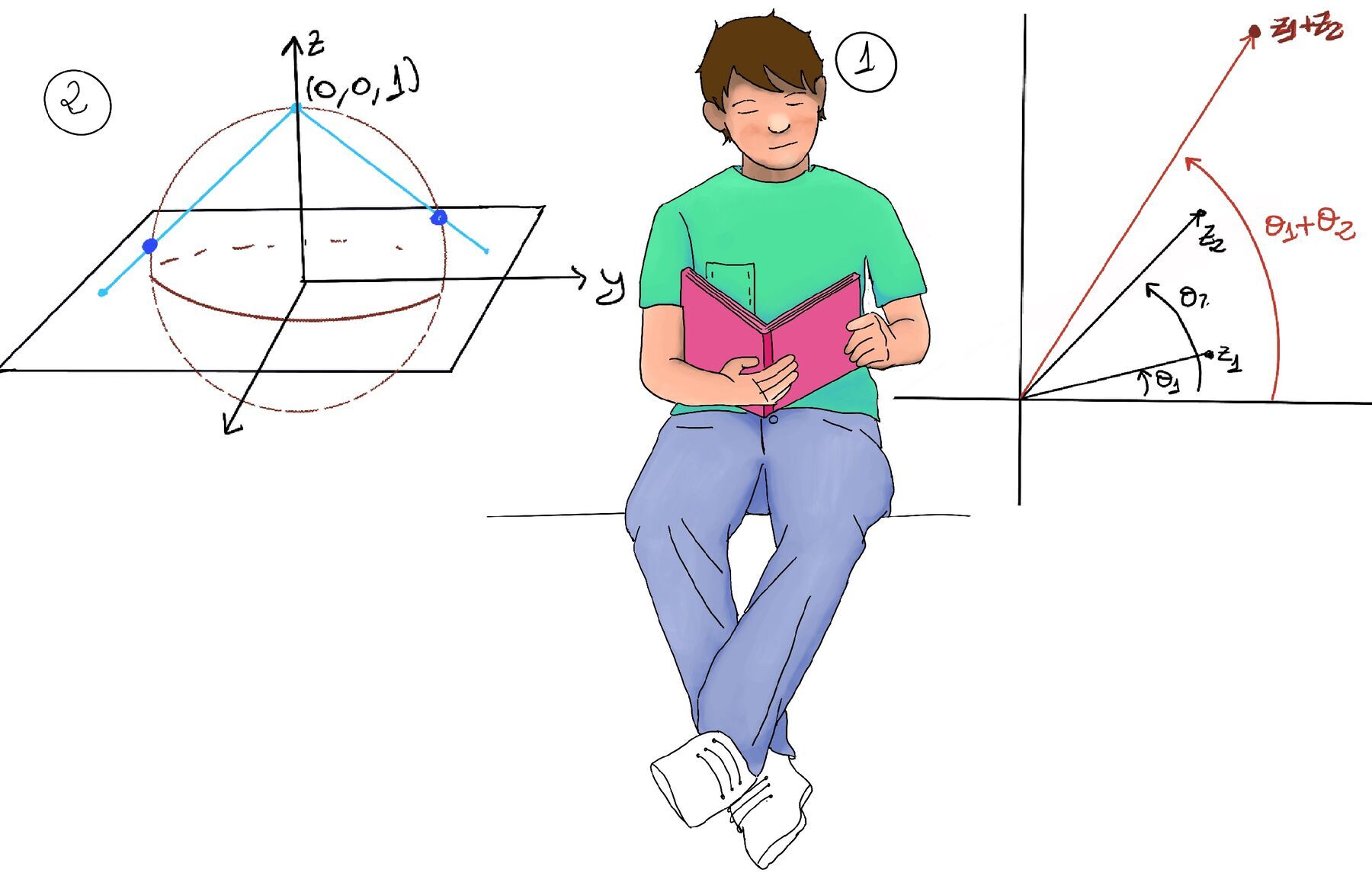
Let two complex numbers be given in polar form: $z_1 = r_1(cos(\theta_1) + isin(\theta_1)), z_2 = r_2(cos(\theta_2) + isin(\theta_2))$.
Derivation of Product Formula.
$$ \begin{aligned} z_1 \cdot z_2 &=r_1(\cos\theta_1 + i\sin\theta_1) \cdot r_2(\cos\theta_2 + i\sin\theta_2) \\[2pt] &= r_1 r_2 [(\cos\theta_1 + i\sin\theta_1)(\cos\theta_2 + i\sin\theta_2)] \\[2pt] &=[\text{Expanding}]r_1 r_2 [\cos\theta_1\cos\theta_2 + i\cos\theta_1\sin\theta_2 + i\sin\theta_1\cos\theta_2 + i^2\sin\theta_1\sin\theta_2] \\[2pt] &= r_1 r_2 [(\cos\theta_1\cos\theta_2 - \sin\theta_1\sin\theta_2) + i(\sin\theta_1\cos\theta_2 + \cos\theta_1\sin\theta_2)] \\[2pt] &\text{Using the angle addition formulas:} \cos(\alpha + \beta) = \cos\alpha\cos\beta - \sin\alpha\sin\beta, \sin(\alpha + \beta) = \sin\alpha\cos\beta + \cos\alpha\sin\beta \\[2pt] &= r_1 r_2 [\cos(\theta_1 + \theta_2) + i\sin(\theta_1 + \theta_2)] \end{aligned} $$$\boxed{z_1 \cdot z_2 = r_1 r_2 [\cos(\theta_1 + \theta_2) + i\sin(\theta_1 + \theta_2)]}$
The Multiplication Rules:
$\frac{z_1}{z_2} = \frac{r_1 e^{i\theta_1}}{r_2 e^{i\theta_2}} = \frac{r_1}{r_2} e^{i(\theta_1 - \theta_2)}$
The Division Rules:
De Moivre’s Theorem: For any complex number $z = r(\cos\theta + i\sin\theta)$ and any $n$: $\boxed{z^n = r^n(\cos(n\theta) + i\sin(n\theta))}, \boxed{(\cos\theta + i\sin\theta)^n = \cos(n\theta) + i\sin(n\theta)}$. Or in exponential notation: $\boxed{(e^{i\theta})^n = e^{in\theta}}$
Proof by Induction
Base Cases: It is obviously a true statement for n = 0 ($z^0 = 1 = r^0(cos(0) + isin(0))$) and 1 ($z^1 = r(\cos\theta + i\sin\theta) = r^1(\cos(1 \cdot \theta) + i\sin(1 \cdot \theta)) \quad \checkmark$).
Inductive step: Assume the theorem holds for n = k, $z^k = r^k(\cos(k\theta) + i\sin(k\theta))$. We aim to prove it for n = k + 1.
$$ \begin{aligned} z^{k+1} &=z^k \cdot z \\[2pt] &\text{Inductive step, n = k} \\[2pt] &=r^k(\cos(k\theta) + i\sin(k\theta)) \cdot r(\cos\theta + i\sin\theta) \\[2pt] &=r^{k+1}[(\cos(k\theta)\cos\theta - \sin(k\theta)\sin\theta) + i(\cos(k\theta)\sin\theta + \sin(k\theta)\cos\theta)]\\[2pt] &\text{Using angle addition formulas: sin(α + β) = sin α cos β + cos α sin β and cos(α + β) = cos α cos β - sin α sin β} \\[2pt] &= r^{k+1}[\cos((k+1)\theta) + i\sin((k+1)\theta)] \quad \blacksquare \end{aligned} $$Extension to Negative Integer. For n = -1:
$$ \begin{aligned} z^{-1} = \frac{1}{z} &=\frac{1}{r(\cos\theta + i\sin\theta)}\\[2pt] &\text{[Multiply by conjugate:]} =\frac{1}{r} \cdot \frac{\cos\theta - i\sin\theta}{(\cos\theta + i\sin\theta)(\cos\theta - i\sin\theta)} \\[2pt] &= \frac{1}{r} \cdot \frac{\cos\theta - i\sin\theta}{\cos^2\theta + \sin^2\theta} \\[2pt] &= \frac{1}{r}(\cos\theta - i\sin\theta) = r^{-1}(\cos(-\theta) + i\sin(-\theta)) \quad \checkmark \end{aligned} $$For general negative $n = -m$ (where $m > 0$):
$$ \begin{aligned} z^{-m} &=(z^m)^{-1} \\[2pt] &[\text{By previous demonstration, the equality holds }] \\[2pt] &=\frac{1}{r^m(\cos(m\theta) + i\sin(m\theta))} \\[2pt] &=\frac{1}{r^m(\cos(m\theta) + i\sin(m\theta))}\frac{\cos(m\theta) - i\sin(m\theta)}{\cos(m\theta) - i\sin(m\theta)} = r^{-m}(\frac{\cos(m\theta) - i\sin(m\theta)}{\cos^2(m\theta) + \sin^2(m\theta)}) \\[2pt] &= r^{-m}(\cos(-m\theta) + i\sin(-m\theta)) \quad \checkmark \end{aligned} $$De Moivre's Theorem. $z^n = r^n(cos(n\theta)+isin(n\theta))$ and the equality holds $\forall n \in \mathbb{Z}.$
Alternative Proof Using Euler’s Formula: $(\cos\theta + i\sin\theta)^n =[\text{Euler's formula}] (e^{i\theta})^n =[\text{Exponential law: } (e^a)^n = e^{an}] e^{in\theta} = \cos(n\theta) + i\sin(n\theta) \quad \blacksquare$
Given $z = re^{i\theta}$, find all $w$ such that $w^n = z$. General Solution: $\boxed{w_k = r^{1/n} e^{i(\theta + 2\pi k)/n} = \sqrt[n]{r}\left(\cos\frac{\theta + 2\pi k}{n} + i\sin\frac{\theta + 2\pi k}{n}\right)}$ for $k = 0, 1, 2, \ldots, n-1$
There are exactly $n$ distinct roots, one for each k = 0, 1, …, n-1. All roots have the same modulus $\vert w_k\vert \ = \sqrt[n]{r} = \vert z \vert^{1/n}$. Consecutive roots’ arguments differ by $\frac{2\pi}{n}$ radians, so they lie on a circle of radius $\sqrt[n]{r}$ centered at the origin and form the vertices of a regular n-gon. If $\theta = Arg(z)$, then the principal n-th root is $w_0 = \sqrt[n]{r} e^{i\theta/n}$ (when $\theta = \text{Arg}(z)$) and the other roots are obtained by successively adding $\frac{2\pi}{n}$ to its argument.
If $z \ne 0$ and we write it in polar form as $z = |z| e^{iArg(z)}$, then all the $n$-th roots of $z$ can be written as: $\boxed{w_k = \sqrt[n]{z} \cdot \omega_n^k}$, k = 0, 1, …, n- 1 where:

JustToThePoint Copyright © 2011 - 2026 Anawim. ALL RIGHTS RESERVED. Bilingual e-books, articles, and videos to help your child and your entire family succeed, develop a healthy lifestyle, and have a lot of fun. Social Issues, Join us.
This website uses cookies to improve your navigation experience.
By continuing, you are consenting to our use of cookies, in accordance with our Cookies Policy and Website Terms and Conditions of use.