
|
 |

|
|
|
|
|
|
All those who seem stupid, they are, and also so are half of those who do not, Quevedo

A complex function $f(z)$ maps $z = x + iy \in \mathbb{C}$ to another complex number. For example: $f(z) = z^2 = (x + iy)^2 = x^2 - y^2 + 2ixy, f(z) = \frac{1}{z}, f(z) = \sqrt{z^2 + 7}$.
A contour is a continuous, piecewise-smooth curve defined parametrically as: $z(t) = x(t) + iy(t), \quad a \leq t \leq b$, e.g., a straight line between two points $z_0$ and $z_1$, $\gamma(t) = z_0 + t(z_1 - z_0), t \in [0, 1]$; the Unit Circle, $\gamma(t) = e^{it} = \cos t + i \sin t, t \in [0, 2\pi]$.
Definition (Smooth Contour Integral). Let ᵞ be a smooth contour (a continuously differentiable path in the complex plane), $\gamma: [a, b] \to \mathbb{C}$. Let $f: \gamma^* \to \mathbb{C}$ be a continuous complex-valued function defined on the trace $\gamma^*$ of the contour (i.e. along the image of $\gamma$). Then, the contour integral of f along $\gamma$ is defined as $\int_{\gamma} f(z)dz := \int_{a}^{b} f(\gamma(t)) \gamma^{'}(t)dt$.
This section develops the fundamental properties of contour integrals: linearity, behavior under path manipulation, key theorems (Cauchy’s theorem, the Cauchy integral formula, the residue theorem), and the principle of contour deformation.
Proposition. Linearity of the contour integral. Let γ be a contour, defined by a function $\gamma: [a, b] \to \mathbb{C}$ and let f and g be continuous complex functions $f, g: \gamma^* \to \mathbb{C}$ both defined along the image of ᵞ. Then, the contour integral satisfies the following linearity properties:
The Cauchy integral formula is one of the most powerful results in complex analysis. It shows that the values of a holomorphic function inside a contour are completely determined by its values on the contour.
Interpretation. The value of $f$ at any interior point $z_0$ is determined by a weighted average of $f$ over the boundary contour.
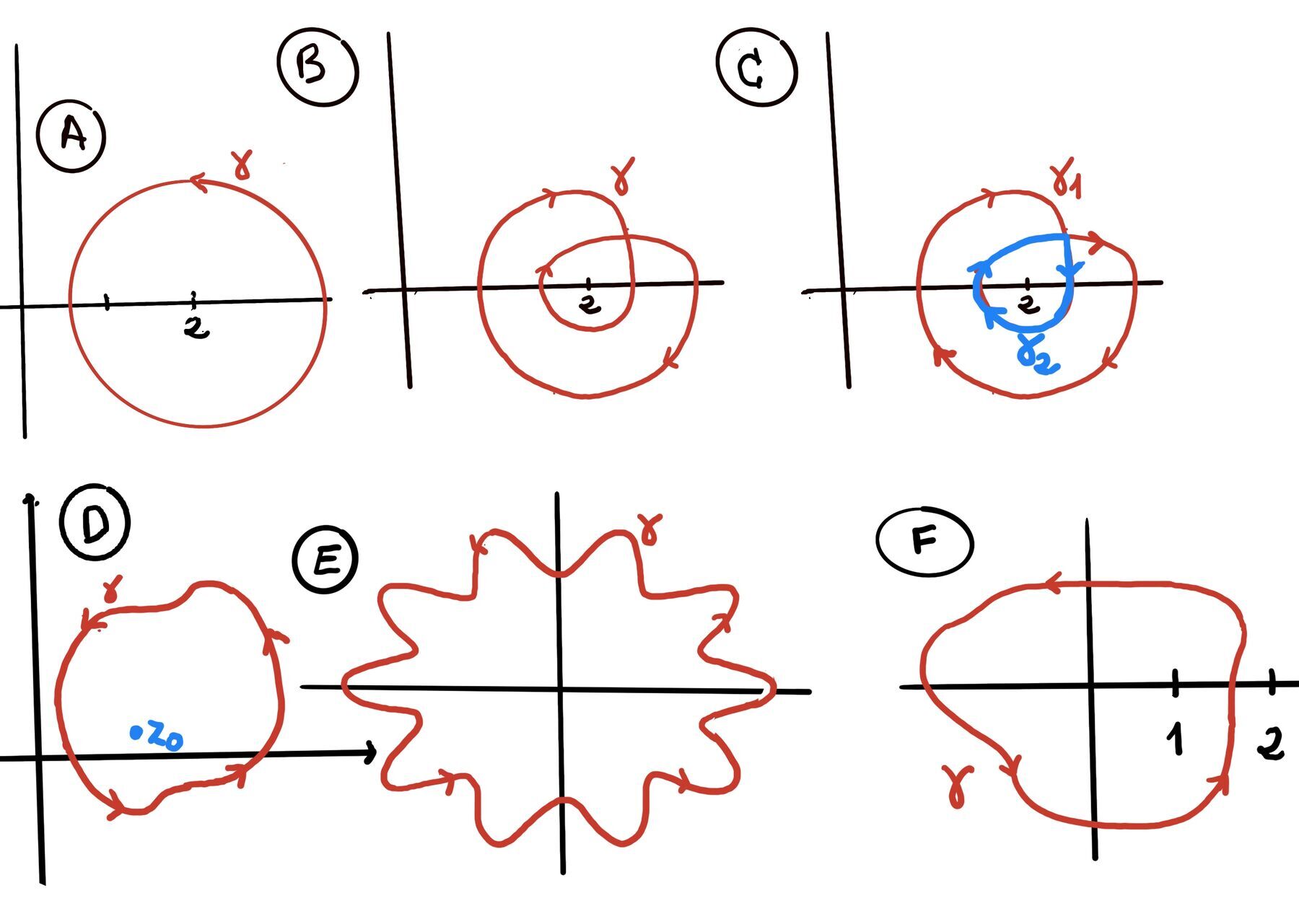
The formula can be used to calculate integrals: $\int_{\gamma} \frac{f(z)}{z-z_0}dz = 2\pi i \cdot f(z_0)$.
This shows that all derivatives of a holomorphic function at $z_0$ are determined by the values of $f$ on any enclosing contour — and, as a corollary, that holomorphic functions are infinitely differentiable.
Think of integrating an analytic function around a closed loop as a “free trip” —you always end up back where you started with a net result of zero (the integral is zero by Cauchy’s theorem).
However, if your function has singularities (points where it “blows up,” like poles), your path is no longer free. The Residue Theorem says that for every singularity you circle, you must “pay a toll.” The residue is the exact value of that toll. The total value of the integral is simply 2πi times the sum of all the “tolls” for the singularities you enclosed on your trip.
From the Laurent series: If $f(z) = \sum_{n=-\infty}^{\infty} a_n(z-z_0)^n$ near $z_0$, then $\operatorname{Res}(f, z_0) = a_{-1}$ — the coefficient of $(z-z_0)^{-1}$.
Calculate the Residues: $Res(f,0) = \lim_{z \to 0}(z - 0)\frac{z-1}{z(z-2)} = \lim_{z \to 0} \frac{z-1}{z-2} = \frac{-1}{-2}= \frac{1}{2}.$
$Res(f,2) = \lim_{z \to 2}(z - 2)\frac{z-1}{z(z-2)} = \lim_{z \to 2} \frac{z-1}{z} = \frac{1}{2}.$
$\oint_\gamma \frac{z-1}{z(z-2)}dz =[\text{Residue Theorem}] 2\pi i \sum Res(f, z_k) = 2\pi i[\frac{1}{2}+\frac{1}{2}] = 2\pi i$.
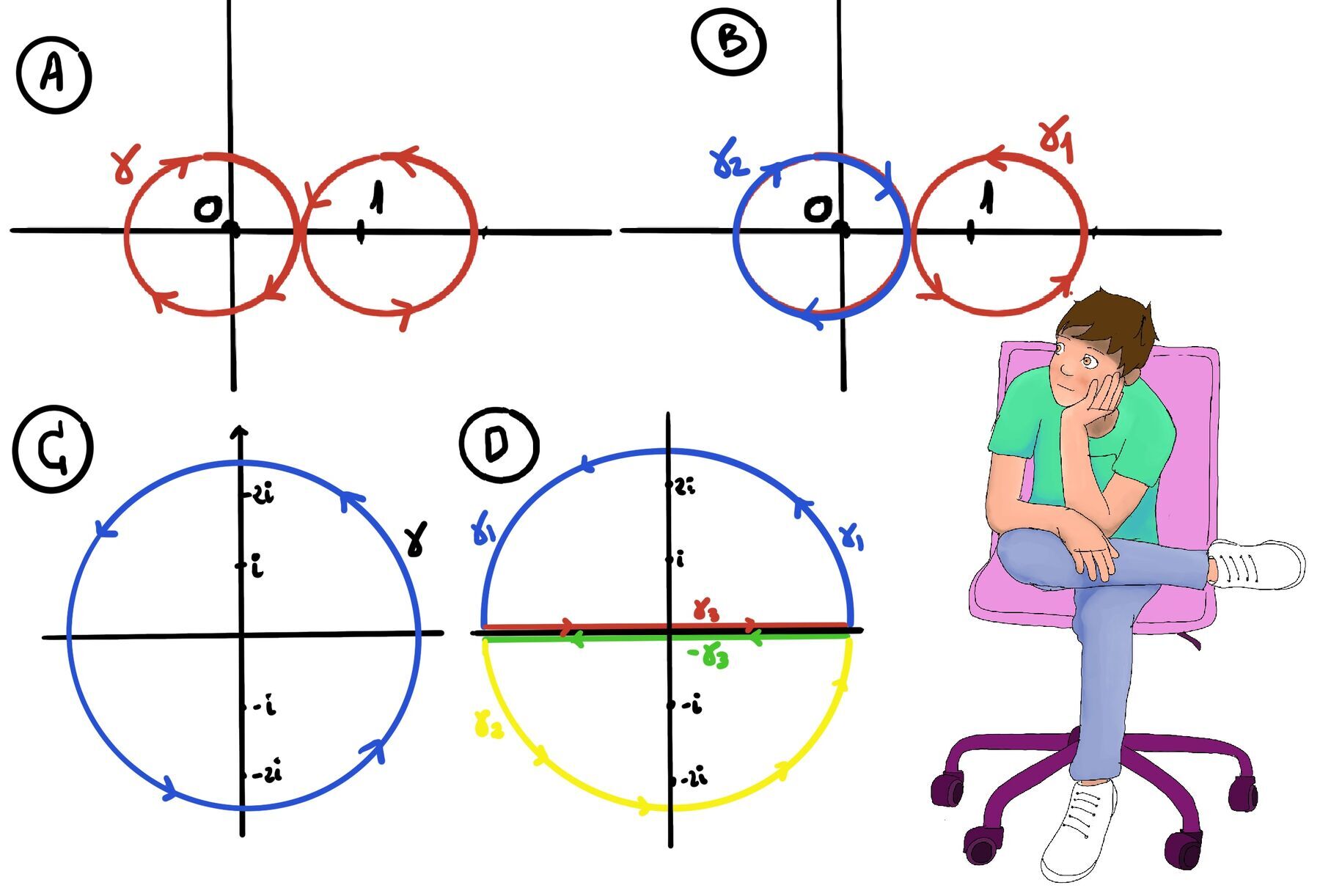
The contour encloses both singularities. Split $\gamma$ into two simple pieces by introducing a “bridge” (a line segment $\gamma_3$ traversed in both directions, whose contributions cancel) as shown in Figure D. Piece 1 encloses only $z = 2i$; Piece 2 encloses only $z = -2i$. Thus, $\gamma = \text{piece1 + piece2} = \gamma_1 + \gamma_3 -\gamma_3 + \gamma_2$ . Both of these two new pieces are simple and each surround just one singularity.
$$ \begin{aligned} \oint_\gamma \frac{z}{z^2+4}dz &=\oint_\gamma \frac{z}{(z-2i)(z+2i)}dz \\[2pt] &=\oint_{piece1} \oint_{piece2} \frac{\frac{z}{z+2i}}{z-2i}dz + \frac{\frac{z}{z-2i}}{z+2i}dz\\[2pt] &=\oint_{\gamma_1 + \gamma_3} \frac{\frac{z}{z+2i}}{z-2i}dz + \oint_{-\gamma_3 + \gamma_2} \frac{\frac{z}{z-2i}}{z+2i}dz\\[2pt] &=\text{Cauchy's Integral formula}\\[2pt] &=2\pi i \frac{2i}{2i+2i} + 2\pi i \frac{-2i}{-2i-2i}\\[2pt] &=2\pi i (\frac{1}{2}+\frac{1}{2})= 2\pi i. \end{aligned} $$The quickest way to solve this is by applying Cauchy’s Integral Theorem. The function being integrated is f(z) = z². As a polynomial, it is analytic (differentiable everywhere) in the entire complex plane. The path $\gamma$ (a line segment joined to a semicircle) is a simple closed contour.
Cauchy’s Integral Theorem states that the integral of an analytic function over any simple closed contour is zero. Therefore, we can immediately conclude: $\int_{\gamma} z^2dz = 0$.
We can confirm this result by calculating the integral along the two separate paths, γ₁ and γ₂, and adding them together.
$\int_{\gamma} z^2dz = \int_{\gamma_1} z^2dz + \int_{\gamma_2} z^2dz$
$\int_{\gamma_1} z^2dz = \int_{-1}^1 (Rt)^2 \cdot R dt = R^3 \int_{-1}^1 t^2dt = R^3 \frac{t^3}{3}\Big|_{-1}^{1} = \frac{2R^3}{3}$
$\int_{\gamma_2} z^2dz = \int_{0}^{\pi} (Re^{it})^2 \cdot iRe^{it} dt = iR^3\int_{0}^{\pi} e^{3it} = iR^3 \frac{e^{3it}}{3i}\Big|_{0}^{\pi} = \frac{R^3}{3}(e^{3i\pi} - e^{0}) = \frac{R^3}{3}(-1-1) = -\frac{2R^3}{3}$
$\int_{\gamma} z^2dz = \int_{\gamma_1} z^2dz + \int_{\gamma_2} z^2dz = \frac{2R^3}{3} -\frac{2R^3}{3} = 0.$ The direct calculation confirms the result provided by Cauchy’s Theorem.
One of the most useful principles in complex analysis is that contour integrals are invariant under continuous deformation of the path, provided the function remains analytic throughout the deformation.
Key Idea: If a function f(z) is analytic in a region D, the integral over any closed contour in D is zero (by Cauchy’s theorem). Deforming a contour is valid only if the entire region between the original and the deformed contour is free of singularities.
The Cauchy-Goursat theorem states that if a function f is analytic at all points inside and on a simple closed contour γ, then: $\oint_{\gamma} f(z)dz = 0$.
However, when dealing with functions that are not analytic everywhere, such as ($f(z) = \frac{1}{z}$), the principle of deformation of contours becomes essential. f(z) is analytic everywhere except at z = 0, where it has a simple pole. If a contour encloses this singularity, the integral may be nonzero. For instance, over the unit circle centered at the origin: $\oint_{\gamma}\frac{1}{z} = 2\pi i$.
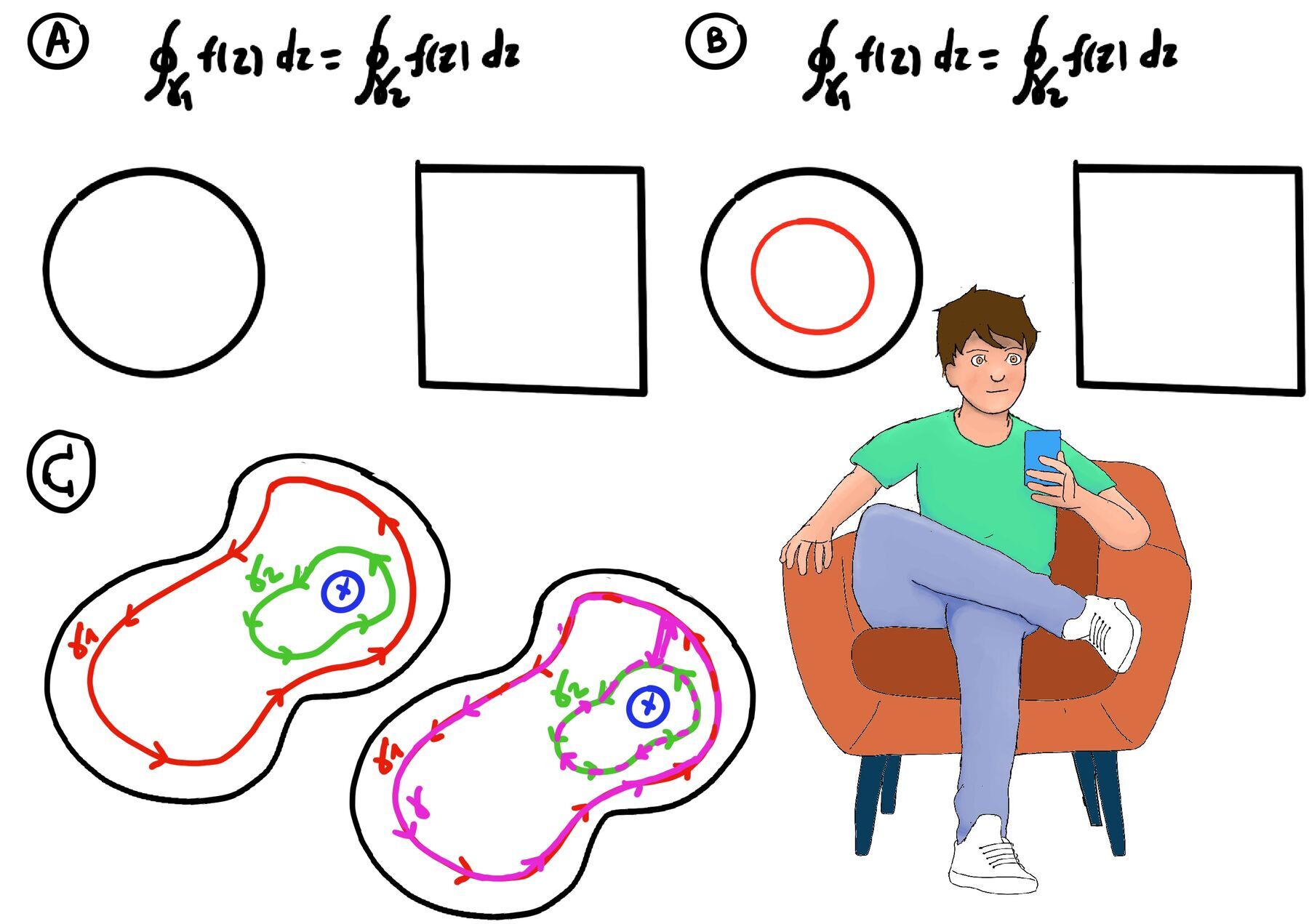
To illustrate this principle, consider two contours: ($\gamma_1$), a square centered at the origin, and ($\gamma_2$), a unit circle also centered at the origin (Figure A). While the integral of ($f(z) = \frac{1}{z}$) over the unit circle has been previously calculated as $2\pi i$, the integral over the square requires a different approach.
Using the principle of deformation of contours, one can replace ($\gamma_1$) and ($\gamma_2$) with new contours that are entirely contained within regions where the function remains analytic. For instance, if an inner circle with radius ($\frac{1}{2}$) is considered, the integral along this path will also yield ($2\pi i$) because the function remains analytic between the two curves (Figure B).
The theoretical foundation of the deformation principle can be visualized by constructing a new contour that connects points on $\gamma_1$ and $\gamma_2$. By creating a “bridge” between these contours, one can define a closed path that encircles a simply connected region:
Consequently, the integral along ($\gamma_1$) equals the integral along ($\gamma_2$) (Figure C). An integral is unchanged under continuous contour deformation provided the integrand stays analytic throughout the region swept out.
The integral $ \int_{\gamma} \frac{1}{z} dz$ is the same for any closed contour $\gamma$ enclosing the origin. The function f(z) = 1/z has a singularity at z = 0. For any closed contour γ that encloses the origin (with positive orientation), the integral is: $\oint_\gamma \frac{dz}{z} = 2\pi i.$
This is the same whether $\gamma$ is:
For a simple pole at a point $z_k$ (i.e., the denominator has a simple root) is calculated using the formula $Res(f, z_k) = \lim_{z \to z_k}(z-z_k)f(z)$. In our particular case, $Res(f, z_0) = \lim_{z \to 0}(z-0)\frac{1}{z} = 1.$
Conversely, if $\gamma$ does not enclose the origin, then $1/z$ is analytic inside $\gamma$, and Cauchy’s theorem gives $\oint_\gamma dz/z = 0$.

JustToThePoint Copyright © 2011 - 2026 Anawim. ALL RIGHTS RESERVED. Bilingual e-books, articles, and videos to help your child and your entire family succeed, develop a healthy lifestyle, and have a lot of fun. Social Issues, Join us.
This website uses cookies to improve your navigation experience.
By continuing, you are consenting to our
use of cookies, in accordance with our Cookies Policy and
Website Terms and Conditions of use.