
|
 |
 |
|
|
|
|
The problem is not the problem. The problem is your attitude about the problem, Captain Jack Sparrow

Topology provides the foundational “language” for discussing limits, continuity, convergence, and analyticity in complex analysis. This article develops the key topological concepts in the context of $\mathbb{C}$.
Recall that $|z|$ is the distance between $0$ and $z$ in the complex plane: $|z| = |x + iy| = \sqrt{x^2 + y^2}$, e.g., $|3 + i| = \sqrt{9 + 1} = \sqrt{10}$.
For two complex numbers $z_1 = x_1 + iy_1$ and $z_2 = x_2 + iy_2$, their distance is: $\boxed{|z_1 - z_2| = \sqrt{(x_1 - x_2)^2 + (y_1 - y_2)^2}}$. This is the standard Euclidean distance in $\mathbb{R}^2$, e.g., $|(1 + i) - (4 + 5i)| = \sqrt{9 + 16} = 5, |2i - (-3)| = \sqrt{9 + 4} = \sqrt{13}, |1 - (-1)| = 2$.
The function $d(z_1, z_2) = |z_1 - z_2|$ is a metric on $\mathbb{C}$. Properties of the Distance Function:
| Property | Statement |
|---|---|
| Non-negativity | $d(z_1, z_2) \geq 0$ |
| Identity of indiscernibles | $d(z_1, z_2) = 0 \iff z_1 = z_2$ |
| Symmetry | $d(z_1, z_2) = d(z_2, z_1)$ |
| Triangle inequality | $d(z_1, z_3) \leq d(z_1, z_2) + d(z_2, z_3)$ |
Definition. $D_R(z_0) = B(z_0; R) = \{z \in \mathbb{C} : |z - z_0| < R\}$ is an open disc (ball) centered at z0 of radius R. An open disc centered at z0 of radius R contains every point in the complex plane who distance from the center z0 is strictly less than R.
Alternate notation: B(a; r) = {z ∈ ℂ | |z - a| < r}; an open disc or ball (Figure 1), the set of all points enclosed by the circle C of radius r centered at a. Its boundary circle is {z ∈ ℂ | |z - a| = r}; e.g., B(i ; 1) = {z ∈ ℂ | |z - i| < 1}. This is the set of all points within distance 1 from $i$, forming a disk of radius 1 centered at the point $(0, 1)$ in the complex plane.
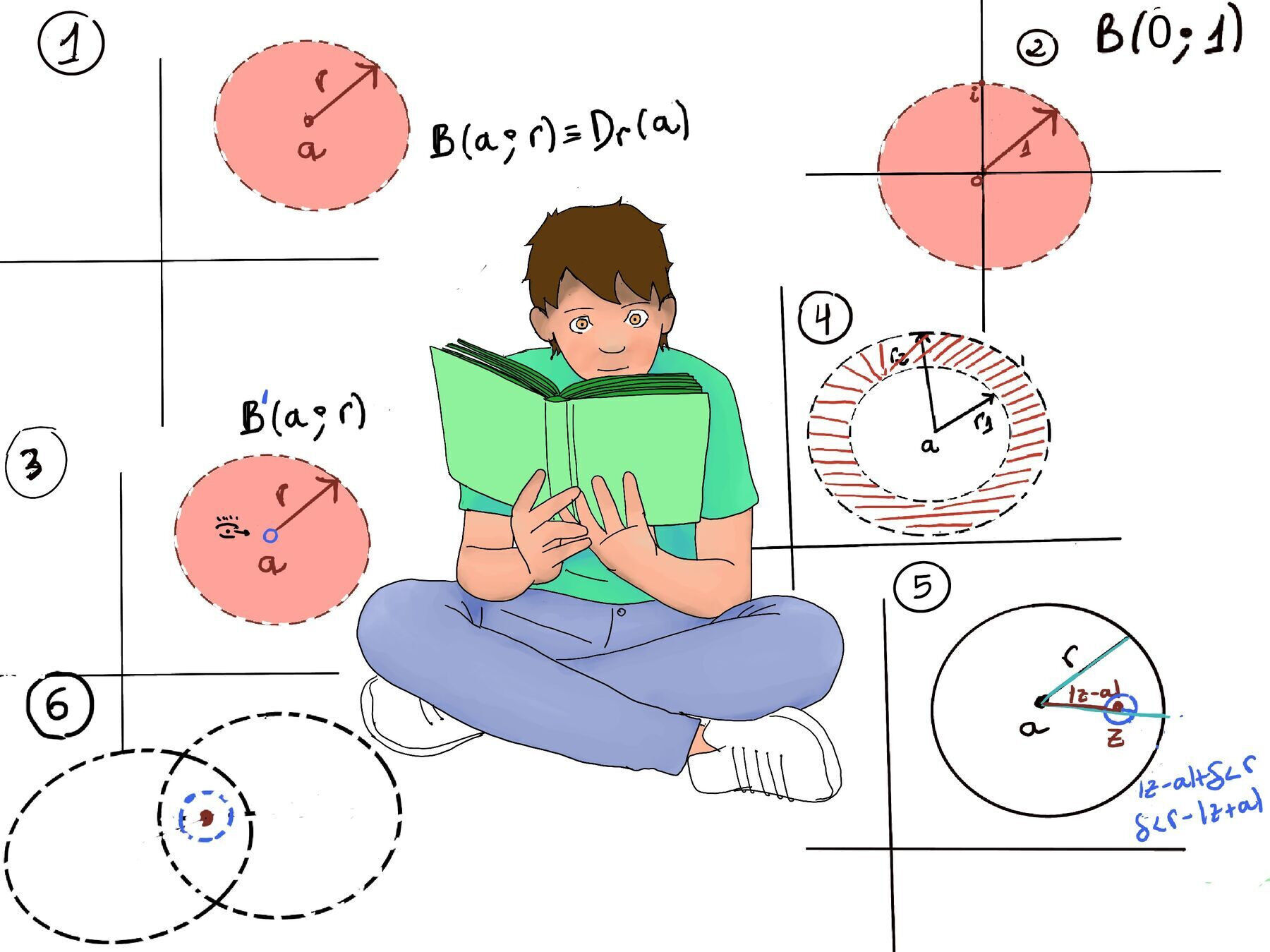
Special Cases: B(0; 1) is the unit disk centered at origin; B(i; 1) is the unit disk centered at i; $B(z_0; \varepsilon)$ is the $\varepsilon$-neighborhood of $z_0$.
Equivalent Characterization. For $z_0 = a + bi$: $B(z_0; R) = \{x + iy : (x - a)^2 + (y - b)^2 < R^2\}$. This is the interior of a circle of radius $R$ centered at $(a, b)$.
Definition. A closed disk of radius R centered at a point a is typically denoted by $\overline{B(a; R)}$. This includes all points whose distance from the center “a” is less than or equal to R. A close ball of radius r around a is essentially a circle of radius r around a, $\boxed{\overline{B(a; R)} = \{z \in \mathbb{C} : |z - a| \leq R\}}$.
The boundary of this disk (both open and closed) — also called the circumference — is the set of points exactly at distance R from “a”: $\boxed{\partial B(a; R) = \{z \in \mathbb{C} : |z - a| = R\}}$.
Key Relationship: $\partial B(a; R) = \overline{B(a; R)} \setminus B(a; R)$. This expression means the boundary is the difference between the closed disk and the open disk (which excludes the boundary).
The set difference is $\overline{B(a, r)} - B(a, r)$ = {z ∈ ℂ | |z - a| = r} = $\partial B(a; R)$. This is the circumference centered at “a” with radius r.
A neighborhood of a point $z_0$ is any open set containing $z_0$. The most common is the $\varepsilon$-neighborhood: $N_\varepsilon(z_0) = B(z_0; \varepsilon) = \{z : |z - z_0| < \varepsilon\}$
A deleted (punctured) neighborhood is the area (neighborhood) surrounding a specific point with the center point removed. This is denoted by $\boxed{B'(z_0; R) = \{z \in \mathbb{C} : 0 < |z - z_0| < R\}}$ (Figure 3). This is also called a punctured disk. Also written as $B(z_0; R) \setminus \{z_0\}$ or $D_R^*(z_0)$.
This will become absolutely essential for defining limits and residues where the function may not be defined at $z_0$ itself.
Definition. The upper half-plane is the portion of the complex plane satisfying Im(z) > 0, $\boxed{\mathbb{H} = \Pi = \{z \in \mathbb{C} : \text{Im}(z) > 0\}}$. It consists of all points strictly above the real axis so it does not include the real line itself.
Some variants: open upper half-plane, $\{z : \text{Im}(z) > 0\}$; closed upper half-plane, $\{z : \text{Im}(z) \geq 0\}$; lower half-plane | $\{z : \text{Im}(z) < 0\}$; right half-plane, $\{z : \text{Re}(z) > 0\}$; and left half-plane, $\{z : \text{Re}(z) < 0\}$.
Definition. An annulus centered at a with inner radius r1 and outer radius r2 (where $0 \leq r_1 < r_2$) is the region (or ring) between two concentric circles. Formally, $\boxed{A(a; r_1, r_2) = \{z \in \mathbb{C} : r_1 < |z - a| < r_2\}}$ (Figure 4).
Variations: open annulus, $r_1 < |z - a| < r_2$; closed annulus, $r_1 \leq |z - a| \leq r_2$; punctured disk, $0 < |z - a| < r_2$ (when $r_1 = 0$); exterior of disk, $|z - a| > r_1$ (when $r_2 = \infty$).
Example: $A(0; 1, 2) = {z : 1 < |z| < 2}$ is the annulus between the circles of radii 1 and 2 centered at the origin.
A sector or wedge is defined by angular constraints: $S = \{z = re^{i\theta} : r > 0, \alpha < \theta < \beta\}$. A sector represents a “slice” of the complex plane, e.g., the first quadrant (where both real and imaginary parts are positive $\{z : \text{Re}(z) > 0 \text{ and } \text{Im}(z) > 0\}$) corresponds to $0 \lt \theta \lt \frac{\pi}{2}$.
A horizontal strip is defined by $\{z : a < \text{Im}(z) < b\}$. It is a region between two horizontal lines. A classic example is $\{z : 0 < \text{Im}(z) < \pi\}$. This is a horizontal strip of height $\pi$. A vertical strip is defined by: $\{z : a < \text{Re}(z) < b\}$, this is a region between two vertical lines.
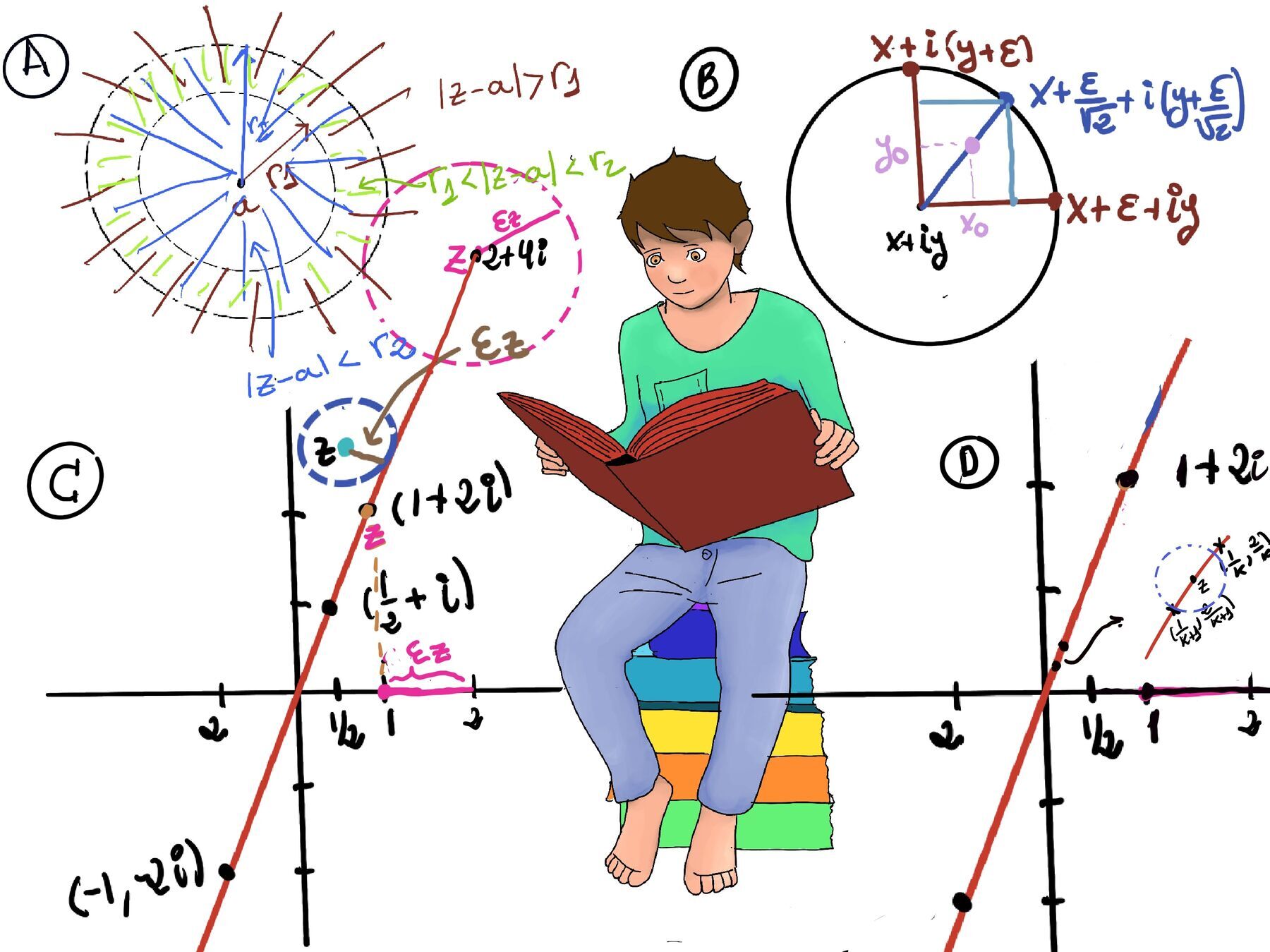
Let $S \subseteq \mathbb{C}$ be any subset. Every point $z \in \mathbb{C}$ can be classified relative to S.
z0 sits in S with a small “bubble” around it containing no other points of S.
Some examples are:
The Classification Theorem. Let S be a set of the complex numbers, $S \subseteq \mathbb{C}$, every point in ℂ ($z \in \mathbb{C}$) is either an interior point, an exterior point, or a boundary point of S, and these three categories are mutually exclusive.
This theorem is a cornerstone of topology in the complex plane. It formalizes the idea that every point in $\mathbb{C}$ has a well-defined relationship to any subset $S \subseteq \mathbb{C}$: it’s either inside, outside, or on the edge — and never more than one at a time.
Proof:
We need to show that these three possibilities are mutually exclusive and exhaustive (meaning every point z in ℂ must fall into exactly one of these categories).
Mutually exclusive:
Interior vs. Exterior: A point cannot be both an interior point and an exterior point. If z were both, there would exist disks $D_1 \subseteq S$ and $D_2 \subseteq \mathbb{C} \setminus S$, both centered at $z$. The intersection of these disks would be empty, but both contain z ($z \in D_1 \cap D_2 \neq \emptyset$), which is obviously a contradiction.
Interior vs. Boundary: A point cannot be both an interior point and a boundary point. If z were an interior point, some disk $B(z; R) \subseteq S$ contains no points of $\mathbb{C} \setminus S$, contradicting the definition of a boundary point (they require every disk to meet $\mathbb{C} \setminus S$).
Exterior vs. Boundary: A point cannot be both an exterior point and a boundary point. Suppose, for the sake of contradiction, that a point z is both an exterior point and a boundary point of a set S.
Because z is an exterior point, there exists an open disk Dez (where the subscript ’e’ stands for exterior) centered at z such that Dez ⊆ $\mathbb{C} \setminus S$. Because z is a boundary point, every open disk centered at z must contain at least one point of S -which contradicts the assumption that the disk lies entirely in $\mathbb{C} \setminus S$ ⊥
Exhaustiveness: Let z be an arbitrary point in ℂ. Consider an arbitrary open disk Dz centered at z. There are three possibilities:
Since these possibilities are mutually exclusive, we have already proved Exhaustiveness $\blacksquare$.
A set $S \subseteq \mathbb{C}$ is open if every point of S is an interior point (Every point has some “breathing room” —no edge points are included), i.e., every point has some open disc entirely contained in S, $\forall z \in S, \exists R > 0: B(z; R) \subseteq S$. Equivalently: $S = \text{int}(S)$.
A set $S \subseteq \mathbb{C}$ is closed if if it contains all its boundary points. Mathematically, this can be expressed as: $\partial S \subseteq S$. The boundary is part of the set.
This means the set is “complete” in a topological sense —it doesn’t leave out any edge points.
Theorem. Let S be a set of the complex numbers, S ⊆ ℂ, $S$ is closed if and only if $\mathbb{C} \setminus S$ is open.
Proof:
($\Rightarrow$) Suppose S is closed. Claim: $\mathbb{C} \setminus S$ is open.
Let $z \in \mathbb{C} \setminus S$. Since $z \notin S$ and $S$ contains all its boundary points, $z$ is not a boundary point of $S$.
By the classification theorem, $z$ must be an exterior point of $S$. So there exists a disk $B(z; R) \subseteq \mathbb{C} \setminus S$.
Since z was an arbitrary point in $\mathbb{C} \setminus S$, we have shown that every point in $\mathbb{C} \setminus S$ is an interior point. By definition, this means that $\mathbb{C} \setminus S$ is open.
($\Leftarrow$) Suppose $\mathbb{C} \setminus S$ is open. Let $z \in \partial S$.
Suppose for the sake of contraction $z \notin S$, then $z \in \mathbb{C} \setminus S$.
Since $\mathbb{C} \setminus S$ is open, there exists $B(z; R) \subseteq \mathbb{C} \setminus S$.
But $z \in \partial S$ means every disk around $z$ meets $S$ (and $\mathbb{C} \setminus S$). Contradiction.
Therefore, our assumption that $z \notin S$ must be false. Thus, z must be in S. Since z was an arbitrary boundary point of S, we have shown that all boundary points of S are contained in S. This means $\partial S \subseteq S$, and therefore, S is closed $\blacksquare$.
Examples:

JustToThePoint Copyright © 2011 - 2026 Anawim. ALL RIGHTS RESERVED. Bilingual e-books, articles, and videos to help your child and your entire family succeed, develop a healthy lifestyle, and have a lot of fun. Social Issues, Join us.
This website uses cookies to improve your navigation experience.
By continuing, you are consenting to our use of cookies, in accordance with our Cookies Policy and Website Terms and Conditions of use.