
|
 |

|
|
|
|
|
|
Without pain, without sacrifice, we would have nothing, Fight Club.

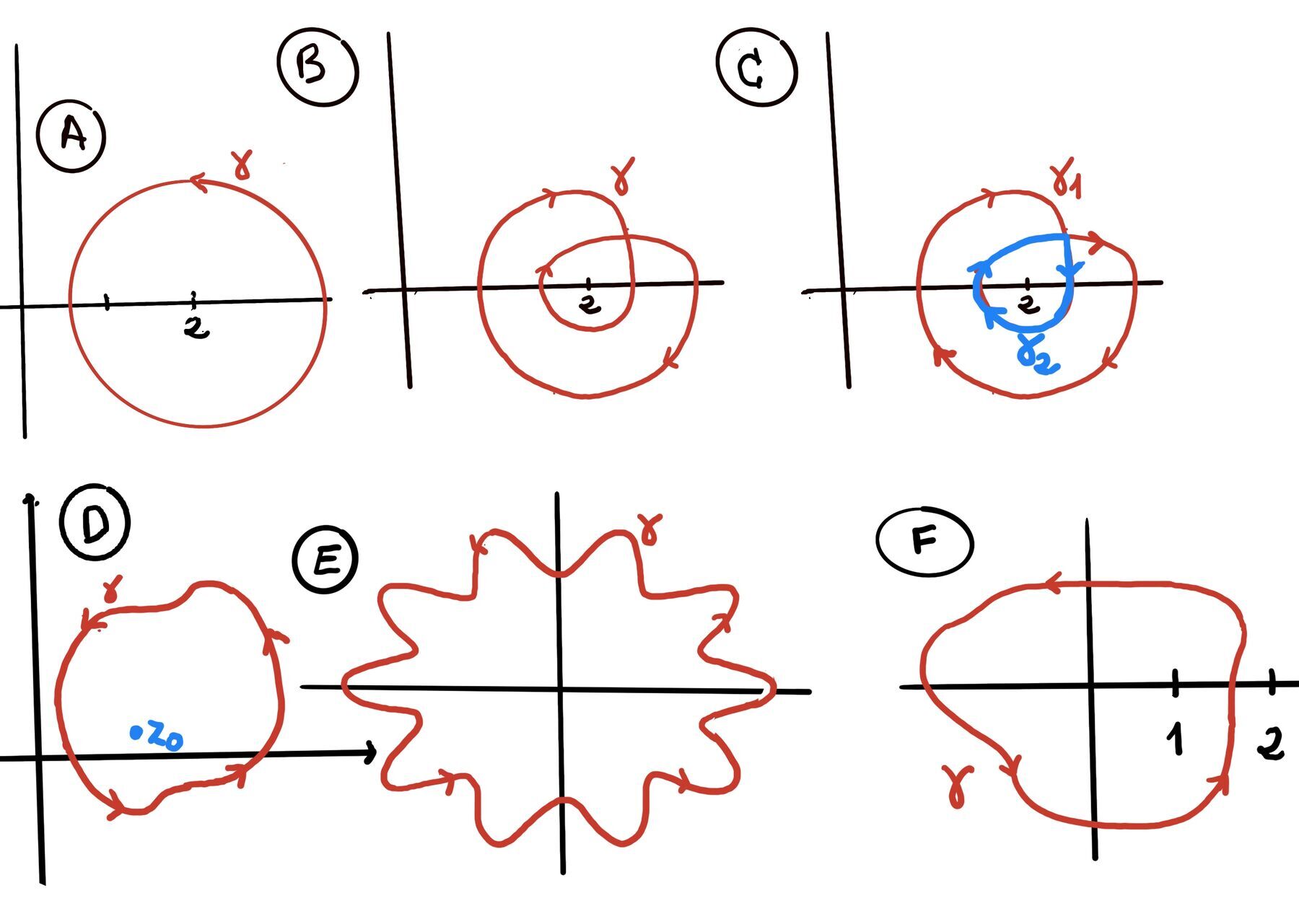
Deformation of Contours. If two contours $\gamma_1$ and $\gamma_2 $ are homotopic (i.e., one can be continuously deformed into the other without crossing any singularities of f) in a domain where f(z) is analytic, then: $\int_{\gamma_1} f(z)dz = \int_{\gamma_2} f(z)dz.$
Fundamental Theorem of Calculus for Contours. Suppose $\gamma$ is a contour (piecewise smooth path) from a to b, f is defined on a domain D containing $\gamma^*$ (the image of $\gamma$) and admits a primitive (antiderivative) F on D (i.e., $F'(z) = f(z)$), then $\int_{\gamma} f(z)dz = F(\gamma(b)) - F(\gamma(a))$. In particular, if $\gamma$ is a closed contour (i.e., $\gamma(a)=\gamma(b)$), this integral evaluates to zero, $\int_{\gamma} f(z)dz = 0.$
Estimation Theorem or the Triangle Inequality for Integrals. The triangle inequality for integrals in complex analysis states thatfor any continuous complex function $f:[a,b] \to \mathbb{C}$ on a closed real interval [a,b] (f(t) = u(t) + iv(t), t a real parameter), the following holds: $∣\int_a^b f(t)dt| \leq \int_a^b |f(t)|dt$.
Estimation Lemma (ML Inequality) for contour integrals. For any continuous complex function $f:[a,b] \to \mathbb{C}$ on a closed real interval [a,b] (f(z) = u(x, y) + iv(x, y)) with f bounded by some constant M along the entire contour, |f(z)| ≤ M for all $z \in \gamma^*$ (the image/trace of the contour in the complex plane), the following holds: $∣\int_\gamma f(z)dz| \leq M \cdot l(\gamma)$ where l(γ) is the arc length of the contour γ given by $\int_a^b |\gamma^{'}(t)|dt = \int_a^b \sqrt{x'(t)^2 + y'(t)^2} \text{ where } \gamma(t) = x(t) + iy(t)$.
Jordan’s curve theorem. Any simple closed curve (a continuous loop in the plane that does not intersect itself) separates the plane into two disjoint connected regions: one interior (bounded) and one exterior (unbounded). The curve itself is the boundary of both regions. In other words, it partitions the plane into exactly three disjoint sets:
Cauchy’s theorem (Classical “Green’s theorem” version). Let $\Omega \subset \mathbb{C}$ be an open domain. Suppose f = u + iv is analytic in $\Omega$ and its partial derivatives ( $u_x,u_y,v_x,v_y$) are continuous in $\Omega$. If $\gamma$ is a positively oriented, piecewise-smooth $C^1$, simple closed contour with $\gamma^* \cup \operatorname{Int}(\gamma) \subset \Omega$ (its path and interior both lie inside Ω), then $\oint_{\gamma} f(z)dz = 0.$
Cauchy’s Theorem (Cauchy–Goursat). This is the more powerful version, as it removes the need for continuous partial derivatives. If f is analytic in an open set containing a simple closed contour γ and its interior $\gamma^*\cup\operatorname{Int}(\gamma)$, then $\oint_{\gamma} f(z)dz = 0$.
Cauchy’s Theorem for a Rectangle. Let R be a rectangle region $R = \{x + iy : a \leq x \leq b,\; c \leq y \leq d\}$. Let f be holomorphic on an open setcontaining R (so f is analytic on and in a neighborhood of R). Then, the positively oriented boundary ($\partial R$) contour integral of f vanishes,$\boxed{\oint_{\partial R} f(z)\,dz = 0.}$
Theorem (Cauchy’s Theorem for a Triangle). Let T be a triangular region. Let f be holomorphic on an open set containing T (so f is analytic on and in a neighborhood of T). Then, the positively oriented boundary ($\partial T$) contour integral of f vanishes, $\oint_{\partial T} f(z)\,dz = 0.$
Proof.
The proof relies on the method of bisection. While the logic applies equally well to a triangle, for the sake of simplicity, we will formalize the proof for the rectangular region $R$.
1. The Bisection Process.
Let’s name the initial rectangle $R_0 = R$. We denote its perimeter as $l$ and its diagonal as $d$.
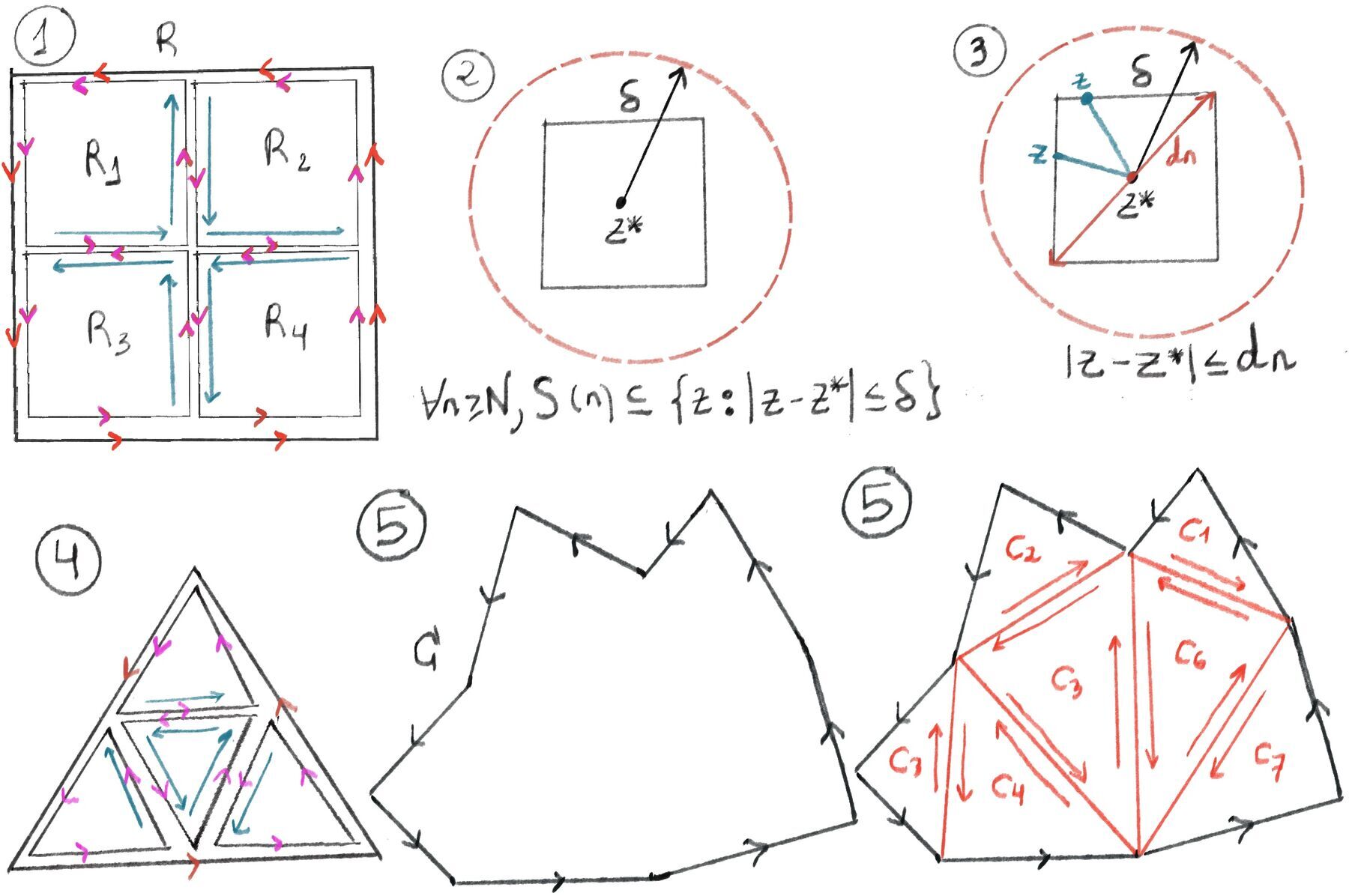
We subdivide $R_0$ into four equally sized subrectangles (Figure 1) by drawing lines parallel to its sides through its center (Figure 1). We observe that the contour integrals along the inner boundaries cancel each other out due to opposite orientations (every newly created interior edge is traversed twice in opposite directions).
Consequently, the integral over the entire boundary of ∂R can be expressed as the sum of integrals over these four smaller rectangles, $\int_{\partial R}f(z)dz = \int_{\partial R_1}f(z)dz + \int_{\partial R_2}f(z)dz + \int_{\partial R_3}f(z)dz + \int_{\partial R_4}f(z)dz$. Or using a different notation, $\int_{\partial R_0}f(z)dz = \int_{\partial R_1^{(1)}}f(z)dz + \int_{\partial R_1^{(2)}}f(z)dz + \int_{\partial R_1^{(3)}}f(z)dz + \int_{\partial R_1^{(4)}}f(z)dz$
Similarly, we can divide the triangular contour shown in Figure 4, then: $\int_{\partial T}f(z)dz = \int_{\partial T_1}f(z)dz + \int_{\partial T_2}f(z)dz + \int_{\partial T_3}f(z)dz + \int_{\partial T_4}f(z)dz$
Applying the triangle inequality, we get: $\left|\int_{\partial R_0}f(z)dz\right| \le \sum_{k=1}^{4} \left|\int_{\partial R_1^{(k)}}f(z)dz\right|$
By a simple averaging argument (or the Pigeonhole Principle), at least one of these four subrectangles must contribute at least one-fourth of the total absolute value. Let’s call this specific subrectangle $R_1$. Therefore: $\left|\int_{\partial R_1}f(z)dz\right| \ge \frac{1}{4}\left|\int_{\partial R_0}f(z)dz\right|$
Set $a_k:=\left| \int _{\partial R_1^{(k)}}f(z)\, dz\right| \geq 0,\quad k=1,\dots ,4,$ and let $S:=\sum _{k=1}^4a_k,$ so $\left| \int _{\partial R_0}f(z)\, dz\right| \leq S.$ Now, by the Pigeonhole Principle (or just basic averaging), if all four $a_k$ were strictly less than S/4, then $\sum _{k=1}^4a_k<4\cdot \frac{S}{4}=S,$ which is impossible.
2. Constructing the Nested Sequence.
We can apply this reasoning recursively. We divide $R_1$ into four even smaller rectangles, select the one that satisfies the inequality, and call it $R_2$.
Continuing by induction, we obtain an infinite sequence of rectangles $\{R_n\}_{n=0}^\infty$ with the following properties:
3. Cantor’s Intersection Theorem (Metric Space Version).
Let (X, d) be a complete metric space (like $\mathbb{R}^n$). Suppose $\{S(n)\}_{n=1}^\infty$ is a sequence of non-empty, closed, and bounded subsets of X such that:
Then, their intersection $\bigcap_{n=1}^\infty S(n)$ contains exactly one point, $z^*$.
Because $\mathbb{C}$ (equivalent to $\mathbb{R}^2$) is a complete metric space, we can apply Cantor’s Intersection Theorem. Since our sequence $\{R_n\}_{n=0}^\infty$ consists of non-empty, closed, and bounded subsets that are nested, and their diameters (the diagonals $d_n$) shrink to zero as $n \to \infty$, their infinite intersection must contain exactly one point. Let’s call this unique point $z^*$: $\bigcap_{n=0}^\infty R_n = \{z^*\}$.
4. Applying Analyticity
Since $z^*$ is inside $R_0$, and $f$ is analytic on an open set containing $R_0$, we know $f$ is complex differentiable at $z^*$ (analyticity implies complex differentiability at $z^*$). By the definition of the derivative: $\lim_{z \to z^*} \frac{f(z) - f(z^*)}{z-z^*} = f'(z^*) \iff \lim_{z \to z^*} \frac{f(z) - f(z^*) - f'(z^*)(z-z^*)}{z-z^*} = 0$
This implies that for any arbitrarily small $\epsilon > 0$, there exists a $\delta > 0$ such that for all $z$ satisfying $|z - z^*| \le \delta$, the following holds: $|f(z) - f(z^*) - f'(z^*)(z-z^*)| \le \epsilon|z-z^*|, (\star).$
Because the diameters of our rectangles shrink to zero, we can find a sufficiently large index $N$ such that for all $n \ge N$, the entire rectangle $R_n$ is contained within the $\delta$-neighborhood of $z^*$. Thus, for any $z$ on the boundary $\partial R_n$, the above $\epsilon$-inequality holds.
5. The Final Estimation
Let’s integrate the function over the boundary of this tiny rectangle $R_n$. By the Fundamental Theorem of Calculus (or noting that polynomials have global antiderivatives), the integrals of constant and linear terms over any closed loop vanish:
By the Fundamental Theorem of Calculus, we know that $\int_{\partial R_n} 1dz = 0, \int_{\partial R_n} zdz = 0$
Constant and linear terms vanish. $\int_{\partial S} 1dz = 0, \int_{\partial S} zdz = 0$ for any closed contour S because their respective antiderivatives are z and $\frac{z²}{2}$.
Therefore, subtracting zero from our integral doesn’t change its value: $\int_{\partial R_n}f(z)dz = \int_{\partial R_n} \left[ f(z) - f(z^*) - f'(z^*)(z-z^*) \right] dz$
Now, we take the absolute value and apply the standard Estimation Lemma ($ML$-inequality). The maximum value of the integrand ($M$) is bounded by $\epsilon|z-z^*|, (\star)$, and the length of the contour ($L$) is the perimeter $l_n$:
$$\left|\int_{\partial R_n}f(z)dz\right| \le \int_{\partial R_n} \epsilon|z-z^*| |dz|$$Since both $z$ and $z^*$ lie within $R_n$, the distance $|z-z^*|$ can never exceed the diagonal of the rectangle, $d_n$. $\left|\int_{\partial R_n}f(z)dz\right| \le \epsilon \cdot d_n \cdot l_n$
Substitute the known values for $d_n$ and $l_n$: $\left|\int_{\partial R_n}f(z)dz\right| \le \epsilon \left(\frac{d}{2^n}\right) \left(\frac{l}{2^n}\right) = \frac{\epsilon \cdot d \cdot l}{4^n}$
Finally, we chain this result back to our original geometric inequality from Step 2: $\frac{1}{4^n}\left|\int_{\partial R_0}f(z)dz\right| \le \left|\int_{\partial R_n}f(z)dz\right| \le \frac{\epsilon \cdot d \cdot l}{4^n}$
Multiplying the entire inequality by $4^n$ yields: $\left|\int_{\partial R_0}f(z)dz\right| \le \epsilon \cdot d \cdot l$
Because $d$ and $l$ are fixed constants of our initial rectangle, and $\epsilon$ can be chosen to be arbitrarily close to $0$, the only way this inequality holds is if the absolute value is exactly zero. $\left|\int_{\partial R}f(z)dz\right| = 0 \implies \int_{\partial R}f(z)dz = 0\, \blacksquare$
There are several forms of Cauchy’s theorem. If C is a closed polygonal contour lying entirely within a simply connected domain D, f is a complex function analytic in D, then $\int_{\partial C}f(z)dz = 0$.
Proof by triangulation:
Whether $C$ is a tidy square, an irregular hexagon, or a jagged polygon with thousands of vertices, analyticity inside forces the integral to zero.
The idea is to approximate $\Gamma$ by inscribed polygons and use the polygon result. The uniform continuity of $f$ and the finite length of $\Gamma$ ensure the approximation error vanishes in the limit.

JustToThePoint Copyright © 2011 - 2026 Anawim. ALL RIGHTS RESERVED. Bilingual e-books, articles, and videos to help your child and your entire family succeed, develop a healthy lifestyle, and have a lot of fun. Social Issues, Join us.
This website uses cookies to improve your navigation experience.
By continuing, you are consenting to our
use of cookies, in accordance with our Cookies Policy and
Website Terms and Conditions of use.