
|
 |

|
|
|
|
|
|
When the world says, ‘Give up,’ hope whispers, ‘Try it one more time,’ Lyndon B. Johnson.

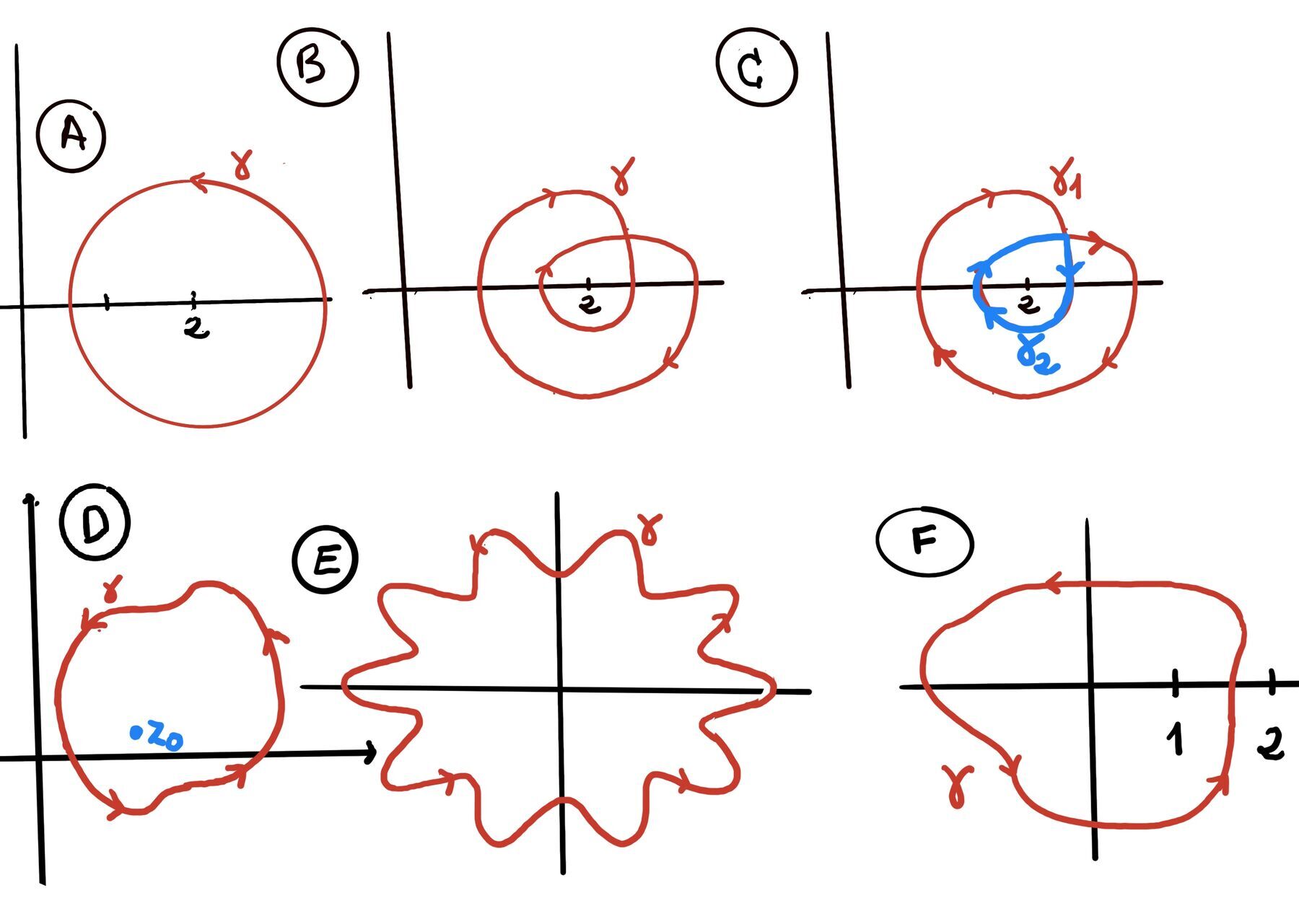
Deformation of Contours. If two contours $\gamma_1$ and $\gamma_2 $ are homotopic (i.e., one can be continuously deformed into the other without crossing any singularities of f) in a domain where f(z) is analytic, then: $\int_{\gamma_1} f(z)dz = \int_{\gamma_2} f(z)dz.$
Fundamental Theorem of Calculus for Contours. Suppose $\gamma$ is a contour (piecewise smooth path) from a to b, f is defined on a domain D containing $\gamma^*$ (the image of $\gamma$) and admits a primitive (antiderivative) F on D (i.e., $F'(z) = f(z)$), then $\int_{\gamma} f(z)dz = F(\gamma(b)) - F(\gamma(a))$. In particular, if $\gamma$ is a closed contour (i.e., $\gamma(a)=\gamma(b)$), this integral evaluates to zero, $\int_{\gamma} f(z)dz = 0.$
Estimation Theorem or the Triangle Inequality for Integrals. The triangle inequality for integrals in complex analysis states thatfor any continuous complex function $f:[a,b] \to \mathbb{C}$ on a closed real interval [a,b] (f(t) = u(t) + iv(t), t a real parameter), the following holds: $∣\int_a^b f(t)dt| \leq \int_a^b |f(t)|dt$.
Estimation Lemma (ML Inequality) for contour integrals. For any continuous complex function $f:[a,b] \to \mathbb{C}$ on a closed real interval [a,b] (f(z) = u(x, y) + iv(x, y)) with f bounded by some constant M along the entire contour, |f(z)| ≤ M for all $z \in \gamma^*$ (the image/trace of the contour in the complex plane), the following holds: $∣\int_\gamma f(z)dz| \leq M \cdot l(\gamma)$ where l(γ) is the arc length of the contour γ given by $\int_a^b |\gamma^{'}(t)|dt = \int_a^b \sqrt{x'(t)^2 + y'(t)^2} \text{ where } \gamma(t) = x(t) + iy(t)$.
Jordan’s curve theorem. Any simple closed curve (a continuous loop in the plane that does not intersect itself) separates the plane into two disjoint connected regions: one interior (bounded) and one exterior (unbounded). The curve itself is the boundary of both regions. In other words, it partitions the plane into exactly three disjoint sets:
Cauchy’s theorem is the central result of complex analysis. It asserts that the integral of an analytic function around a closed loop is zero — a statement with no analogue in real analysis.
Cauchy’s Theorem (Cauchy–Goursat). Let $f$ be holomorphic on an open set containing a simple closed contour $\gamma$ and its interior $\gamma^* \cup \operatorname{Int}(\gamma)$. Then, $\boxed{\oint_\gamma f(z)\,dz = 0.}$.
Cauchy’s theorem (Classical “Green’s theorem” version). Let $\Omega \subseteq \mathbb{C}$ be open, and let $f = u + iv$ be holomorphic in $\Omega$ with continuous partial derivatives $u_x, u_y, v_x, v_y$. If $\gamma$ is a positively oriented, piecewise-smooth, simple closed contour with $\gamma^* \cup \operatorname{Int}(\gamma) \subseteq \Omega$ (its path and interior both lie inside Ω), then $\oint_\gamma f(z)\,dz = 0$.
At its core, Cauchy’s Integral Theorem is a profound statement about the nature of “well-behaved” complex functions. It says that if a function is analytic (differentiable at every point in a open set), then integrating it around any simple closed loop within that region will always yield a result of zero. Analytic functions are so “smooth” and well-behaved that their integrals over closed loops vanish (when you walk a closed loop in a region where f is analytic, positive contributions cancel negative ones, so the net integral is zero). This is a consequence of the extreme rigidity of holomorphic functions.
Let’s break down the conditions mentioned:
Proof (Classical Version via Green’s Theorem):
Since both integrands are identically zero everywhere inside the contour, the double integrals over that area must both be zero.
Theorem: If a function f(z) is analytic throughout a simply connected domain D, then f(z) is guaranteed to have an antiderivative (also called a primitive), F(z), in D, meaning we can always find a function F(z) such that F′(z) = f(z).
This step relies on the domain being simply connected; if there were holes, an antiderivative might not exist.
Once we know an antiderivative F(z) exists, we can use the Fundamental Theorem of Calculus for Contour Integrals. This theorem states that if f(z) has an antiderivative F(z), then the integral of f(z) from a point $z_1$ to a point $z_2$ is simply: $\int_{z_1}^{z_2} f(z)dz = F(z_2) - F(z_1)$ (path-independent).
A closed contour is a path where the start and end points are the same, $z_1 = z_2$. Plugging this into the formula from the Fundamental Theorem: $\oint_{\gamma} f(z)dz = \int_{z_1}^{z_2} f(z)dz = F(z_2) - F(z_1) = 0$.
In summary, the corollary follows this logical chain:
Proof:
Fix $z_0 \in D$ and define F(z) = $\int_{z_0}^z f(w)dw$ along any path in $D$ from $z_0$ to $z$. The vanishing of closed contour integrals guarantees path independence, so $F$ is well-defined.
Let’s take two different paths, γ₁ and γ₂, from z₀ to z. Now, create a new closed loop γ by going from z₀ to z along γ₁ and then returning from z to z₀ along the reverse of γ₂ (denoted -γ₂), γ = γ₁-γ₂. By our starting condition, the integral around this closed loop must be zero, $\oint_{\gamma} f(w)dw = 0$. By linearity, $\oint_{\gamma} f(w)dw = \oint_{\gamma_1} f(w)dw -\oint_{\gamma_2} f(w)dw = 0 \leadsto \oint_{\gamma_1} f(w)dw = \oint_{\gamma_2} f(w)d$. This proves that the integral only depends on the endpoints, not the path, and our definition for F(z) is well-defined and gives a single, unique value for each z.
Now we have to show that this function F(z) is actually the antiderivative of f(z). We do this using the formal limit definition of a derivative: F’(z) = $\lim_{h \to 0} \frac{F(z+h)-F(z)}{h}$.
Our task is to show that: $F'(z) = \lim_{h \to 0} \frac{F(z+h)-F(z)}{h} = f(z)$ where $F(z+h)-F(z) = \int_{z_0}^{z+h} f(w)dw - \int_{z_0}^z f(w)dw$.
Using path independence, we can choose the path from z₀ to z+h to go via z. Specifically, we go from z₀ to z and then from z to z+h along a straight line segment, $\int_{z_0}^{z+h} f(w)dw = \int_{z_0}^{z} f(w)dw + \int_{z}^{z+h} f(w)dw$.
Then, $F(z+h)-F(z) = \int_{z_0}^{z+h} f(w)dw - \int_{z_0}^z f(w)dw = \int_{z_0}^{z} f(w)dw + \int_{z}^{z+h} f(w)dw - \int_{z_0}^z f(w)dw$
The first and last terms cancel, leaving us with a very simple result: $F(z+h)-F(z) = \int_{z}^{z+h} f(w)dw$, hence F’(z) = $\lim_{h \to 0} \frac{F(z+h)-F(z)}{h} = \lim_{h \to 0} \frac{\int_{z}^{z+h} f(w)dw}{h} = \lim_{h \to 0} \frac{1}{h}\int_{z}^{z+h} f(w)dw$. We want to show this limit equals f(z).
Let’s consider the expression $(\frac{1}{h}\int_{z}^{z+h} f(w))-f(z)$. Notice that $f(z) = \frac{1}{h}\int_{z}^{z+h} f(z)dw$ (Integrating a constant f(z) along a path of length h gives f(z)·h). Therefore,
$(\frac{1}{h}\int_{z}^{z+h} f(w))-f(z) = \frac{1}{h}\int_{z}^{z+h} f(w) - \frac{1}{h}\int_{z}^{z+h} f(z)dw =\frac{1}{h} \int_{z}^{z+h} [f(w) - f(z)]dw$.
Since f is analytic, it is continuous. This means that as w gets close to z, f(w) gets close to f(z). For any small ε > 0, there exists δ > 0 such that: ∣w − z∣ < δ ⇒ |f(w) - f(z)| < ε.
Now, if ∣h∣ < δ, then for all w on the straight-line segment from z to z + h, we have ∣w − z∣ ≤ ∣h∣ < δ, so: |f(w) - f(z)| < ε.
Using the ML-Inequality on the integral part: M = max{∣f(w)−f(z)∣: w on the segment}. Then, M < ε. L = Length of the path or segment from z to z + h, which is |h|.
Thus, $|\frac{1}{h} \int_{z}^{z+h} [f(w) - f(z)]dw| = \frac{1}{|h|}|\int_{z}^{z+h} [f(w) - f(z)]dw| \le \frac{1}{|h|}(M \cdot L) \le \frac{1}{|h|} (ε \cdot |h|) = ε$.
We have shown that for any ε > 0, there exists δ > 0 such that if 0 < ∣h∣ < δ, then:
$|\frac{F(z+h)-F(z)}{h}-f(z)| = |\frac{1}{h} \int_{z}^{z+h} [f(w) - f(z)]dw|$ < ε. This is exactly the definition of $\lim_{h \to 0} \frac{F(z+h)-F(z)}{h} = f(z)$, i.e., F′(z) = f(z).
Contour integrals of analytic functions are topologically invariant —they depend only on how the contour winds around singularities, not on its specific shape.
It allows us to replace a complicated contour integral with a much simpler one. The core idea is that you can freely change the shape of a contour without changing the value of the integral, as long as the contour does not pass through any singularities of the function, e.g., suppose you need to calculate $\oint_{\gamma_1} \frac{1}{z}dz$ where $\gamma_1$ is a complicated square around the origin.
f(z) = 1/z has a singularity at z = 0. Let $\gamma_2$ be a simple unit circle, ∣z∣ = 1. The function is analytic in the region between the square and the circle. By the Deformation Principle, the difficult integral over the square is equal to the easy integral over the circle: $\oint_{\text{square}} \frac{1}{z}dz = \oint_{\text{circle}} \frac{1}{z}dz = 2\pi \cdot i$
If a contour γ can be shrunk down to a single point without crossing any singularities, it means that the function f(z) is analytic everywhere inside γ. This is just a restatement of the original Cauchy’s Integral Theorem, which tells us the integral must be zero.
Proof:
Let f(z) be analytic in the region between two simple closed contours, γ₁ and γ₂, where both are positively oriented (counter-clockwise). Imagine an outer loop γ₁ and an inner loop γ₂. We are going to construct a single, non-intersecting closed path, which we’ll call γ, by adding a “bridge” connecting the two loops.
The new path γ travels: (i) Along the outer contour γ₁ (counter-clockwise). (ii) Down the bridge. (iii)Along the inner contour γ₂ in the opposite (clockwise) direction. We denote this path as −γ₂. (iv) Up the bridge, returning to the start.
The function f(z) is analytic everywhere in the region enclosed by this new path γ. Notice that the singularities (if any) are in the “hole” inside γ₂ (no singularities in or between both contours), so they are outside the region we are integrating around.
Because f(z) is analytic inside and on the path γ, Cauchy’s Integral Theorem applies, and the integral is zero: $\oint_{\gamma} f(z)dz = 0$.
The integral over the full path is the sum of its parts: $\oint_{\gamma_1} f(z)dz + \oint_{\text{bridge}} f(z)dz + \oint_{-\gamma_2} f(z)dz + \oint_{\text{-bridge}} f(z)dz = 0$. The integrals along the bridge are taken over the same path but in opposite directions, so they cancel each other out. We are left with: $\oint_{\gamma_1} f(z)dz + \oint_{-\gamma_2} f(z)dz = 0$. Since reversing a path negates its integral, $\oint_{\gamma_1} f(z)dz - \oint_{\gamma_2} f(z)dz = 0 \leadsto \oint_{\gamma_1} f(z)dz = \oint_{\gamma_2} f(z)dz$
Proof (one paragraph, pure logic).
Assume the opposite: f is analytic on the open set D ⊃ γ ∪ Int(γ). Cauchy’s theorem gives $\oint_{\gamma} f(z)dz = 0$. This contradicts the hypothesis “the integral is non-zero”. Hence the assumption “f analytic throughout Int(γ)” is false, therefore analyticity fails at (at least) one point inside γ.
Classic example: $f(z)=1/z$ on the unit circle, $\gamma(t)=e^{it}, 0 \le t \le 2\pi$. Direct parametrisation: $\oint_{\gamma} f(z)dz = \int_0^{2π} \frac{ie^{it}}{e^{it}} dt = i\int_0^{2\pi} dt = 2\pi i ≠ 0$. The corollary now guarantees that 1/z cannot be analytic everywhere inside the unit disk – and indeed its derivative does not exist at z = 0. Thus, a non-zero integral is an alarm bell: somewhere beneath γ the function is not complex-differentiable.
$\oint_C z^2 dz = 0.$ Why? This result is a direct consequence of Cauchy’s Integral Theorem. It states that if a function is analytic (holomorphic) on and inside a simple closed contour, then the integral of the function along that contour is zero.
Case 1. a outside $\gamma$. Then, $\frac{1}{z-a}$ is analytic on and inside γ, $\gamma^* \cup \operatorname{Int}(\gamma)$ so Cauchy’s theorem applies and $\oint_{\gamma} \frac{1}{z-a} dz = 0$.
Case 2. a inside $\gamma$, a simple, positively oriented, piecewise-$C^1$ closed curve that winds once around a. The integrand is not analytic at a, so Cauchy’s theorem does not apply.
Approach 1. By contour deformation, we are allowed to replace $\gamma$ with a circle $|z-a| = R$, parametrized by $\gamma(t) = a + Re^{it}, f(\gamma(t)) = \frac{1}{R e^{it}}, 0 ≤ t ≤ 2π, \gamma'(t) = iR e^{it}dt$. Then, $\oint_{\gamma} \frac{1}{z-a}dz = \oint_{\text{circle}} \frac{1}{z-a}dz = \int_{0}^{2π} \frac{iR e^{it}}{R e^{it}}dt = \int_{0}^{2π} idt = i \cdot 2\pi = 2\pi i$.
Since γ can be continuously shrunk to this circle without crossing the singularity, the integral over γ equals the same value.
Approach 2. Residue viewpoint. The function $f(z) = \frac{1}{z-a}$ has a simple pole at z = a with residue $Res(f, a) = \lim_{z \to a} (z – a)·\frac{1}{z-a} = 1.$
Recall. For a simple pole at a point $z_k$ (i.e., the denominator has a simple root), the residue is calculated using the formula $Res(f, z_k) = \lim_{z \to z_k}(z-z_k)f(z)$. The Residue Theorem states that the integral of a function f(z) around a simple (doesn't cross itself), and positively oriented (counter-clockwise) contour γ is equal to 2πi times the sum of the residues of all singularities inside the contour, $\int_{\gamma} f(z)dz = 2\pi i \sum Res(f, z_k) = 2\pi i \cdot 1 = 2\pi i$.
A residue is the “fingerprint” of a singularity that tells you how much that singularity contributes to a contour integral.
Path independence in practice. For any two paths $\gamma_1, \gamma_2$ from 1 to 1 + i in $\mathbb{C}, \int_{\gamma_1} e^z dz = \int_{\gamma_2} e^z dz$.
Because $e^z$ is entire, the integral depends only on the endpoints, not on the route taken. The integrand has the global antiderivative F(z) = $e^z$ on $\mathbb{C}$. Hence, for any path γ from 1 to 1+i (the fundamental theorem of calculus in the complex plane), $\int_{\gamma} e^z dz = F(1+i) - F(i) = e^{1+i}-e^1= e(\cos 1 + i\sin 1) - e.$
The polygonal or “wiggly” nature of $\gamma$ does not matter, because the integral depends only on the analyticity of f and the absence of singularities inside.
The deformation principle lets us locally smooth corners without changing the integral, so the shape of $\gamma$ is irrelevant — only the analyticity of $f$ and the absence of singularities inside matter (so the double integral in Green’s formula vanishes by the Cauchy–Riemann equations exactly as before). A tidy triangle, an hexagon, a jagged polygon, a smooth ellipse, a fractal-looking or “wiggly” loop all give zero, provided the function is well-behaved throughout.
Since $1/z$ is analytic on $\mathbb{C}\setminus\{0\}$ and $z = 0$ is inside the square, the function has a singularity inside. By contour deformation, replace the square with the unit circle (both enclose $z = 0$, and $1/z$ is analytic between them): $\oint_{\text{square}}\frac{dz}{z} = \oint_{|z|=1}\frac{dz}{z} = 2\pi i.$

JustToThePoint Copyright © 2011 - 2026 Anawim. ALL RIGHTS RESERVED. Bilingual e-books, articles, and videos to help your child and your entire family succeed, develop a healthy lifestyle, and have a lot of fun. Social Issues, Join us.
This website uses cookies to improve your navigation experience.
By continuing, you are consenting to our
use of cookies, in accordance with our Cookies Policy and
Website Terms and Conditions of use.