
|
 |

|
|
|
|
|
|
Do, or do not. There is no try, Yoda.

A complex function $f(z)$ maps $z = x + iy \in \mathbb{C}$ to another complex number. For example: $f(z) = z^2 = (x + iy)^2 = x^2 - y^2 + 2ixy, f(z) = \frac{1}{z}, f(z) = \sqrt{z^2 + 7}$.
A contour is a continuous, piecewise-smooth curve defined parametrically as: $z(t) = x(t) + iy(t), \quad a \leq t \leq b$.
Definition (Smooth Contour Integral). Let ᵞ be a smooth contour (a continuously differentiable path in the complex plane), $\gamma: [a, b] \to \mathbb{C}$. Let $f: \gamma^* \to \mathbb{C}$ be a continuous complex-valued function defined on the trace $\gamma^*$ of the contour (i.e. along the image of $\gamma$). Then, the contour integral of f along $\gamma$ is defined as $\int_{\gamma} f(z)dz := \int_{a}^{b} f(\gamma(t)) \gamma^{'}(t)dt$.
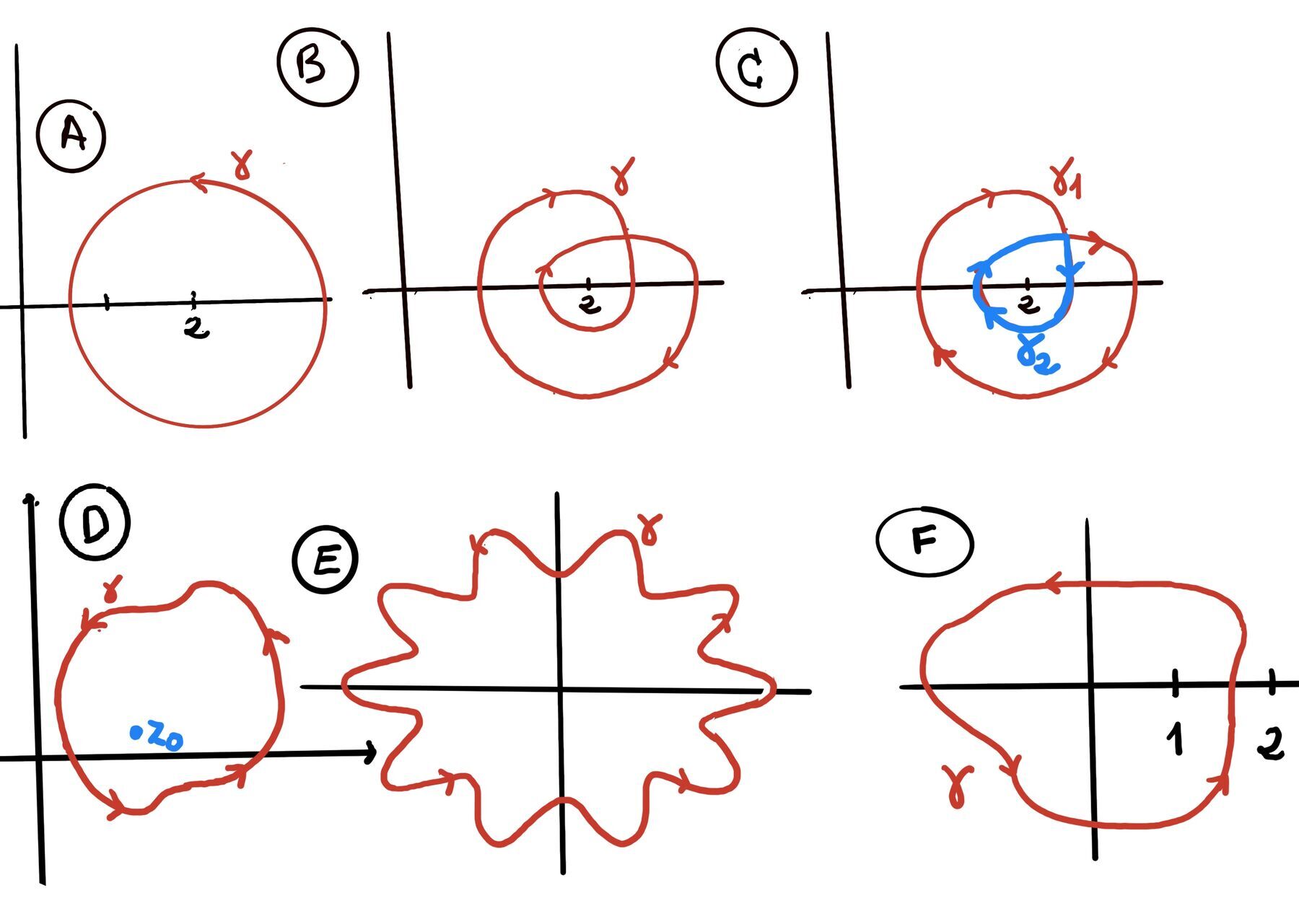
Deformation of Contours. If two contours $\gamma_1$ and $\gamma_2 $ are homotopic (i.e., one can be continuously deformed into the other without crossing any singularities of f) in a domain where f(z) is analytic, then: $\int_{\gamma_1} f(z)dz = \int_{\gamma_2} f(z)dz.$
Fundamental Theorem of Calculus for Contours. Suppose $\gamma$ is a contour (piecewise smooth path) from a to b, f is defined on a domain D containing $\gamma^*$ (the image of $\gamma$) and admits a primitive (antiderivative) F on D (i.e., $F'(z) = f(z)$), then $\int_{\gamma} f(z)dz = F(\gamma(b)) - F(\gamma(a))$. In particular, if $\gamma$ is a closed contour (i.e., $\gamma(a)=\gamma(b)$), this integral evaluates to zero, $\int_{\gamma} f(z)dz = 0.$
Estimation Theorem or the Triangle Inequality for Integrals. The triangle inequality for integrals in complex analysis states thatfor any continuous complex function $f:[a,b] \to \mathbb{C}$ on a closed real interval [a,b] (f(t) = u(t) + iv(t), t a real parameter), the following holds: $∣\int_a^b f(t)dt| \leq \int_a^b |f(t)|dt$.
Estimation Lemma (ML Inequality) for contour integrals. For any continuous complex function $f:[a,b] \to \mathbb{C}$ on a closed real interval [a,b] (f(z) = u(x, y) + iv(x, y)) with f bounded by some constant M along the entire contour, |f(z)| ≤ M for all $z \in \gamma^*$ (the image/trace of the contour in the complex plane), the following holds: $∣\int_\gamma f(z)dz| \leq M \cdot l(\gamma)$ where l(γ) is the arc length of the contour γ given by $\int_a^b |\gamma^{'}(t)|dt = \int_a^b \sqrt{x'(t)^2 + y'(t)^2} \text{ where } \gamma(t) = x(t) + iy(t)$.
Jordan’s curve theorem. Any simple closed curve (a continuous loop in the plane that does not intersect itself) separates the plane into two disjoint connected regions: one interior (bounded) and one exterior (unbounded). The curve itself is the boundary of both regions. In other words, it partitions the plane into exactly three disjoint sets:
Cauchy’s theorem (Classical “Green’s theorem” version). Let $\Omega \subset \mathbb{C}$ be an open domain. Suppose f = u + iv is analytic in $\Omega$ and its partial derivatives ( $u_x,u_y,v_x,v_y$) are continuous in $\Omega$. If $\gamma$ is a positively oriented, piecewise-smooth $C^1$, simple closed contour with $\gamma^* \cup \operatorname{Int}(\gamma) \subset \Omega$ (its path and interior both lie inside Ω), then $\oint_{\gamma} f(z)dz = 0.$
Cauchy’s Theorem (Cauchy–Goursat). This is the more powerful version, as it removes the need for continuous partial derivatives. If f is analytic in an open set containing a simple closed contour γ and its interior $\gamma^*\cup\operatorname{Int}(\gamma)$, then $\oint_{\gamma} f(z)dz = 0$.
Cauchy’s Theorem for simply connected domains. If a function f is analytic (a function that is complex-differentiable at every point within a domain, i.e., well-behaved and smooth, with no sharp corners, breaks, or singularities like division by zero) throughout a simply simple connected domain D then $\oint_C f(z)dz = 0$ for every closed contour C lying in D.
General Cauchy Theorem for Multiply Connected Domains. Let $R$ be the multiply connected region (with n holes) inside $C$ but outside of every $C_k$ (each $C_k$ surrounds only one hole in the domain), $R = Int(C) \setminus \bigcup_{k=1}^n \overline{Int(C_k)}$, and let $f(z)$ be analytic on $R$. Now, let $\Gamma$ be any general closed contour (not necessarily simple) that lies entirely in R. This $\Gamma$ can wind around the “holes” (the regions inside each $C_k$) in any way it likes (this is the winding number or index of $\Gamma$ around each hole), the integral over $\Gamma$ is: $\oint_{\Gamma} f(z)dz = \sum_{k=1}^n m_k \oint_{C_k} f(z)dz$.
The Anti-Derivative Theorem. Let f be a continuous function on a region G (a region is an open, connected set). Then, the following statements are equivalent:
Proof.
(1) ⇒ (2)
Let $\gamma$ be any closed contour in G. Let’s parameterize it by z(t) for t in an interval $[\alpha, \beta]$. Since the loop is closed, it starts and ends at the same point, let’s call it a, $z(\alpha) = z(\beta) = a$.
Now, let’s write out the integral using the definition of the complex line integral:
$$ \begin{aligned} \oint_\gamma f(z)dz &=\int_\alpha^\beta f(z(t)) \cdot z'(t) dt \\[2pt] &=[\text{Since we assumed F'(z) = f(z)}] \int_\alpha^\beta F'(z(t)) \cdot z'(t) dt \\[2pt] & [\text{By the chain rule, }] \frac{d}{dt} \left( F(z(t)) \right) = F'(z(t)) \cdot z'(t) \\[2pt] &=\int_\alpha^\beta \frac{d}{dt} \left( F(z(t)) \right) dt \\[2pt] &= [\text{By the Fundamental Theorem of Calculus, }] \left[ F(z(t)) \right]_\alpha^\beta = F(z(\beta)) - F(z(\alpha)) \\[2pt] &= [z(\alpha) = z(\beta) = a] F(a) - F(a) = 0. \end{aligned} $$The proof for $(1) \implies (3)$ is almost identical. The integral from $a$ to $b$ would be $F(z(\beta)) - F(z(\alpha)) = F(b) - F(a)$, which depends only on the endpoints, not on the path taken between them.
(2) ⇒ (3). Let $\gamma_1 \text{ and } \gamma_2$ be two distinct contours in G that both start at a and end at b.
Consider the new contour $\Gamma = \gamma_1 - \gamma_2$ where $-\gamma_2$ is the path $\gamma_2$ but traversed in reversed (from b back to a). This path starts at a, goes to b (via $\gamma_1$), and then returns to a (via $-\gamma_2$). Therefore, it is a closed contour.
By our assumption 2, $\oint_{\gamma_1 - \gamma_2} f(z)dz = 0$. Using the linearity of integrals, we can split the integral over $\Gamma, \int_{\gamma_1} f(z)dz + \int_{-\gamma_2} f(z)dz = 0.$
A key property of contour integrals is that reversing the path negates the value, $\oint_{\gamma_1}f(z)dz - \oint_{\gamma_2}f(z)dz = 0 \leadsto \oint_{\gamma_1}f(z)dz = \oint_{\gamma_2}f(z)dz$.
This shows that the integral’s value only depends on the endpoints (a and b), not the path taken. This is the definition of path independence.
3 ⇒ 1
Suppose the integral $\oint_{\gamma}f(z)dz$ depends only on the initial and final points of a contour γ lying in G. Since $G$ is a region (connected), we can fix a starting point $z_0$ anywhere in G. Let’s define a function F(z) for any other point z in G as follows: $F(z) = \oint_{\gamma}f(z)dz$ where γ is any contour lying in G from $z_0$ to z.
F is well-defined (meaning it gives a single, unambiguous value) because we are assuming path independence (3). It doesn’t matter which path we take from $z_0$ to z, the integral’s value will be the same, $F(z) = \oint_{\gamma}f(z)dz = \int_{z_0}^z f(z)dz$.
We aim to prove that F’(z) = f(z). Let z ∈ G and consider the difference quotient for a small displacement h:
$$|\frac{F(z+h) - F(z)}{h} - f(z)| = |\frac{\int_{z_0}^{z+h} f(ξ)dξ - \int_{z_0}^z f(ξ)dξ}{h} - f(z)|$$Because of path independence (F is well defined), we can choose our integration paths to be convenient. Let’s consider a path from $z_0$ to z + h to be a path from $z_0$ to z, followed by a straight line segment from z to z + h.
This is allowed because G is an open set, so for a small enough h, the straight line segment from z to z + h will be entirely contained within G. Formally, there exists a radius $\delta_0 \gt 0$ such that if $∣h∣ \lt \delta_0$, the entire straight line segment [z, z + h] lies entirely within G.
Now we can split the first integral: $\int_{z_0}^{z+h} f(ξ)dξ - \int_{z_0}^z f(ξ)dξ = (\int_{z_0}^{z} f(ξ)dξ + \int_{z}^{z+h} f(ξ)dξ) - \int_{z_0}^z f(ξ)dξ = \int_{z}^{z+h} f(ξ)dξ$ (the integral from $z_0$ to z, $\int_{z_0}^{z} f(ξ)dξ$ cancel out perfectly) where the integral is over the straight line from z to z + h.
Hence, $|\frac{\int_{z_0}^{z+h} f(ξ)dξ - \int_{z_0}^z f(ξ)dξ}{h} - f(z)| = |\frac{\int_{z}^{z+h} f(ξ)dξ}{h} - f(z)|$.
Since G is open and z ∈ G, there is a $\delta_0 \gt 0$ such that $B(z; \delta_0) \subseteq G$. When $|h| \lt \frac{\delta_0}{2}$, the straight line joining z and z + h is contained in G. Therefore, we choose the straight line (contour) from z to z + h for the above integral when $|h| \lt \frac{\delta_0}{2}$.
Then, $\frac{\int_{z}^{z+h} f(ξ)dξ}{h} - f(z) = \frac{\int_{[z, z+h]} (f(ξ) - f(z))dξ}{h}$ where $\int_{[z, z+h]}$ indicates the integral over the straight line (contour) from z to z + h, and we can write the constant f(z) as an integral over the straight line $[z, z+h]$. The path has length $L = |(z+h) - z| = |h|$, integrating a constant f(z) over it gives $f(z) \cdot h$.
We can parameterize the path as $\gamma(t) = z + th$ for $t \in [0, 1], \gamma'(t) = h$, Then, $\int_{[z, z+h]} f(z)dξ = \int_0^1 f(z) \cdot \gamma'(t) dt = \int_0^1 f(z) \cdot h dt = f(z) \cdot h \cdot t\bigg|_{0}^{1} = f(z)\cdot h$.
Therefore, we can write $f(z) = \frac{1}{h} \int_z^{z+h} f(z)d\xi$ and $\frac{\int_{z}^{z+h} f(ξ)dξ}{h} - f(z) = \frac{\int_{[z, z+h]} (f(ξ) - f(z))dξ}{h}$.
By the standard Estimation Theorem (ML-inequality) for complex integrals: $|\frac{\int_{[z, z+h]} (f(ξ) - f(z))dξ}{h}| \le \frac{1}{|h|} \int_{[z, z+h]} |f(ξ) - f(z)| dξ$
Analicity implies continuity and by continuity of f, given $\epsilon \gt 0$, there is a $\delta \gt 0$ such that whenever $|ξ -z| \lt \delta, |f(ξ) - f(z)| \lt \epsilon$ (as $\xi$ gets closer to $z, f(\xi)$ gets closer to $f(z)$).
So given $\epsilon \gt 0$, choose $\delta_1 = min(\delta, \delta_0)$ so that whenever $|ξ -z| \lt \delta_1, |f(ξ) - f(z)| \lt \epsilon \text{ and } \frac{1}{|h|} \int_{[z, z+h]} |f(ξ) - f(z)| dξ \lt \epsilon \frac{1}{|h|} \cdot \int_{[z, z+h]} dξ = \epsilon$.
Therefore, given $\epsilon \gt 0$, we have found a $\delta_1$ so that whenever $|ξ -z| \lt \delta_1, |\frac{F(z+h) - F(z)}{h} - f(z)| \lt \epsilon$. So F is differentiable at every point z ∈ G and F’(z) = f(z).
The Antiderivative Theorem and Cauchy’s Theorem are complementary results that interact as follows.
Cauchy’s Theorem $\Rightarrow$ Antiderivative (in simply connected domains). If $f$ is analytic on a simply connected domain $D$, Cauchy’s Theorem guarantees condition (2): $\oint_\gamma f = 0$ for all closed contours in $D$. By the Antiderivative Theorem, $(2) \Rightarrow (1)$: $f$ has an antiderivative on $D$.
Corollary. Every analytic function on a simply connected domain has a global antiderivative on that domain.
Let $f(z) = 3z^2 + 2z$ and let $\gamma$ be any contour from $z = 1$ to $z = i$ in $\mathbb{C}$.
The function $f$ is entire, and an antiderivative is $F(z) = z^3 + z^2$ (since $F'(z) = 3z^2 + 2z = f(z)$). By condition $(1) \Rightarrow (3)$, the integral is path-independent and equals:
$$\int_\gamma (3z^2 + 2z)\,dz = F(i) - F(1) = \bigl(i^3 + i^2\bigr) - \bigl(1^3 + 1^2\bigr) = (-i - 1) - 2 = -3 - i.$$This is the same regardless of whether $\gamma$ is a straight line, a semicircle, or any other path from $1$ to $i$.
Let $f(z) = e^z$ and let $\gamma$ be any closed contour in $\mathbb{C}$. Since $f$ has the antiderivative $F(z) = e^z$ (entire), condition $(1) \Rightarrow (2)$ gives:
$$\oint_\gamma e^z\,dz = 0.$$No more computation is needed — the existence of an antiderivative settles the matter immediately.
Let $f(z) = \frac{1}{z}$ on $G = \mathbb{C} \setminus \{0\}$. Consider the unit circle $\gamma: z(t) = e^{it}$, $t \in [0, 2\pi]$:
$$\oint_\gamma \frac{dz}{z} = 2\pi i \neq 0.$$Since condition (2) fails, the Antiderivative Theorem tells us that $f(z) = 1/z$ has no antiderivative on $\mathbb{C} \setminus \{0\}$. Any attempt to define $\log z$ on this domain inevitably becomes multi-valued.
However, the reader should observe that in the slit plane $G' = \mathbb{C} \setminus (-\infty, 0]$, no closed contour can wind around the origin (the slit blocks it), so $\oint_\gamma \frac{dz}{z} = 0$ for every closed contour $\gamma$ in $G'$. By $(2) \Rightarrow (1)$, an antiderivative exists: it is the principal logarithm $\operatorname{Log} z$.
Let $f(z) = \cos z$, which has the antiderivative $F(z) = \sin z$.
For any contour $\gamma$ from $0$ to $\pi + i$: $\int_\gamma \cos z\,dz = \sin(\pi + i) - \sin(0) = \sin(\pi + i).$
Using the identity $\sin(\pi + i) = -\sin(i) =[\text{Using exponentials}] -\frac{e^{i \cdot i} - e^{-i\cdot i}}{2i} = -\frac{e^{-1} - e}{2i} = \frac{e - e^{-1}}{2i} = -i\sinh(1)$:
Therefore, $\int_\gamma \cos z\,dz = -i\sinh(1)$ regardless of the path.
Let $f(z) = \overline{z}$ (the complex conjugate). This function is not analytic (it fails the Cauchy–Riemann equations). Consider two paths from $0$ to $1 + i$:
The two integrals are different ($1 \neq 1 + i$), confirming path dependence. By the Antiderivative Theorem (contrapositively), $\overline{z}$ has no antiderivative on $\mathbb{C}$. This is consistent: $\overline{z}$ is not analytic, so there is no reason to expect an analytic antiderivative.
The Antiderivative Theorem applies only to continuous functions that might or might not have antiderivatives. Non-analytic functions like $\overline{z}$ can never satisfy conditions (1)–(3), because an analytic antiderivative $F$ would force $f = F'$ to be analytic as well.
In other words, the Antiderivative Theorem lives in the analytic world.
Let $f(z) = \frac{1}{1+z^2}$ on the simply connected domain $G = \{z : \operatorname{Re}(z) > 0\}$ (the right half-plane). Since $f$ is analytic on $G$ (the poles at $z = \pm i$ are not in $G$) and $G$ is simply connected, Cauchy’s Theorem gives condition (2). By $(2) \Rightarrow (1)$, an antiderivative exists.
Following the constructive proof, fix $z_0 = 1$ so we can define the function $F(z) = \int_1^z \frac{d\zeta}{1+\zeta^2}$, the integral is path-independent, so F is well defined and analytic on G.
On the real axis, for x > 0, $F(x)=\int _1^x\frac{dt}{1+t^2}=\arctan x-\arctan 1=\arctan x-\frac{\pi }{4}.$ So on $(0, \infty)$, F coincides with a real branch of $\arctan x$ shifted by a constant.

JustToThePoint Copyright © 2011 - 2026 Anawim. ALL RIGHTS RESERVED. Bilingual e-books, articles, and videos to help your child and your entire family succeed, develop a healthy lifestyle, and have a lot of fun. Social Issues, Join us.
This website uses cookies to improve your navigation experience.
By continuing, you are consenting to our
use of cookies, in accordance with our Cookies Policy and
Website Terms and Conditions of use.