
|
 |

|
|
|
|
|
|
Enjoy life. This is not a dress rehearsal, Friedrich Nietzsche

A complex function $f(z)$ maps $z = x + iy \in \mathbb{C}$ to another complex number. For example: $f(z) = z^2 = (x + iy)^2 = x^2 - y^2 + 2ixy, f(z) = \frac{1}{z}, f(z) = \sqrt{z^2 + 7}$.
A contour is a continuous, piecewise-smooth curve defined parametrically as: $z(t) = x(t) + iy(t), \quad a \leq t \leq b$.
Definition (Smooth Contour Integral). Let ᵞ be a smooth contour (a continuously differentiable path in the complex plane), $\gamma: [a, b] \to \mathbb{C}$. Let $f: \gamma^* \to \mathbb{C}$ be a continuous complex-valued function defined on the trace $\gamma^*$ of the contour (i.e. along the image of $\gamma$). Then, the contour integral of f along $\gamma$ is defined as $\int_{\gamma} f(z)dz := \int_{a}^{b} f(\gamma(t)) \gamma^{'}(t)dt$.
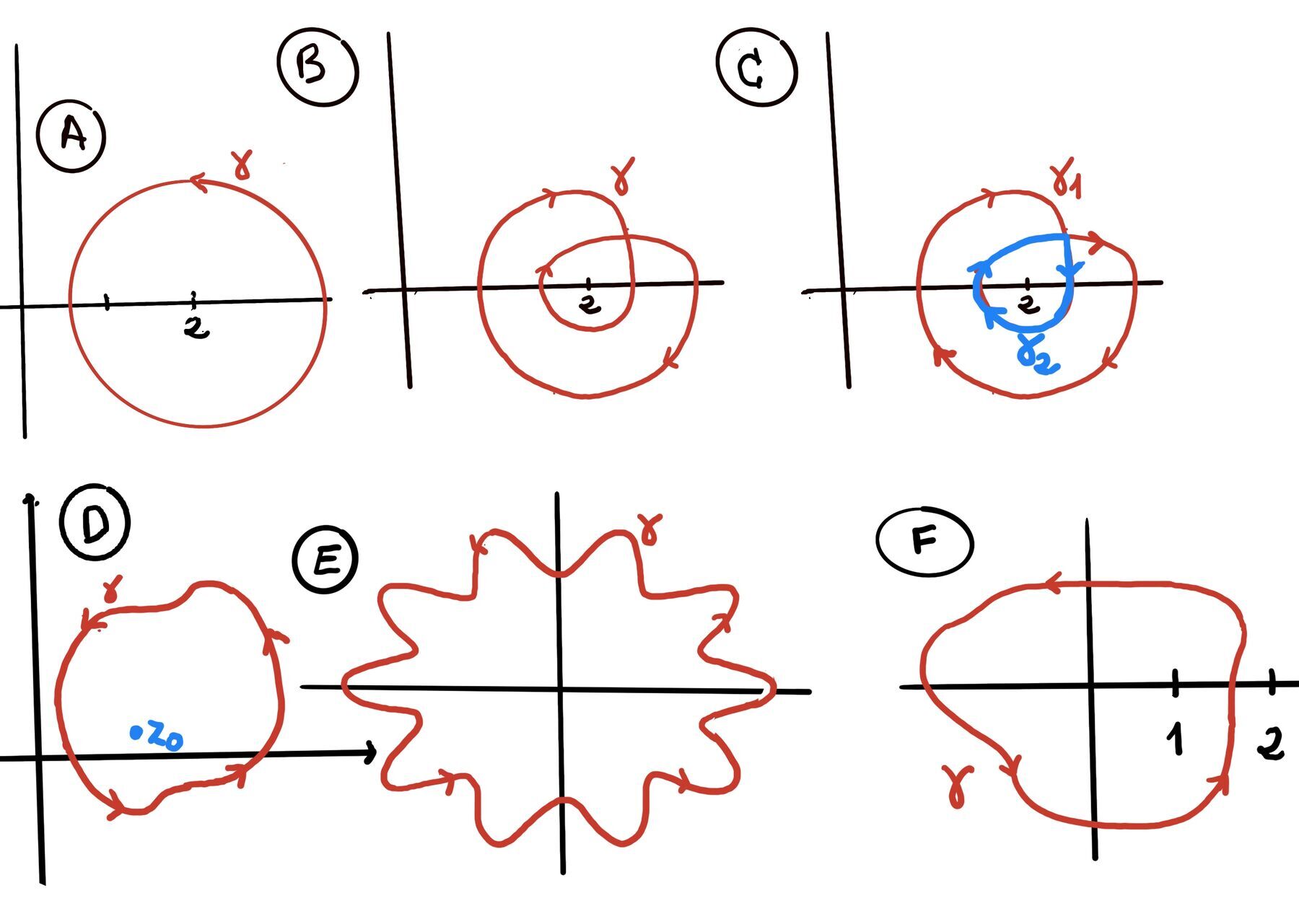
Deformation of Contours. If two contours $\gamma_1$ and $\gamma_2 $ are homotopic (i.e., one can be continuously deformed into the other without crossing any singularities of f) in a domain where f(z) is analytic, then: $\int_{\gamma_1} f(z)dz = \int_{\gamma_2} f(z)dz.$
Fundamental Theorem of Calculus for Contours. Suppose $\gamma$ is a contour (piecewise smooth path) from a to b, f is defined on a domain D containing $\gamma^*$ (the image of $\gamma$) and admits a primitive (antiderivative) F on D (i.e., $F'(z) = f(z)$), then $\int_{\gamma} f(z)dz = F(\gamma(b)) - F(\gamma(a))$. In particular, if $\gamma$ is a closed contour (i.e., $\gamma(a)=\gamma(b)$), this integral evaluates to zero, $\int_{\gamma} f(z)dz = 0.$
Estimation Theorem or the Triangle Inequality for Integrals. The triangle inequality for integrals in complex analysis states thatfor any continuous complex function $f:[a,b] \to \mathbb{C}$ on a closed real interval [a,b] (f(t) = u(t) + iv(t), t a real parameter), the following holds: $∣\int_a^b f(t)dt| \leq \int_a^b |f(t)|dt$.
Estimation Lemma (ML Inequality) for contour integrals. For any continuous complex function $f:[a,b] \to \mathbb{C}$ on a closed real interval [a,b] (f(z) = u(x, y) + iv(x, y)) with f bounded by some constant M along the entire contour, |f(z)| ≤ M for all $z \in \gamma^*$ (the image/trace of the contour in the complex plane), the following holds: $∣\int_\gamma f(z)dz| \leq M \cdot l(\gamma)$ where l(γ) is the arc length of the contour γ given by $\int_a^b |\gamma^{'}(t)|dt = \int_a^b \sqrt{x'(t)^2 + y'(t)^2}dt \text{ where } \gamma(t) = x(t) + iy(t)$.
In real-variable calculus, a function can be differentiable once, but fail to be differentiable a second time (for example, $f(x) = x|x|$ is differentiable everywhere, $f'(x) = 2|x|$, but $f''(0)$ does not exist). This theorem proves that complex analysis is entirely different: if a complex function is differentiable just once in an open set, it is infinitely smooth forever. This is one of the most striking rigidity phenomena in mathematics: holomorphic functions are, in a sense, “perfect.”
Theorem. Analyticity Implies Infinite Differentiability. Let $f$ be holomorphic (analytic) in an open set $G \subseteq \mathbb{C}$. Then:
Proof.
We know that $f$ is analytic in an open set $G$, which means its first derivative $f'(z)$ exists. We want to prove that its second derivative $f''(a)$ also exists for any arbitrary point $a$ inside $G$. If we can prove this, the logic loops infinitely: if $f'$ has a derivative, then $f'$ is analytic, which means its derivative ($f''$) must also be analytic, and so on.
Fix an arbitrary point $a$ inside our open set $G$. Because $G$ is open, we can draw a perfectly safe, positively oriented circular contour $\gamma$ centered at $a$ with a radius of 2r, ensuring the entire closed disk $\overline{B(a; 2r)}$ lies completely inside $G$.
Let $ \gamma=\partial B(a;2r)$ (positively oriented circle). Because f is analytic in G, Cauchy’s formula for the first derivative holds on $\operatorname{Int}\gamma$: $f'(z) = \frac{1}{2\pi i}\oint_{\gamma} \frac{f(w)}{(w-z)^2}dw$.
We will evaluate it at $a$ and at a slightly perturbed point $a+h$. We choose $h$ strictly such that $|h| < r$, trapping $a+h$ safely inside the contour.
We are going to apply the same reasoning as the previous proof:
$$ \begin{aligned} \frac{f'(a+h)-f'(a)}{h} &\text{ [We apply the Cauchy’s Integral Formula for the First Derivative to the points a + h and a] } \\[2pt] &=\frac{1}{2\pi i h} \left[ \oint_{\gamma} \frac{f(w)}{(w-a-h)^2}dw - \oint_{\gamma} \frac{f(w)}{(w-a)^2}dw \right] \\[2pt] &\text{Linearity Property of Contour Integrals} \\[2pt] &=\frac{1}{2\pi i h} \oint_{\gamma}\left[ \frac{f(w)}{(w-a-h)^2} - \frac{f(w)}{(w-a)^2} \right]dw \\[2pt] &\text{Combine the fractions inside the brackets using the common denominator} \\[2pt] &=\frac{1}{2\pi i h} \oint_{\gamma} \frac{f(w)}{(w-a-h)^2 (w-a)^2} [(w-a)^2 - (w-a-h)^2]dw \\[2pt] &\text{It simplifies to } A^2 - B^2 = (A-B)(A+B) = h[2(w-a)-h] \\[2pt] &=\frac{1}{2\pi i h} \oint_{\gamma} \frac{f(w)}{(w-a-h)^2 (w-a)^2} [(-h)^2 +2wh - 2ah]dw \\[2pt] &\text{The factor h cancels:} \\[2pt] &=\frac{1}{2\pi i} \oint_{\gamma} \frac{f(w)}{(w-a-h)^2 (w-a)^2} [-h +2w - 2a]dw \\[2pt] &=\frac{1}{2\pi i} \oint_{\gamma} \frac{f(w)}{(w-a-h)^2 (w-a)^2} [2w - 2a -2h + h]dw \\[2pt] &=\frac{1}{2\pi i} \oint_{\gamma}\left[ \frac{f(w) \cdot 2(w - a -h)}{(w-a-h)^2 (w-a)^2} + \frac{f(w)h}{(w-a-h)^2 (w-a)^2}\right]dw \\[2pt] &=\frac{1}{2\pi i} \oint_{\gamma} f(w)\left[ \frac{2}{(w-a-h) \cdot (w-a)^2} + \frac{h}{(w-a-h)^2 (w-a)^2}\right]dw \text{ (i) } \end{aligned} $$We strongly suspect the second derivative is going to be exactly what we get if we differentiate the Cauchy formula again $f''(a) = \frac{2}{2\pi i} \oint_{\gamma} \frac{f(w)}{(w-a)^3}dw$. To prove this, we subtract our expected formula from our actual difference quotient (i) and try to show that the “Error” difference shrinks to 0.
$$ \begin{aligned} |Error| &=|\frac{f'(a+h)-f'(a)}{h} -\frac{2}{2\pi i} \oint_\gamma \frac{f(w)}{(w-a)^3}dw| \\[2pt] &=\text{(i)} \\[2pt] &=|\frac{1}{2\pi i} \oint_{\gamma} f(w)\left[ \frac{2}{(w-a-h) \cdot (w-a)^2} + \frac{h}{(w-a-h)^2 (w-a)^2} -\frac{2}{(w-a)^3} \right]dw| \\[2pt] &\text{Combine the fractions inside the brackets using the common denominator} \\[2pt] &=|\frac{1}{2\pi i} \oint_{\gamma} f(w)\left[ \frac{2(w-a) -2(w-a-h)}{(w-a-h) \cdot (w-a)^3} + \frac{h}{(w-a-h)^2 (w-a)^2} \right]dw| \\[2pt] &=|\frac{1}{2\pi i} \oint_{\gamma} f(w)\left[ \frac{2h}{(w-a-h) \cdot (w-a)^3} + \frac{h}{(w-a-h)^2 (w-a)^2} \right]dw| \\[2pt] &\text{Combine the fractions inside the brackets using the common denominator and move h outside the integral} \\[2pt] &=|\frac{h}{2\pi i} \oint_{\gamma} f(w)\left[ \frac{2(w-a-h)+(w-a)}{(w-a-h)^2 \cdot (w-a)^3}\right]dw| \end{aligned} $$Bounding the Error with ML-Estimation.
We must prove that as $h \to 0$, the absolute value of this Error integral is forced to zero. We apply the ML-Inequality ($| \oint f(z) dz | \le \text{Max}(|f|) \cdot \text{Length}$).
Plugging all of our maximum numerators and minimum denominators into the Error formula gives the absolute upper bound:
$0 \le |\frac{f'(a+h)-f'(a)}{h} -\frac{2}{2\pi i} \oint_\gamma \frac{f(w)}{(w-a)^3}dw| \le \frac{2M}{r^3}|h|$
Since $M$ and $r$ are fixed constants, as $h \to 0$, the upper bound $\frac{2M}{r^3}|h|$ approaches or collapses to $0$. $\lim_{h \to 0} \frac{2M}{r^3}|h| = \lim_{h \to 0} 0 = 0 \leadsto[\text{By the Squeeze Theorem, the Error itself must equal 0}]$
$\lim_{h \to 0} |\frac{f'(a+h)-f'(a)}{h} -\frac{2}{2\pi i} \oint_\gamma \frac{f(w)}{(w-a)^3}dw| = 0 \leadsto \lim_{h \to 0} \frac{f'(a+h)-f'(a)}{h} -\frac{2}{2\pi i} \oint_\gamma \frac{f(w)}{(w-a)^3}dw = 0$.
Since $\frac{2}{2\pi i} \oint_\gamma \frac{f(w)}{(w-a)^3}dw$ is constant related to h, the second derivative exists, and its value is $f''(a) = \frac{2}{2\pi i}\oint_\gamma \frac{f(w)}{(w-a)^3}dw$
Since $f''(a)$ exists for an arbitrary point $a \in G$, $f'(z)$ is differentiable on $G$, meaning $f'$ is analytic in $G$. (This proves part (i)).
We normally use the following notation: $f''(z) = \frac{2!}{2\pi i}\oint_\gamma \frac{f(w)}{(w-z)^3}dw, \forall z \in \mathcal{Int}(\gamma)$
(ii) We proved that if f is analytic in G then f’ is analytic in G by (i). Since f’ is analytic in G, we can replace f by f’ in the previous statement, so f’’ is analytic in G, and we can continue this process indefinitely (infinite induction), so f is infinitely differentiable in G.
Furthermore, the same Cauchy integral argument at each stage yields the general formula: $\boxed{f^{(n)}(a) = \frac{n!}{2\pi i}\oint_\gamma \frac{f(w)}{(w-a)^{n+1}}\,dw}$ for any $n \geq 0$ and any circle $\gamma$ centered at $a$ with $\overline{B(a; R)} \subset G$. $\quad\square$
From the formula $f^{(n)}(a) = \frac{n!}{2\pi i}\oint_\gamma \frac{f(w)}{(w-a)^{n+1}}\,dw$ with $\gamma$ the circle of radius $R$, applying the ML inequality:
$$|f^{(n)}(a)| \leq \frac{n!}{2\pi}\cdot\frac{M}{R^{n+1}}\cdot 2\pi R = \frac{n!\,M}{R^n},$$where $M = \max_{|w-a|=R}|f(w)|$. This is Cauchy’s inequality, which bounds derivatives of holomorphic functions and leads directly to Liouville’s theorem.
The ML-inequality states: $\left|\oint_\gamma g(w)\,dw\right| \leq M \cdot L$ where $M = \max_{w \in \gamma}|g(w)|$ and $L = \text{length}(\gamma)$. $\left|f^{(n)}(a)\right|\leq \frac{n!}{2\pi} \cdot \underbrace{\frac{M}{R^{n+1}}}_{\text{bound on } |g(w)|} \cdot \underbrace{2\pi R}_{\text{length}}$
Liouville’s theorem. A bounded entire function is constant.
Suppose $|f(z)| \leq M$ for all $z \in \mathbb{C}$. Apply Cauchy’s inequality with $n=1$ at any point $a$: $|f'(a)| \leq \frac{M}{R}$.
This holds for any $R > 0$. Let $R \to \infty$: $|f'(a)| \leq \lim_{R\to\infty}\frac{M}{R} = 0$
So $f'(a) = 0$ for all $a \in \mathbb{C}$, hence $f$ is constant. $\square$
Since all derivatives exist, $f$ has a Taylor series at every point $a \in G$: $\boxed{f(z) = \sum_{n=0}^{\infty}\frac{f^{(n)}(a)}{n!}(z-a)^n,}$ and this series converges to $f(z)$ on the largest open disk centered at $a$ contained in $G$. In complex analysis, “holomorphic” and “analytic” (representable by a convergent power series) are equivalent — a fact that fails spectacularly in real analysis.
$$\frac{1}{w-z} = \frac{1}{w-a}\cdot\frac{1}{1-\frac{z-a}{w-a}} = \frac{1}{w-a}\sum_{n=0}^{\infty}\left(\frac{z-a}{w-a}\right)^n$$This converges uniformly for $|z-a| < |w-a| = R$. Substitute into: $f(z) = \frac{1}{2\pi i}\oint_{C_R}\frac{f(w)}{w-z}\,dw = \sum_{n=0}^{\infty}\left(\frac{1}{2\pi i}\oint_{C_R}\frac{f(w)}{(w-a)^{n+1}}\,dw\right)(z-a)^n$
The coefficient is exactly $\frac{f^{(n)}(a)}{n!}$ by the generalized Cauchy Integral Formula.
The real and imaginary parts $u = \operatorname{Re}(f)$, $v = \operatorname{Im}(f)$ are not just $C^\infty$ — they are real-analytic (expressible as convergent real power series in $x$ and $y$). They are also harmonic: $\nabla^2 u = \nabla^2 v = 0$.
$f(z) = e^z$ is entire. Its derivatives are $f^{(n)}(z) = e^z$ for all $n$ — an infinite sequence of holomorphic functions, all equal.
$f(z) = \frac{1}{1-z}$ is holomorphic on $\mathbb{C}\setminus\{1\}$. Its derivatives are $f^{(n)}(z) = \frac{n!}{(1-z)^{n+1}}$, all holomorphic on the same domain.
$f'(z)=\frac{1}{(1-z)^2}. f''(z)=\frac{2}{(1-z)^3}. f^{(n)}(z)=\frac{n!}{(1-z)^{n+1}}$
Real counterexample. The function $f(x) = e^{-1/x^2}$ (with $f(0) = 0$) is $C^\infty$ on $\mathbb{R}$ and all its derivatives at $x = 0$ are zero: $f^{(n)}(0) = 0$ for all $n$. However, $f$ is not identically zero near $0$, so its Taylor series (which is identically $0$) does not converge to $f$. This function is $C^\infty$ but not real-analytic. No such pathology exists in complex analysis: a holomorphic function always equals its Taylor series.
A sequence of holomorphic functions $\{ f_n \}$ on a domain $G \subset \mathbb{C}$ such that $f_n \to f$ converges uniformly on compact subsets of G (i.e., $\forall K \subset G$, K compact and every $\varepsilon \gt 0, \exist N, \text{ s.t. } n \ge N \implies |f_n(z) -f(z)| \lt \varepsilon, \forall z \in K$), then $f$ is holomorphic (by Morera’s theorem). By the theorem above, $f$ is then automatically $C^\infty$. Moreover, $f_n^{(k)} \to f^{(k)}$ uniformly on compact subsets for every $k$ — uniform convergence of holomorphic functions propagates to all derivatives.
Proof.
Morera’s Theorem: If $f$ is continuous on a domain $G$ and $\oint_\gamma f(z)\, dz = 0$ for every closed triangle $\gamma \subset G$, then $f$ is holomorphic on $G$.
Holomorphic functions are infinitely differentiable and even real‑analytic. The moment we know f is holomorphic, the entire Cauchy‑theoretic machinery becomes available.
For any closed curve $\gamma$ around z: $\boxed{f^{(k)}(z)=\frac{k!}{2\pi i}\oint _{\gamma }\frac{f(w)}{(w-z)^{k+1}}\, dw.}$ This important result gives:
Furthermore, uniform convergence propagates to derivatives. If $f_n\rightarrow f$ uniformly on compact sets and each $f_n$ is holomorphic, then $f_n^{(k)}\rightarrow f^{(k)}$ uniformly on compact sets for every $k\geq 0$. 🌟 Holomorphicity is stable under uniform convergence on compact sets.

JustToThePoint Copyright © 2011 - 2026 Anawim. ALL RIGHTS RESERVED. Bilingual e-books, articles, and videos to help your child and your entire family succeed, develop a healthy lifestyle, and have a lot of fun. Social Issues, Join us.
This website uses cookies to improve your navigation experience.
By continuing, you are consenting to our
use of cookies, in accordance with our Cookies Policy and
Website Terms and Conditions of use.