
|
 |

|
|
|
|
|
|
I’d far rather be happy than right any day, Douglas Adams, The Hitchhiker’s Guide to the Galaxy

When a $2 \times 2$ matrix $A$ is diagonalizable, the general solution to the system $\vec{x}' = A\vec{x}$ is: $\vec{x}(t) = c_1 e^{\lambda_1 t}\vec{v_1} + c_2 e^{\lambda_2 t}\vec{v_2}$ where:
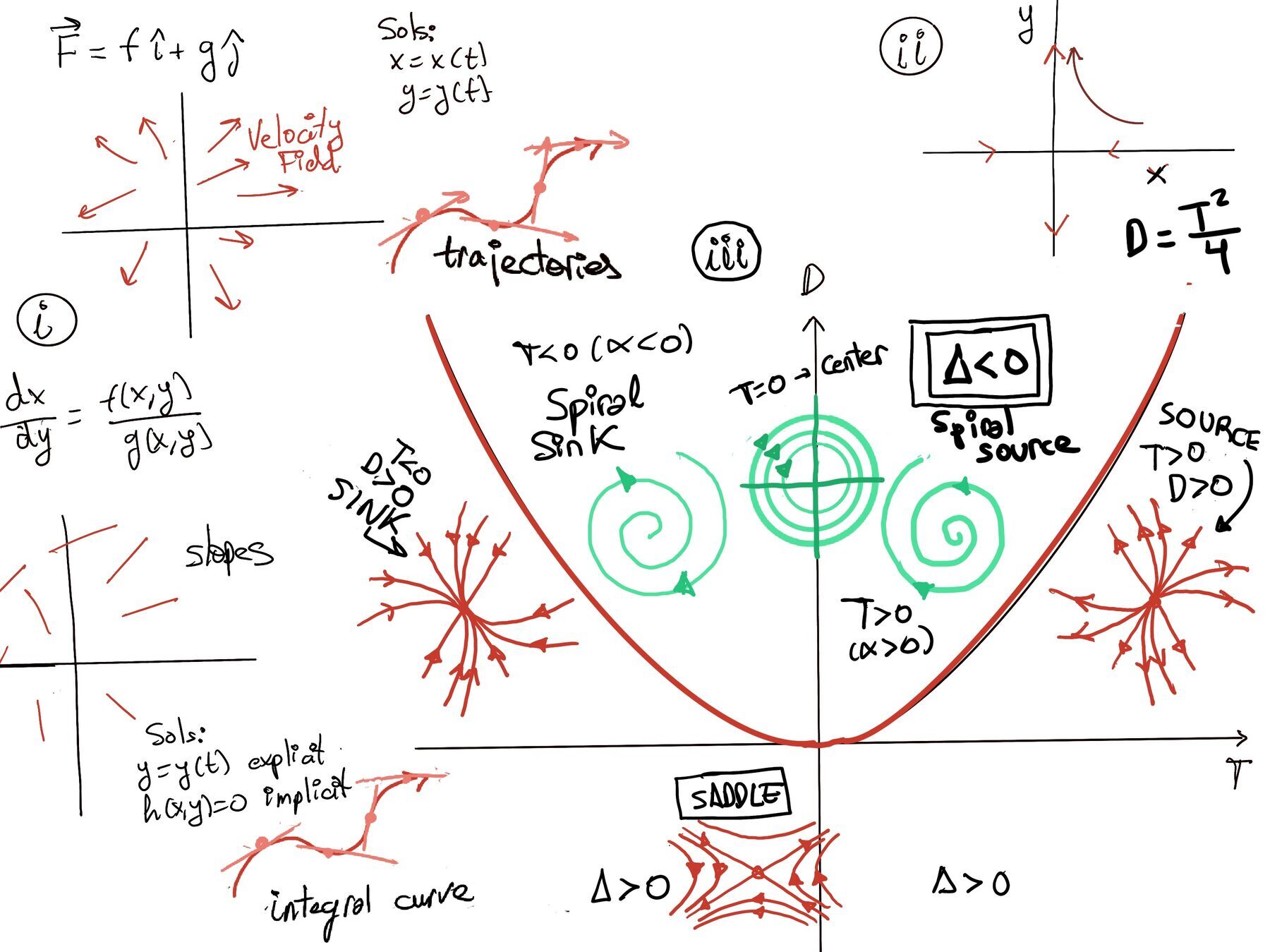
Depending on the nature of the eigenvalues, the equilibrium point at the origin $(0,0)$ can be classified into several distinct geometric categories:
Nodes (Real Eigenvalues, Same Sign).
$\star$ Stable Node: Both eigenvalues are real and negative ($\lambda_1, \lambda_2 < 0$). Trajectories approach the equilibrium.
$\star$ Unstable Node: Both eigenvalues are real and positive ($\lambda_1, \lambda_2 > 0$). Trajectories move away from the equilibrium.
$\star$ Improper (Degenerate) Node: Repeated real eigenvalues. Depending on whether the matrix has a full set of eigenvectors (a “star” node) or is defective, trajectories either move radially or shear as they approach/recede.
Saddle Points (Real Eigenvalues, Opposite Signs).
Eigenvalues are real with opposite signs ($\lambda_1 < 0 < \lambda_2$). Solutions approach the equilibrium along one eigenvector (the stable direction) and depart along another eigenvector (the unstable direction).
Spirals (Complex Eigenvalues, Non-zero Real Part).
$\star$ Stable Spiral: Real part is negative ($\alpha < 0$); solutions spiral inwards, decaying into the equilibrium.
$\star$ Unstable Spiral: Real part is positive ($\alpha > 0$); solutions spiral outwards, growing away from the equilibrium.
Centers (Purely Imaginary Eigenvalues)
Eigenvalues are purely imaginary ($\alpha = 0$). Solutions form closed orbits (ellipses or circles). The system exhibits neutral stability, meaning trajectories neither converge to nor diverge from the origin.
In the study of $2 \times 2$ linear systems of differential equations, a crucial scenario occurs when the coefficient matrix has two distinct real eigenvalues. We start with the general form of a linear system $\vec{x}' = A\vec{x}$, where $A$ is a constant coefficient matrix, and $\vec{x}(t) = \begin{pmatrix} x(t) \\ y(t) \end{pmatrix}$.
Consider a system where $A$ has distinct real eigenvalues $\lambda$ and $\mu$. In the simplest (canonical) case where $A$ is already diagonal, it can be written as: $A = \begin{pmatrix} \lambda & 0 \\ 0 & \mu \end{pmatrix}$
In this special case, the equations decouple completely: $\begin{cases} x' = \lambda x \\ y' = \mu y \end{cases}$
The general solution provided assumes that the system is decoupled, meaning that the equations for x and y do not depend on each other. For a system with distinct real eigenvalues λ and μ, the general solution is: $\vec{x}(t) = c_1e^{λt}\vec{v_1} + c_2e^{μt}\vec{v_2}$ where $\vec{v_1}$ and $\vec{v_2}$ are eigenvectors corresponding to λ and μ, respectively.
Because the system is perfectly decoupled, the equation for $x$ does not depend on $y$, and vice versa.
Solving $x' = \lambda x \implies \frac{dx}{dt} = \lambda x \implies \int \frac{dx}{x} = \int \lambda \, dt \implies \ln|x| = \lambda t + C' \implies x(t) = C_1 e^{\lambda t}$. Analogously, $y(t) = C_2 e^{\mu t}$.
If $x_0$ and $y_0$ are the initial conditions at $t = 0$, we substitute them to find $C_1 = x_0$ and $C_2 = y_0$. The general solution simplifies beautifully to:
$$\begin{cases} x(t) = x_0 e^{\lambda t} \\ y(t) = y_0 e^{\mu t} \end{cases}$$This form clearly shows how each solution component evolves independently over time along the principal axes.
Based on the signs of $\lambda$ and $\mu$, there are three cases to consider:
Both eigenvalues are positive ($\lambda > 0, \mu > 0$). Both $e^{\lambda t}$ and $e^{\mu t}$ grow exponentially as $t$ increases. Solutions and trajectories move away from the origin in all directions.
The origin is an unstable Node (source) because trajectories diverge from it. In other words, the origin repels trajectories.
Both eigenvalues are negative ($\lambda < 0, \mu < 0$). Both $e^{\lambda t}$ and $e^{\mu t}$ decay exponentially as t increase. Solutions or trajectories move toward the origin.
The origin is a stable Node (sink) because trajectories converge to it. In other words, the origin attracts all trajectories.
Eigenvalues of Opposite Signs ($\lambda > 0$ and $\mu < 0$). Mixed behavior. The component $x(t) = x_0 e^{\lambda t}$ grows exponentially, while $y(t) = y_0 e^{\mu t}$ decays exponentially.
Solutions or trajectories approach the origin along one direction (y-axis where x = 0, the stable manifold) and move away in another (x-axis where y = 0, the instable manifold). The origin is a saddle point because it’s stable in one direction and unstable in the other.
The origin is unstable, with trajectories approaching along the stable manifold and departing along the unstable manifold.
This situation arises when the discriminant of the characteristic equation is precisely zero, i.e., $T^2 - 4D = 0$.
For a $2 \times 2$ matrix $A$, this forces a single repeated real eigenvalue: $\lambda = \frac{T \pm \sqrt{T^2 - 4D}}{2} = \frac{T}{2}$
$A = \lambda I = \begin{pmatrix} \lambda & 0 \\ 0 & \lambda \end{pmatrix}$
Every non-zero vector is an eigenvector. We can choose the standard basis vectors. The solution is: $\boxed{\begin{pmatrix} x(t) \\ y(t) \end{pmatrix} = c_1 e^{\lambda t} \begin{pmatrix} 1 \\ 0 \end{pmatrix} + c_2 e^{\lambda t} \begin{pmatrix} 0 \\ 1 \end{pmatrix}}$
Because both components scale identically by $e^{\lambda t}$, trajectories move in perfectly straight lines radially toward or away from the origin. This forms a Star Node. Stable if $\lambda < 0$, Unstable if $\lambda > 0$.
$A = \begin{pmatrix} \lambda & 1 \\ 0 & \lambda \end{pmatrix}$
There is only one linearly independent eigenvector. The general solution includes an extra polynomial $t$ term to account for the missing eigenvector: $\boxed{\begin{pmatrix} x(t) \\ y(t) \end{pmatrix} = (c_1 \vec{v} + c_2(t\vec{v} + \vec{w})) e^{\lambda t}}$
Because of the linear $t$ term multiplying the exponential, trajectories exhibit a distinct shearing (because the linear component t acts as a pulling force that grows over time), parabolic curve as they approach or leave the origin. This forms an Improper (Degenerate) Node. Stable if $\lambda < 0$, Unstable if $\lambda > 0$.
When the trace is strictly zero ($T = 0$) and the determinant is positive ($D > 0$), the eigenvalues simplify to: $\lambda = \frac{T±\sqrt{T^2-4D}}{2} = \frac{±\sqrt{-4D}}{d}= \pm i\sqrt{D}$
Centers correspond to systems with purely imaginary eigenvalues.
When analyzing centers, the real part of the eigenvalues ($\alpha$) is exactly zero. The eigenvalues take the form $\lambda = \pm i\omega$, where $\omega = \sqrt{D}$. For $\Delta$ to be strictly negative while $T=0$, $D$ must be positive ($D > 0$).
Because $T = 0 \implies \alpha = 0$, there is no exponential growth or decay ($e^{0} = 1$). Solutions rely entirely on the oscillatory sine and cosine functions. Trajectories form perfectly closed orbits (circles or ellipses) around the equilibrium point. Systems with purely imaginary eigenvalues exhibit center behavior. The origin neither attracts nor repels trajectories; it is neutrally stable.
Relationship Between Trace, Determinant, and Eigenvalues
We can unify all these distinct cases by expressing the eigenvalues entirely in terms of the Trace ($T = \lambda_1 + \lambda_2$) and Determinant ($D = \lambda_1 \cdot \lambda_2$).
$$\lambda = \frac{T \pm \sqrt{T^2 - 4D}}{2} \quad \text{with discriminant} \quad \Delta = T^2 - 4D$$Let’s examine different scenarios by rigorously analyzing the signs and inequalities of $T$ and $D$:
$D < 0$ (Saddle Point): If $D$ is negative, then $\Delta = T^2 - 4D = T^2 + 4|D|$. Therefore, $\Delta > T^2$, which strictly implies $\sqrt{\Delta} > |T|$.
Because the square root of the discriminant is larger than the absolute value of the trace, adding it to $T$ produces a positive number, and subtracting it produces a negative number:
One positive and one negative eigenvalue guarantees a Saddle Point.
Whenever $D < 0$, the eigenvalues mathematically must have opposite signs. The origin is a Saddle Point, absolutely regardless of the value of $T$.
$T > 0$ and $D > 0$ (Unstable Node): Here, $\Delta = T^2 - 4D$. Assuming $\Delta > 0$ (real eigenvalues), we know $\Delta < T^2$ because we are subtracting a positive number ($4D$). This means $\sqrt{\Delta} < T$.
Both $\lambda_1$ and $\lambda_2$ are strictly positive. The origin is an Unstable Node (Source).
$T < 0$ and $D > 0$ (Stable Node): Again, assuming $\Delta > 0$, we have $\Delta < T^2$, which means $\sqrt{\Delta} < |T| = -T$.
$\lambda_1 = \frac{T + \sqrt{\Delta}}{2} < \frac{T + (-T)}{2} = 0, \lambda_2 = \frac{T - \sqrt{\Delta}}{2} < 0$
Both eigenvalues are strictly negative. The origin is a Stable Node (Sink).
If $D$ is large enough that $\Delta = T^2 - 4D < 0$, the discriminant is negative, guaranteeing complex conjugate eigenvalues $\lambda = \alpha \pm i\beta$.
Because the Real Part ($\alpha$) is directly proportional to the trace ($T = 2\alpha$), classification is trivial:

JustToThePoint Copyright © 2011 - 2026 Anawim. ALL RIGHTS RESERVED. Bilingual e-books, articles, and videos to help your child and your entire family succeed, develop a healthy lifestyle, and have a lot of fun. Social Issues, Join us.
This website uses cookies to improve your navigation experience.
By continuing, you are consenting to our
use of cookies, in accordance with our Cookies Policy and
Website Terms and Conditions of use.