
|
 |

|
|
|
|
|
|
Whoever fights monsters should see to it that in the process he does not become a monster. And when you look long into an abyss, the abyss also looks into you, Friedrich Nietzsche.

Convolution is a powerful mathematical operation that blends two functions together to produce a third function. It is widely used in engineering, physics, signal processing, and applied mathematics to analyze systems and solve differential equations.
The convolution of two functions $f(t)$ and $g(t)$ is denoted by $(f * g)(t)$ and is defined by the integral $\boxed{(f * g)(t) = \int_{0}^{t} f(u)g(t-u) du}$
Consider an undamped mass-spring system where the mass $m=1$ is attached to a spring ($k=1$). The mass is released from a displacement of $1$ with zero initial velocity.
At exactly time $t = \frac{\pi}{2}$, we strike the mass with a hammer (or “kicked”) imparting an impulse of magnitude $A$. This can be expressed mathematically using the Dirac delta function $Aδ(t-\frac{π}{2})$, which models the instantaneous application of force at $t = \frac{\pi}{2}$.
The Initial Value Problem is as follows:
The goal is to solve the differential equation that governs the motion of the system using the Laplace Transform.
Therefore, the model that control our motion is $y'' + y = Aδ(t-\frac{π}{2})$
Take the Laplace Transform. Apply the transform to both sides.
Recall the standard Laplace Transform rules: $\mathcal{L}(y'') = s^2Y(s) −sy(0) −y'(0), \mathcal{L}(y) = Y(s), \mathcal{L}(Aδ(t-\frac{π}{2})) = Ae^{\frac{-π}{2}s}$, the model’s equation Laplace Transform is $s^2Y -s +Y = Ae^{\frac{-π}{2}s}$.
$(s^2Y(s) - sy(0) - y'(0)) + Y(s) = \mathcal{L}\left\{A\delta\left(t - \frac{\pi}{2}\right)\right\}$
Substitute the initial conditions and transform the delta function: $(s^2Y(s) - s \cdot 1 - 0) + Y(s) = A e^{-\frac{\pi}{2}s}$.
Simplify, $s^2Y(s) - s + Y(s) = A e^{-\frac{\pi}{2}s}$
Solve for $Y(s)$
Group the $Y(s)$ terms: $Y(s)(s^2 + 1) - s = A e^{-\frac{\pi}{2}s}$
$Y(s)(s^2 + 1) = s + A e^{-\frac{\pi}{2}s}$
$Y(s) = \frac{s}{s^2 + 1} + A \frac{e^{-\frac{\pi}{2}s}}{s^2 + 1}$
Apply the Inverse Laplace Transform. We now take the Inverse Laplace Transform to find y(t) in the time domain. The expression for Y(s) consists of two terms that we can invert separately.
We recognize two standard forms here: $\mathcal{L}^{-1}\left\{\frac{s}{s^2 + 1}\right\} = \cos(t)$ and $\mathcal{L}^{-1}\left\{\frac{1}{s^2 + 1}\right\} = \sin(t)$. With the $e^{-\frac{\pi}{2}s}$ term, we must apply the Time-Shifting Theorem, $\boxed{e^{-as}F(s) \leadsto_{\mathcal{L}^{-1}} u(t-a)f(t-a)}$.
Taking the inverse transform of the entire equation yields: $y(t) = \cos(t) + A \cdot u\left(t - \frac{\pi}{2}\right)\sin\left(t - \frac{\pi}{2}\right)$
Interpret and Simplify
Using the trigonometric shift identity $\sin(t - \frac{\pi}{2}) = -\cos(t)$, we can simplify our solution: $y(t) = \cos(t) - A \cdot u\left(t - \frac{\pi}{2}\right)\cos(t)$
$sin(t-\frac{π}{2}) = sin(t)cos(\frac{π}{2}) -cos(t)sin(\frac{π}{2}) = sin(t)·0 -cos(t)·1 = -cos(t)$
$y = \begin{cases} cos(t), &0 ≤ t ≤ π/2 \\\\ cost(t) -Acos(t), &t ≥ π/2 \end{cases}$
$y = \begin{cases} cos(t), &0 ≤ t ≤ π/2 \\\\ (1 - A)cos(t), &t ≥ π/2 \end{cases}$
Refer to Figure iii for a visual representation and aid in understanding it.
Physical Interpretation:
For $0 \le t < \frac{\pi}{2}$, the system oscillates naturally with displacement $y(t) = \cos(t)$. The mass is moving toward equilibrium. No external force has been applied yet.
At exactly $t = \frac{\pi}{2}$, the hammer strikes. The step function turns “on,” instantaneously adding the $-A \cos(t)$ term to the system’s trajectory. The amplitude of the oscillation is violently and permanently altered by the impulse! The system continues to oscillate, but the amplitude is altered due to the impulse.
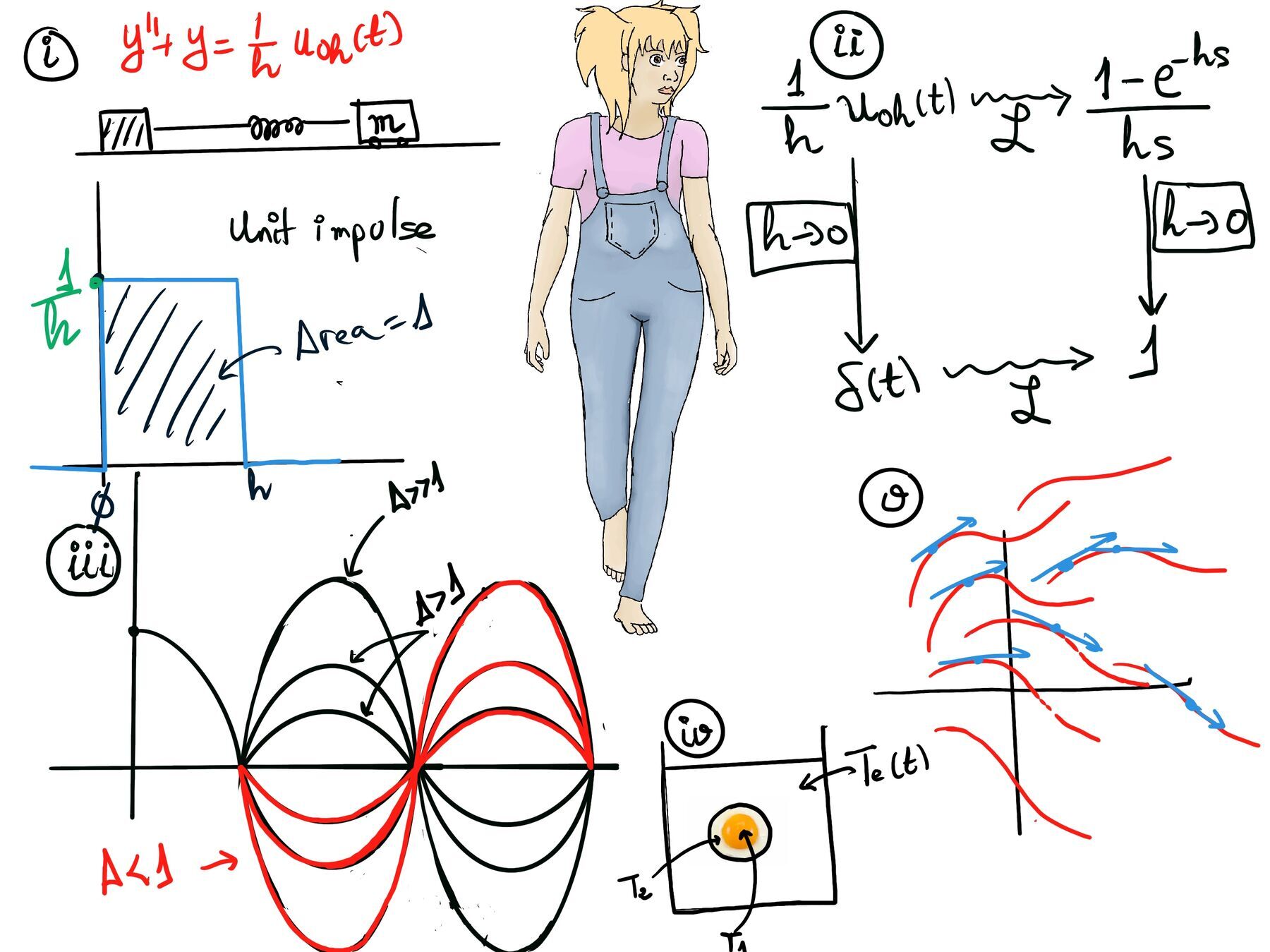
Consider an undamped mass-spring system where:
Suppose the system starts from rest ($y(0) = 0, y'(0) = 0$). We strike it with a unit impulse at $t = 0$, $t = \pi$, $t = 2\pi$, and so on. These periodic impulses are modeled using an infinite sum of Dirac delta functions: $\sum_{n=0}^{\infty} \delta(t - n\pi)$.
Therefore, the differential equation governing the motion of the system is: $y'' + y = \sum_{n=0}^\infty \delta(t - n\pi)$ with initial conditions y(0) = y’(0) = 0. These conditions indicate that the system starts from rest with no initial displacement or velocity.
The goal is to solve the differential equation that governs the motion of the system using the Laplace Transform.
Using the standard Laplace Transform rules: $\mathcal{L}(y'') = s^2Y(s) −sy(0) −y'(0), \mathcal{L}(y) = Y(s), \mathcal{L}(δ(t-a)) = e^{-as}$, the model’s equation Laplace Transform is $\mathcal{L}(y'')+\mathcal{L}(y) = \mathcal{L}(\sum_{n=0}^\infty δ(t-nπ)) ↭ s^2Y(s) + Y(s) = \sum_{n=0}^\infty e^{-nπs} ↭ (s^2+1)Y(s) = \sum_{n=0}^\infty e^{-nπs}$.
Then, we solve for Y(s), $Y(s) = \sum_{n=0}^\infty \frac{e^{-nπs}}{s^2+1}$.
Recall the Time-Shifting Theorem $u(t-a)f(t-a) \leadsto_{\mathcal{L}^{-1}} e^{-as}F(s)$, where F(s) = $\frac{1}{s^2+1}, \mathcal{L}^{-1}(\frac{1}{s^2+1}) = f(t) = sin(t)$.
Applying this to each term in the infinite sum: $y(t) = \sum_{n=0}^{\infty} u(t - n\pi)\sin(t - n\pi)$
Recall the trigonometric shift identity: $\sin(t - n\pi) = (-1)^n\sin(t)$ (Because shifting a sine wave by $\pi$ flips it upside down).
$\sin(t −\pi) = −\sin(t), sin(t −2\pi) = \sin(t)$, and so on.
We can factor out the $\sin(t)$ from the sum: $y(t) = \sin(t) \sum_{n=0}^{\infty} (-1)^n u(t - n\pi)$
Let’s expand the first few terms of this sum to see the behavior clearly: $y(t) = \sin(t) \Big[ u(t) - u(t-\pi) + u(t-2\pi) - u(t-3\pi) + \dots \Big]$
This alternating sum of step functions acts as an ON/OFF switch for the sine wave!
For $t \in [0, \pi)$: Only $u(t)$ is active. $y(t) = \sin(t)$. The system oscillates naturally with displacement $y(t) = \sin(t)$. This is due to the initial impulse at t = 0.
For $t \in [\pi, 2\pi)$: $u(t)$ and $u(t-\pi)$ are both active. Their sum is $1 - 1 = 0$. So, $y(t) = 0$. The system is completely at rest! At $t = \pi$ a second impulse is applied that stops the oscillation.
For $t \in [2\pi, 3\pi)$: The third step function turns on ($1 - 1 + 1 = 1$). $y(t) = \sin(t)$. Another impulse is applied that restarts the oscillation. This pattern repeats.
💡 The Physical Intuition: Why does the kick at $t=\pi$ stop the motion? At $t=\pi$, the mass is exactly at the equilibrium point ($y=0$), but it is moving with a velocity of $y'(\pi) = \cos(\pi) = -1$. The unit impulse delivers a sudden change in velocity of exactly $+1$. The new velocity becomes $-1 + 1 = 0$. Because the mass is at $y=0$ with $v=0$, it sits perfectly still until the next kick at $t=2\pi$ starts it moving again! The system alternates between oscillating and being at rest due to the periodic impulses.
In this explanation, we will explore how to solve a general second-order linear differential equation using Laplace Transforms.
We begin by considering the following general second-order linear differential equation: $y'' + ay' + by = f(t)$ where:
Recall the following properties of the Laplace Transform: $\mathcal{L}(y''(t))=s^2Y(s)-sy(0)-y'(0) =[\text{Applying initial conditions}] s^2Y(s), \mathcal{L}(y'(t)) = sY(s)-y(0) = [\text{Applying initial conditions}] = sY(s), \mathcal{L}(y(t)) = Y(s), \mathcal{L}(f(t)) = F(s)$
The Laplace transform of the equation $y'' + ay' + by = f(t)$ is $s^2Y +aSY + bY = F(s)$. Combining like terms: $(s^2 +aS + b)Y = F(s)$.
Solve for Y: $Y(s) = F(s)·\frac{1}{s^2+as+b}$
The term $\frac{1}{s^2+as+b}$ is referred to as the Transfer function of the system, denoted by W(s) (or often H(s) in engineering). The transfer function is incredibly important: It completely characterizes how the system responds to inputs in the frequency domain, independent of what the actual input is.
$Y(s) = F(s) \cdot W(s)$, meaning Output = Input $\times$ Transfer Function.
The inverse Laplace transform of the transfer function, $\mathcal{L}^{-1}(\frac{1}{s^2+as+b}) = w(t)$ is called the weight function (or impulse response function).
The solution y(t) in the time domain can be found by taking the inverse Laplace Transform of Y(s).
By the Convolution Theorem, the inverse transform of a product $F(s)W(s)$ is the convolution of their time-domain functions: $y(t) = \mathcal{L}^{-1}\{F(s) \cdot W(s)\} = (f * w)(t)$
$y(t) = f(t)*w(t)$. Thus, the solution in the time domain can be written as a convolution between the input function f(t) and the weight function w(t).
By the definition of convolution, this is written as: $\boxed{y(t)= \int_{0}^{t} f(u)w(t-u)du}$
To understand what w(t) represents, consider the following scenario: we subject the system to a unit impulse δ(t), which is a sharp “hit” or “kick” (unit impulse) applied at t = 0. This is equivalent to solving the differential equation with a unit Dirac delta impulse at t = 0, meaning $f(t) = \delta(t)$.
Because $\mathcal{L}\{\delta(t)\} = 1$, the input $F(s) = 1$. Substitute this into our system equation: $Y(s) = 1 \cdot W(s) =[\text{The delta function acts as the identity under convolution}] W(s)$, and taking its inverse Laplace transform: $y(t) = w(t)$. Therefore, the the Impulse Response or weight function w(t) is the solution to the system when it is subjected to a unit impulse at t = 0 and starts from rest..
Besides, $\boxed{y(t)= \int_{0}^{t} f(u)w(t-u)du}$. The convolution integral tells us that the system’s response to any continuous input f(t) is simply the sum of infinitely many tiny, scaled impulse responses!

JustToThePoint Copyright © 2011 - 2026 Anawim. ALL RIGHTS RESERVED. Bilingual e-books, articles, and videos to help your child and your entire family succeed, develop a healthy lifestyle, and have a lot of fun. Social Issues, Join us.
This website uses cookies to improve your navigation experience.
By continuing, you are consenting to our
use of cookies, in accordance with our Cookies Policy and
Website Terms and Conditions of use.