
|
 |

|
|
|
|
|
|
Mathematics is not a careful march down a well-cleared highway, but a journey into a strange wilderness, where the explorers often get lost, W.S. Anglin.

The Laplace Transform of a function f(t), where t ≥ 0, is defined as $\mathcal{L}(f(t)) = \int_{0}^{∞} f(t)e^{-st}dt = F(s)$.
One of the most important properties of the Laplace Transform is linearity, which states: $\mathcal{L}(af(t)+bg(t)) = a\mathcal{L}(f(t))+b\mathcal{L}(g(t))$
The following table summarizes the most frequent mappings used in system analysis.
| Function | Laplace Transform |
|---|---|
| Unit Step, u(t) | $\mathcal{L}(u(t)) = \frac{1}{s}, s > 0$ |
| Exponential, $e^{at}$ | $\frac{1}{s - a}, s > a$ |
| Complex Exp $e^{(a + bi)t}$ | $\mathcal{L}(e^{(a + bi)t}) = \frac{1}{s - (a + bi)}, s > a$ |
| Cosine $\cos(\omega t)$ | $\mathcal{L}(\cos(\omega t)) = \frac{s}{s^2 + \omega^2}, s > 0$ |
| Sine $\sin(\omega t)$ | $\mathcal{L}(\sin(\omega t)) = \frac{\omega}{s^2 + \omega^2}, s > 0$ |
| Power, $t^n$ | $\mathcal{L}(t^n) = \frac{n!}{s^{n+1}}, s > 0$ |
| Delayed Step, $u(t-a)$ | $\mathcal{L}(u(t-a)) = \frac{e^{-as}}{s}, s > 0$ |
| Dirac Delta $\delta(t-a)$ | $\mathcal{L}(\delta(t-a)) = e^{-as}, a \geq 0$ |
| $\frac{1}{t}$ | $\mathcal{L}\left(\frac{1}{t}\right) = \text{not defined}$ |
| $e^{-bt} \cos(\omega t)$ | $\mathcal{L}(e^{-bt} \cos(\omega t)) = \frac{s + b}{(s + b)^2 + \omega^2}, s > -b$ |
| $e^{-bt} \sin(\omega t)$ | $\mathcal{L}(e^{-bt} \sin(\omega t)) = \frac{\omega}{(s + b)^2 + \omega^2}, s > -b$ |
| $e^{at}f(t)$ | $\mathcal{L}(e^{at}f(t)) = F(s-a)$ |
This is a fundamental result in Laplace Transform theory and is widely used in solving differential equations and analyzing systems.
Recall that the Laplace Transform of a function $f(t)$ is defined as: $\mathcal{L}\{f(t)\} = F(s) = \int_{0}^{\infty} f(t)e^{-st} dt$ (where $s$ is a complex number, typically with its real part $Re(s) > 0$ to ensure the integral converges).
For $f(t) = t^n$, the Laplace Transform becomes: $\mathcal{L}\{t^n\} = \int_{0}^{\infty} t^n e^{-st} dt$
Below are two distinct methods for evaluating this integral.
To compute this integral directly, we use the method of integration by parts: $\int u \, dv = uv - \int v \, du$.
💡 Strategy: Choose $u$ as a function that becomes simpler when differentiated (the polynomial $t^n$), and $dv$ as a function that remains manageable when integrated (the exponential $e^{-st}$). We will use this repeatedly to step the power of $t$ down to zero.
Step 1: Set up the parts. Let $u = t^n \implies du = nt^{n-1} dt$. Let $dv = e^{-st} dt \implies v = \frac{e^{-st}}{-s}$
Step 2: Apply the integration by parts formula (∫udv =[Part A] uv − [Part B] ∫vdu). $\int_{0}^{\infty} t^n e^{-st} dt = \left[ t^n \frac{e^{-st}}{-s} \right]_{0}^{\infty} - \int_{0}^{\infty} \left( \frac{e^{-st}}{-s} \right) nt^{n-1} dt$
Step 3: Evaluate the boundary term (the $uv$, [A] part).
Let’s look at the first term evaluated from $0$ to $\infty$: $\lim_{t \to \infty} \left( \frac{t^n e^{-st}}{-s} \right) - \left( \frac{0^n e^{-0}}{-s} \right)$
At $t \to \infty$: We evaluate $\lim_{t \to \infty} \frac{t^n}{-s e^{st}}$. Because $s > 0$, the exponential term $e^{st}$ grows significantly faster than the polynomial $t^n$. By applying L’Hôpital’s rule $n$ times, we can rigorously show that this limit goes to $0$.
At $t = 0$: $\left( \frac{0^n e^{-0}}{-s} \right) =[\text{n is a non-negative integer}] \frac{0\cdot 1}{-s} = 0$
Thus, the entire boundary term vanishes: $0 - 0 = 0$.
Step 4: Establish the recursive relation
We are left with just the integral term. Pulling the constants $n$ and $-s$ out of the integral yields: $\mathcal{L}\{t^n\} = \frac{n}{s} \int_{0}^{\infty} t^{n-1} e^{-st} dt$
Notice that the remaining integral is exactly the definition of the Laplace transform for $t^{n-1}$! This gives us our recursive relation: $\mathcal{L}\{t^n\} = \frac{n}{s} \mathcal{L}\{t^{n-1}\}$
Step 5: Unroll the recursion
We can apply (or unfold) this recursive formula repeatedly until we reach $t^0 = 1$: $\mathcal{L}\{t^n\} = \left(\frac{n}{s}\right) \left(\frac{n-1}{s}\right) \mathcal{L}\{t^{n-2}\}= \frac{n(n-1) \dots 1}{s^n} \mathcal{L}\{t^0\}$
Since $\mathcal{L}\{1\} = \frac{1}{s}$, we multiply it into the chain: $\mathcal{L}\{t^n\} = \frac{n!}{s^n} \cdot \frac{1}{s} = \boxed{\frac{n!}{s^{n+1}} \quad \text{for } s > 0}$
This result is fundamental and provides a direct way to compute the Laplace Transform of any non-negative integer power of t.
An alternative, elegant way to solve this is by utilizing the Gamma function, which is the continuous generalization of the factorial function.
The Gamma function is defined as: $\Gamma(z) = \int_{0}^{\infty} t^{z-1} e^{-t} dt \quad \text{for } Re(z) > 0$
We aim to demonstrate that $\Gamma(n+1) = n!$
If we evaluate $\Gamma(n+1)$, we get: $\Gamma(n+1) = \int_{0}^{\infty} t^n e^{-t} dt$
Using integration by parts ($u = t^n, dv = e^{-t} dt$), we get: $\Gamma(n+1) = \left[ -t^n e^{-t} \right]_{0}^{\infty} + n \int_{0}^{\infty} t^{n-1} e^{-t} dt$
Just like before (Method 1), the boundary term vanishes so we are left with: $\Gamma(n+1) = n \Gamma(n)$
Applying this recursively down to $\Gamma(1) = 1$ proves that $\Gamma(n+1) = n!$.
Evaluating the Laplace Transform
Now, let’s look back at our Laplace Transform integral: $\mathcal{L}\{t^n\} = \int_{0}^{\infty} t^n e^{-st} dt$
We can use $u$-substitution to make this look exactly like the Gamma function.
Let $u = st$. This means $t = \frac{u}{s}$, then differentiating gives $dt = \frac{du}{s}$
Substitute these into the integral: $\int_{0}^{\infty} \left( \frac{u}{s} \right)^n e^{-u} \left( \frac{du}{s} \right)$
Factor out the constants (all the $s$ terms in the denominator): $= \frac{1}{s^{n+1}} \int_{0}^{\infty} u^n e^{-u} du$
Notice that the remaining integral is exactly the definition of $\Gamma(n+1)$! $= \frac{1}{s^{n+1}} \Gamma(n+1)$
Since we proved earlier that $\Gamma(n+1) = n!$, we arrive at the exact same, fundamental result: $\mathcal{L}\{t^n\} = \frac{n!}{s^{n+1}}$
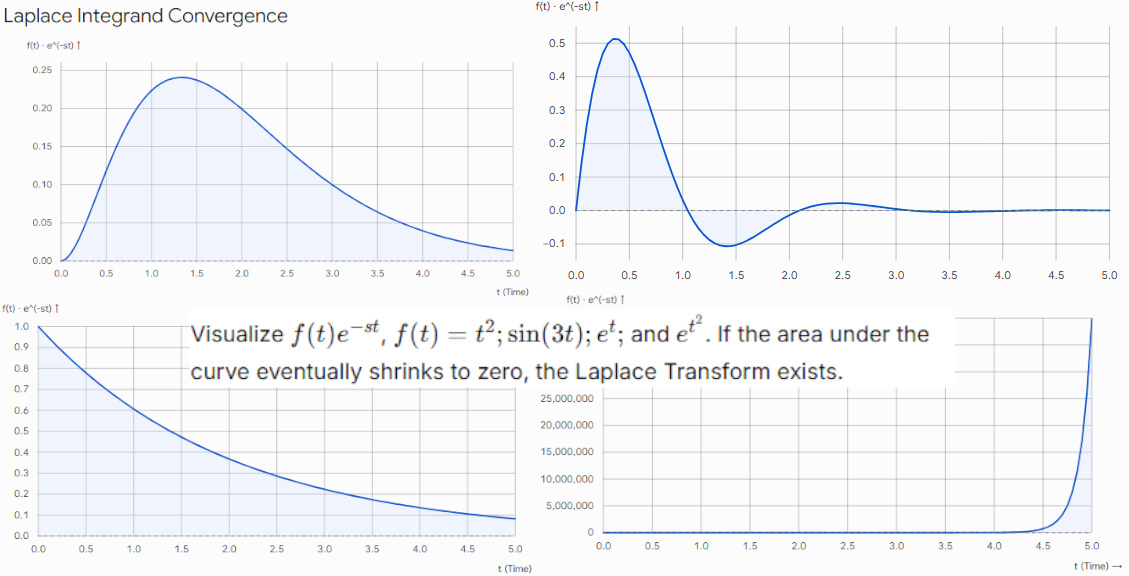
This is the core issue: the Laplace integral is essentially a “race to infinity” between the function $f(t)$ trying to grow and the damping factor $e^{-st}$ trying to crush it to zero.
Recall that the Laplace Transform of a function $f(t)$ is defined as an improper integral: $\mathcal{L}\{f(t)\} = F(s) = \int_{0}^{\infty} f(t)e^{-st} dt$
For this transform to exist, the integral must converge to a finite value. Because the integration goes to infinity, $f(t)$ cannot grow so rapidly that the exponential decay factor $e^{-st}$ is unable to overpower it.
Piecewise Continuity.
The function $f(t)$ must be piecewise continuous on the interval $[0, \infty)$.
This means $f(t)$ is continuous everywhere except for possibly a finite number of jump discontinuities in any finite interval. Crucially, it means $f(t)$ cannot have vertical asymptotes (infinite discontinuities) within the domain of integration
Exponential Order $\alpha$
A function $f(t)$ is said to be of exponential order $\alpha$ if it does not grow faster than a standard exponential function as $t \to \infty$.
Formally, there must exist real constants $M > 0$, $\alpha$, and $t_0 > 0$ such that: $|f(t)| \le M e^{\alpha t} \quad \text{for all } t \ge t_0$
If $f(t)$ satisfies this condition, the damping factor $e^{-st}$ can successfully force the integrand to zero, provided we choose an $s$ that is large enough ($s > \alpha$).
Let’s prove that if $f(t)$ is piecewise continuous and of exponential order $\alpha$, its Laplace Transform exists for $s > \alpha$.
We analyze the absolute value of the integral to test for absolute convergence: $|F(s)| = \left| \int_{0}^{\infty} e^{-st}f(t) dt \right| \le \int_{0}^{\infty} \left| e^{-st}f(t) \right| dt$
We split this integral into two parts, namely before $t_0$ and after $t_0$: $= \int_{0}^{t_0} |e^{-st}f(t)| dt + \int_{t_0}^{\infty} |e^{-st}f(t)| dt$
On a compact interval $[0,t_0]$, a piecewise continuous function has only finitely many jump discontinuities and is continuous on each subinterval. Each continuous piece is bounded, and a finite union of bounded pieces is bounded. The exponential factor is bounded on $[0,t_0]$. Product of bounded functions is bounded.
Conclusion: The Laplace Transform exists and is absolutely convergent for any $s > \alpha$.
The sine function oscillates between $-1$ and $1$, meaning it is strictly bounded: $|\sin(t)| \le 1$.
We can rewrite this as $|\sin(t)| \le 1 \cdot e^{0 \cdot t}$.
In this case, the sine function is of exponential type with $\alpha=0$ and $M=1$, indicating that it does not grow exponentially at all, so its Laplace Transform exists for all $s > 0$
For any positive $\alpha$, an exponential function will always eventually outgrow a polynomial. We can prove that $t^n$ is of exponential order by taking the limit of their ratio as $t \to \infty$: $\lim_{t \to \infty} \frac{t^n}{e^{\alpha t}}$
By applying L’Hôpital’s rule $n$ times, each differentiation reduces the degree of the numerator, it becomes a constant n! and the denominator remains an exponential function multiplied by a polynomial term, which still grows exponentially ($\alpha^n e^{\alpha t}$). $\lim_{t \to \infty} \frac{n!}{\alpha^n e^{\alpha t}} = 0$
Since the ratio goes to zero, $t^n$ is strictly bounded by $M e^{\alpha t}$ for sufficiently large $t$. Therefore, polynomials have a Laplace Transform for $s > 0$.
The function $f(t) = \frac{1}{t}$ does not fail the exponential order test as $t \to \infty$ (in fact, it shrinks to zero). It fails the piecewise continuity test at $t = 0$.
Because there is an infinite discontinuity (a vertical asymptote) right at the starting bound of the integral, the area under the curve near $t=0$ blows up to infinity. Therefore, the Laplace Transform of $\frac{1}{t}$, $\mathcal{L}\left\{\frac{1}{t}\right\}$, does not exist.
This is the classic example of a function that breaks the exponential order rule. Let’s look at the integrand: $f(t)e^{-st} = e^{t^2}e^{-st} = e^{t^2 - st} = e^{t(t-s)}$
As $t \to \infty, t(t-s) \gt 0$, so $f(t)e^{-st}$ grows with bond. The integrand blows up, the area is infinite, and thus, $\mathcal{L}\{e^{t^2}\}$ does not exist.
In practice, the exponential growth condition ensures that the Laplace Transform can handle a wide variety of useful functions, including polynomials, exponentials, and trigonometric functions, all of which appear frequently in solving differential equations and modeling physical systems.

JustToThePoint Copyright © 2011 - 2026 Anawim. ALL RIGHTS RESERVED. Bilingual e-books, articles, and videos to help your child and your entire family succeed, develop a healthy lifestyle, and have a lot of fun. Social Issues, Join us.
This website uses cookies to improve your navigation experience.
By continuing, you are consenting to our
use of cookies, in accordance with our Cookies Policy and
Website Terms and Conditions of use.