
|
 |

|
|
|
|
|
|
Arithmetic is where numbers fly like pigeons in and out of your head, Carl Sandburg.

The damped harmonic oscillator is a fundamental concept in physics and engineering. It describes systems where two primary forces act on an object:
These systems are prevalent in mechanical and electrical engineering, modeling phenomena like oscillating springs, RLC circuits, and even financial markets.
The general equation of motion is derived from Newton’s Second Law ($F = ma$): $mx'' + bx' + kx = F_{\text{ext}}(t)$ where
When there is no external driving force ($F_{\text{ext}} = 0$), the equation simplifies to the homogeneous case: $mx'' + bx' + kx = 0$. This is a second-order linear homogeneous differential equation that describes the motion of a damped oscillator without any external forces.
To solve this second-order linear homogeneous differential equation, we assume a solution of the form $x(t) = e^{st}$, where $s$ is a constant to be determined.
Substituting $x(t) = e^{st}$, $x'(t) = se^{st}$, and $x''(t) = s^2e^{st}$ into the equation yields: $m(s^2e^{st}) + b(se^{st}) + ke^{st} = 0$
Dividing both sides by $e^{st}$ (which is never zero) gives us the characteristic equation: $ms^2 + bs + k = 0$. $s^2+\frac{b}{m}s + \frac{k}{m} = 0 ↭[\text{Complete the square}] (s+\frac{b}{2m})^2 -(\frac{b}{2m})^2 = -\frac{k}{m} ↭ (s+\frac{b}{2m})^2 = (\frac{b}{2m})^2 -\frac{k}{m}$
Alternatively, using the quadratic formula to solve for $s$: $s = \frac{-b \pm \sqrt{b^2 - 4mk}}{2m} = -\frac{b}{2m} \pm \sqrt{\left(\frac{b}{2m}\right)^2 - \frac{k}{m}}$
The behavior of the physical system depends entirely on the discriminant under the square root: $\left(\frac{b}{2m}\right)^2 - \frac{k}{m}$.
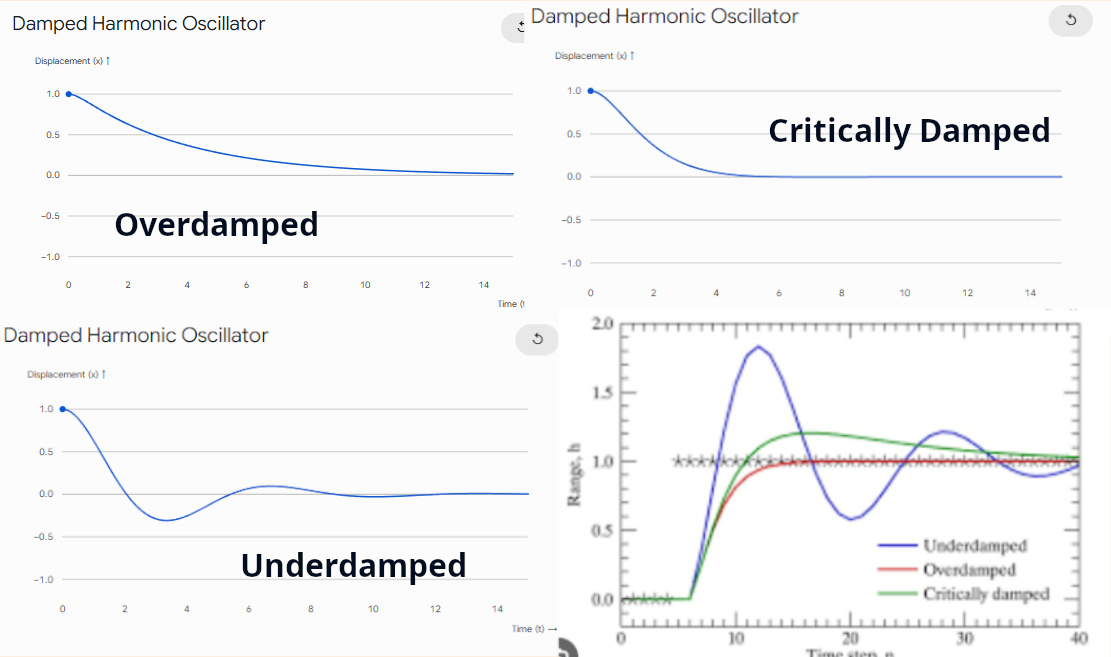
Underdamped systems ($\frac{k}{m}>(\frac{b}{2m})^2$). In this case, the system oscillates with a gradually decreasing amplitude due to damping because the roots of the characteristic equation are complex. The roots are: $s = \frac{-b}{2m}±iw_d$ where $\omega_d = \sqrt{\frac{k}{m}-(\frac{b}{2m})^2}$. This $\omega_d$ is the damped natural frequency.
Overdamped system ($\frac{k}{m}<(\frac{b}{2m})^2$). In this case, the roots of the characteristic equation are real and negative (s = $-\frac{b}{2m}±\sqrt{(\frac{b}{2m})^2-\frac{k}{m}} = -\frac{b}{2m}±\sqrt{\frac{b^2-4mk}{4m^2}} = \frac{-b±\sqrt{b^2-4mk}}{2m}$), meaning the system does not oscillate. Instead, it slowly returns to equilibrium without oscillating, more slowly than in the critically damped case.
Critically damped system ($\frac{k}{m}=(\frac{b}{2m})^2$). One real repeated root: $s = \frac{-b}{2m}$. This case represents the boundary between oscillatory and non-oscillatory motion. The system returns to equilibrium as quickly as possible without oscillating.
For the underdamped case, where the roots are complex $s = \frac{-b}{2m} ± i\omega_d, \omega_d = \sqrt{\frac{k}{m}-(\frac{b}{2m})^2}$, the general solution to the homogeneous equation is $x_h = Ae^{\frac{-bt}{2m}}cos(\omega_d t - \Phi)$ where:
To make the physics easier to analyze, engineers introduce these quantities:
Using this notation, our homogeneous equation $s^2+\frac{b}{m}s + \frac{k}{m} = 0$ becomes $x'' + 2\zeta \omega_nx' + \omega_n^2x = 0$, and we can rewrite the solution for the underdamped case: $\boxed{x_h = Ae^{\frac{-bt}{2m}}\cos(\omega_dt - \Phi) = Ae^{-\omega_n \zeta t}\cos(\omega_d t- \Phi)}$.
$\zeta = \frac{b}{2\omega_n m} \implies \frac{b}{m} = 2\zeta \omega_n$
$\boxed{x_h = Ae^{-\omega_n \zeta t}cos(\omega_d t- \Phi)}$ where $\omega_d = \omega_n\sqrt{1 -\zeta^2}$. This is the general form of the solution for an underdamped harmonic oscillator where:
The term $\omega_d = \omega_n\sqrt{1- \zeta^2}$ is real and positive.
The roots of the characteristic equation are complex $s = \frac{-b}{2m} \pm i \omega_d =[\frac{b}{m} = 2\zeta \omega_n] -\omega_n\zeta \pm i\omega_d$. The imaginary part ($i\omega_d$) leads to oscillations, while the real part ($\frac{-b}{2m} = -\omega_n \zeta$) introduces an exponential decay factor. The system oscillates (due to the cosine term), but the amplitude decays over time due to damping (there's an exponentially decaying factor). The oscillations happen slightly slower than they would without damping ($\omega_d < \omega_n$).
When the damping perfectly balances the restoring force ($\frac{k}{m} = \left(\frac{b}{2m}\right)^2$), the square root vanishes, $\omega_d = 0$ leaving one real repeated root: $s = \frac{-b}{2m} = -w_n$ where $\omega_d = \omega_n\sqrt{1 - \zeta^2}$ is the damped natural frequency.
In this case, both roots are real and equal, meaning there is no imaginary component, so there is no oscillation (the solution contains no sine or cosine terms, which are responsible for oscillations in the underdamped case). The solution to the equation has the form $\boxed{x_h(t) = Ae^{-\zeta\omega_n t}\cos(\omega_d t - \Phi)}$ where $c_1$ and $c_2$ are constants determined by initial conditions.
$w_n^2 = \frac{k}{m} = \left(\frac{b}{2m}\right)^2$
$\zeta = \frac{b}{2w_n·m} \implies \zeta = \frac{b}{2 \frac{b}{2m} \cdot m} = 1$
It is a purely decaying function. The system does not oscillate and returns to equilibrium as quickly as possible without overshooting. This is highly desirable in engineering (e.g., car suspensions or door closers).
When damping dominates ($\frac{k}{m} < \left(\frac{b}{2m}\right)^2$), the term under the square root is positive, resulting in two distinct real, negative roots ($s_1$ and $s_2$), the general solution for an overdamped system is: $\boxed{x_h(t) = C_1e^{s_1 t} + C_2e^{s_2 t}}$
Since the damping coefficient b is large, there is no imaginary part, and the solution consists of two exponentially decaying terms. Therefore, the system exhibits no oscillatory behavior but returns to equilibrium more slowly than in the critically damped case. The motion is purely, sluggish exponential decay back to equilibrium.
| Damping Ratio (ζ) | D, Roots of Characteristic Equation | System Behavior | Physical Analogy ! |
|---|---|---|---|
| $\zeta < 1$ (Underdamped) | D < 0, Complex conjugate roots $s = -\zeta\omega_n \pm i\omega_d$ | Oscillatory with decaying amplitude | The door swings past the frame, swings back, and rattles before stopping. |
| $\zeta = 1$ (Critically Damped) | D = 0 Real repeated root, $s = -\omega_n$ | Fastest return to equilibrium without oscillation | The door shuts smoothly and quickly without slamming or bouncing |
| $\zeta > 1$ (Overdamped) | D > 0, Real distinct roots $s_1, s_2 < 0$ | Slow, sluggish return to equilibrium | The door closes agonizingly slowly |
In a physical system, damping represents resistive forces like friction or air resistance. In the underdamped case, these forces are not strong enough to immediately stop the oscillations, but they gradually remove energy from the system. As a result, the system oscillates, but the amplitude gets smaller with each cycle, leading to a “decaying” oscillatory motion.
If a door closer (a system) is overdamped, the door will close very slowly and sluggishly, taking longer than necessary to shut, without oscillations.
In a door closer, critical damping ensures the door shuts smoothly and quickly without slamming or bouncing back. Damping is just enough to prevent oscillations, allowing the system to return to equilibrium quickly.
To solve this linear, second-order non-homogeneous differential equation on the interval $[-1, 1]$, we break the problem into two main phases:
Step 1: Find the Fourier Series Representation of $2x$ on $[-1, 1]$
Because $f(x) = 2x$ is an odd function (meaning $f(-x) = -f(x)$), its Fourier series expansion will contain only sine terms. This is known as a Fourier sine series: $2x = \sum_{n=1}^\infty b_n\sin\left(\frac{n\pi x}{L}\right)$ where the coefficients $b_n$ are determined by the integral:
$$b_n = \frac{2}{L}\int_{0}^{L} f(x)\sin\left(\frac{n\pi x}{L}\right)dx$$In our case, the half-period is $L = 1$, so the integral simplifies to: $b_n = 2\int_{0}^{1} (2x)\sin(n\pi x)dx = 4\int_{0}^{1} x\sin(n\pi x)dx$
To solve this, we use integration by parts ($\int u dv = uv - \int v du$):
Let $u = x \implies du = dx$. Let $dv = \sin(n\pi x)dx \implies v = -\frac{1}{n\pi}\cos(n\pi x)$
Applying the formula: $b_n = 4 \left[ \left(-\frac{x}{n\pi}\cos(n\pi x)\right)\bigg|_{0}^{1} - \int_{0}^{1} -\frac{1}{n\pi}\cos(n\pi x)dx \right] = 4 \left[ -\frac{x}{n\pi}\cos(n\pi x) + \frac{1}{(n\pi)^2}\sin(n\pi x) \right]_{0}^{1}$
Now, evaluate the boundaries:
So, the Fourier series representation of the forcing function $2x$ is: $2x = \sum_{n=1}^\infty \frac{4(-1)^{n+1}}{n\pi}\sin(n\pi x)$
Step 2: Assume a Solution $y_p(x)$
We assume the particular solution can be expressed with the same structural shape as the forcing function. We will call its unknown coefficients $A_n$: $y_p(x) = \sum_{n=1}^\infty A_n\sin(n\pi x)$
Why a Sine Series? We choose a pure sine series because the right-hand side ($2x$) contains only sine terms (due to the odd symmetry of 2x over [−1, 1]). Because the differential operator is linear, we can match the assumed shape to the input shape.
Step 3: Compute Derivatives and Substitute into the ODE
First, take the derivatives of our assumed solution:
Now, substitute $y_p''$ and $y_p$ into the original differential equation ($y'' + 3y = 2x$): $\sum_{n=1}^\infty -A_n(n^2\pi^2)\sin(n\pi x) + 3\sum_{n=1}^\infty A_n\sin(n\pi x) = \sum_{n=1}^\infty \frac{4(-1)^{n+1}}{n\pi}\sin(n\pi x)$
Factor out $A_n\sin(n\pi x)$ on the left side: $\sum_{n=1}^\infty A_n(3 - n^2\pi^2)\sin(n\pi x) = \sum_{n=1}^\infty \frac{4(-1)^{n+1}}{n\pi}\sin(n\pi x)$
To find $A_n$, we equate the coefficients on both sides of the equation: $A_n(3 - n^2\pi^2) = \frac{4(-1)^{n+1}}{n\pi}$, $A_n = \frac{4(-1)^{n+1}}{n\pi(3 - n^2\pi^2)}$
Step 4: Write the Particular Solution Substitute $A_n$ back into our assumed solution form: $\boxed{y_p(x) = \sum_{n=1}^\infty \frac{4(-1)^{n+1}}{n\pi(3 - n^2\pi^2)}\sin(n\pi x)}$
Note on Convergence: Because $n$ appears cubed in the denominator ($n \cdot n^2$), the coefficients shrink very rapidly. This guarantees that the infinite series converges quickly and smoothly for all $x \in [-1, 1]$.
Step 5: Solve the Homogeneous Equation
The corresponding homogeneous equation sets the external forcing function to zero: $y'' + 3y = 0$
Assume a solution of the form $y = e^{rx}$ and substitute it in to get the characteristic equation: $r^2e^{rt} + 3e^{rt} = 0 ⇒[\text{Divide by } e^{rt}] r^2 + 3 = 0 \implies r = \pm i\sqrt{3}$
Because the roots are purely imaginary complex conjugates ($r = \alpha \pm i\beta$, where $\alpha = 0$ and $\beta = \sqrt{3}$), the system is a classic undamped harmonic oscillator.
The general homogeneous solution is: $\boxed{y_h(x) = C_1\cos(\sqrt{3}x) + C_2\sin(\sqrt{3}x)}$ where $C_1$ and $C_2$ are constants that would be determined by initial conditions.
Step 6: Write the General Solution By the Principle of Superposition, the complete general solution to the differential equation is the sum of the homogeneous (transient/natural) solution and the particular (steady-state/forced) solution:
$$\boxed{y(x) = y_h(x) + y_p(x) = C_1\cos(\sqrt{3}x) + C_2\sin(\sqrt{3}x) + \sum_{n=1}^\infty \frac{4(-1)^{n+1}}{n\pi(3 - n^2\pi^2)}\sin(n\pi x)}$$
JustToThePoint Copyright © 2011 - 2026 Anawim. ALL RIGHTS RESERVED. Bilingual e-books, articles, and videos to help your child and your entire family succeed, develop a healthy lifestyle, and have a lot of fun. Social Issues, Join us.
This website uses cookies to improve your navigation experience.
By continuing, you are consenting to our
use of cookies, in accordance with our Cookies Policy and
Website Terms and Conditions of use.