
|
 |

|
|
|
|
|
|
You can only grow if you’re willing to feel awkward and uncomfortable when you try something new, Brian Tracy
An algebraic equation is a mathematical statement asserting that two algebraic expressions are equal.. These expressions are constructed using:
An algebraic equation typically has the following general form: Expression1 = Expression2, where the two expressions are set equal to each other.
Examples: y = 2x + 4 (simple linear equation, represents a straight line with a slope of 2 and a y-intercept of 4), ax2 + bx + c = 0 (quadratic equation, it represents a parabola), $ln(xy + t) = z·sin(\sqrt{x})$.
Definition. A differential equation is an equation that involves one or more functions and their derivatives. It relates the function itself (the dependent variable), its derivatives with respect to one or more independent variables (rates of change), and the independent variable(s) themselves, e.g., $\frac{dy}{dx} = 3x +5y, y' + y = 4xcos(2x), \frac{dy}{dx} = x^2y+y, etc.$
If an algebraic equation is a “snapshot” of a relationship, a differential equation is the “instruction manual” for how that relationship moves and changes.
Key Components (e.g., $\frac{dy}{dx} = 3x +5y$):
First-order linear differential equations are fundamental tools in mathematical modeling across various disciplines, including physics, engineering, biology, and economics. They are used to describe dynamic systems where the rate of change of a quantity depends linearly on the quantity itself and, frequently, on external inputs.
Definition. A first-order linear ordinary differential equation is an ordinary differential equation (ODE) involving an unknown function y(x), its first derivative y′, and functions of the independent variable x, which can be written in the general form:: a(x)y' + b(x)y = c(x) where:
These equations are termed “linear” because the unknown function y and its derivative y’ strictly appear to the first power. They are never multiplied together, squared, or composed inside nonlinear functions (like sin(y) or $e^y$).
If the forcing function c(x) = 0 for all x in the interval of interest, the equation simplifies to: a(x)y’ + b(x)y = 0. Such an equation is called a homogeneous linear differential equation. If $c(x) \ne 0$, it is non-homogeneous.
To standardize the equation and prepare it for universal solution methods, we divide both sides of the general form by a(x), assuming a(x) ≠ 0: y’ + p(x)y = q(x) where $p(x)=\frac{b(x)}{a(x)}\text{ and }q(x) = \frac{c(x)}{a(x)}$ This is the standard linear form of a first-order differential equation, which is more convenient for applying solution methods, such as the integrating factor method.

Complex numbers are uniquely suited to representation in polar form. While the rectangular form (x+iy) is helpful for addition and subtraction, the polar form is far more useful for multiplication, division, and calculating powers and roots of complex numbers.
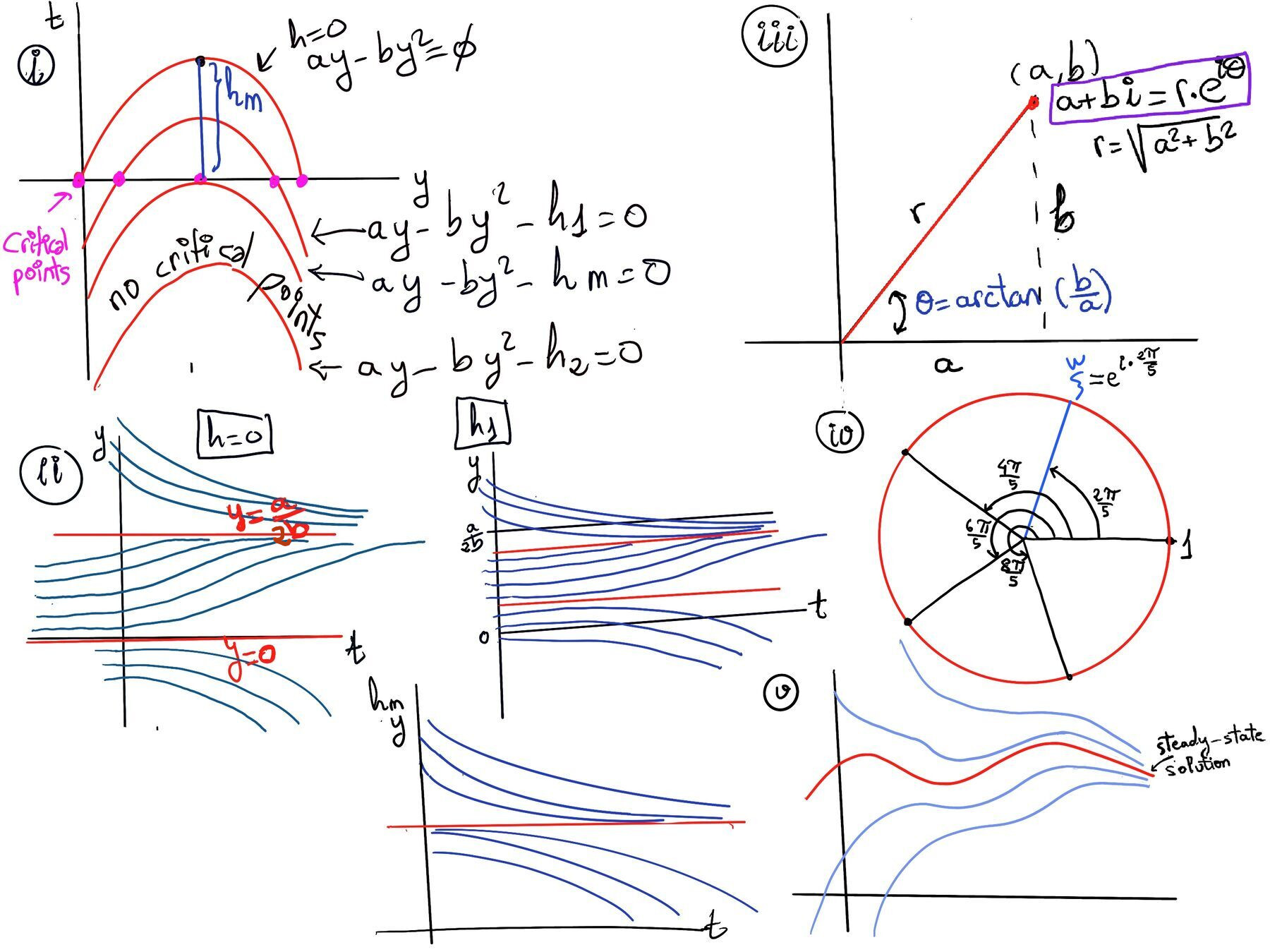
Given a complex number α = ea+ib = ea(cos(b)+isin(b)). It can also be represented in polar form as reiθ = r(cos(θ) + isin(θ)) (Refer to Figure iii for a visual representation and aid in understanding it), where:
A powerful application of Euler’s Formula is the simplification of real integrals involving trigonometric functions. By complexifying the integrand, we often avoid tedious techniques such as multiple integration by parts or trigonometric identities. Complex integration follows the same fundamental rule as real integration: $\boxed{\int e^{az}dz = \frac{1}{a}e^{az} + C}$ for complex constant $a \ne 0$.
Let’s demonstrate this method by solving the classic integral: $\int e^{-x}cos(x)dx$.
We can use complex exponentials to simplify the integral by expressing cos(x) as the real part of eix, cos(x) = $Re(e^{ix})$
$\int e^{-x}cos(x)dx$ =[Express the integral in terms of eix] $Re(\int e^{-x}e^{ix}dx) = Re(\int e^{(-1+i)x}dx)$
Integrate the complex exponential. By the power rule of integration (extended to complex numbers), this results in: $\int e^{(-1+i)x}dx = \frac{e^{(-1+i)x}}{-1+i} + C$ where C is the constant of integration.
Simplifying the expression: $\frac{e^{(-1+i)x}}{-1+i} = \frac{1}{-1+i}e^{-x}e^{ix} = \frac{1}{-1+i}e^{-x}(cos(x)+isin(x))=\frac{1}{-1+i}\frac{-1-i}{-1-i}e^{-x}(cos(x)+isin(x)) = \frac{-1-i}{2}e^{-x}(cos(x)+isin(x))$ 🚀
$\int e^{-x}cos(x)dx = Re(\frac{e^{(-1+i)x}}{-1+i}) =[\text{Taking the real part 🚀}] \frac{e^{-x}}{2}(-cos(x)+sin(x))+C$
In mathematics, “unity” simply refers to the number 1. Therefore, the n-th roots of unity are all the complex number solutions to the equation: $z^n = 1$ where n is a positive integer (n = 1, 2, 3,…).
This equation asks: “Which complex numbers z, when raised to the power of n, yield exactly 1?”. In the real number system, the solution is trivial:
However, the Fundamental Theorem of Algebra states that a polynomial equation of degree n must have exactly n solutions in the complex domain. Consequently, there are always n distinct solutions to this equation, distributed symmetrically on the unit circle in the complex plane.
To find these roots, we utilize Euler’s Formula, which connects complex exponentials with trigonometric functions: $e^{i\theta} = \cos(\theta) + i\sin(\theta)$.
First, we represent the number 1 in its polar (exponential) form. On the unit circle in the complex plane, the number 1 lies on the real axis, corresponding to an angle $\theta = 0$. 1 = $e^{i·0} = cos(0)+ isin(0) = 1 + i·0$.
Because complex exponential functions are periodic with a period of 2πi, adding any integer multiple of 2π to the angle does not change the value. Therefore, we can write a more general form for 1: $1 = e^{i·0 + 2\pi k} = e^{i 2\pi k}$ for any integer k.
Now we substitute this into our original equation, $z^n = 1$: $z^n = e^{i·2πk}$
To solve for z, we take the n-th root of both sides (by raising to the power of 1/n): $z = e^{\frac{2\pi k i}{n}}$ for any integer k.
As k moves through 0, 1, 2, …, n − 1, we get distinct values. However, when k = n, $e^{\frac{2\pi n i}{n}}= e^{2\pi i}$ which is the same as k = 0 ($e^0$). Therefore, there are exactly n unique solutions.
Conclusion: The n-th roots of unity, denoted as $z_k$, are the solution to the equation $z_n = 1$, where z is a complex number. These roots are given by the formula: $\boxed{z_k = e^{\frac{2\pi k i}{n}} = cos(\frac{2\pi k}{n}) + isin(\frac{2\pi k}{n})}$ where k = 0, 1, 2, ···, n-1 and:
These roots have a distinct geometric interpretation. Because the magnitude of $e^{i \theta}$ is always 1, all roots lie on the unit circle. Furthermore, they are equally spaced around that circle. The angle of the first root (k = 0) is 0, and the angle between any two consecutive roots is $\frac{2\pi}{n}$ radians (or $\frac{360}{n}$ degrees).
Therefore, in the complex plane, the n-th roots of unity comprise the vertices of a regular n-sided polygon inscribed within the unit circle, with one vertex always located at (1, 0) (Refer to Figure iv for a visual representation).
Let’s look at the solutions for n = 2, n = 3, and n = 4.
We solve $z^2 = 1$. The index k takes values 0 and 1.
$\star$ For k = 0, $z_0 = e^{\frac{2\pi i \cdot 0}{2}} = e^0=1$.
$\star$ For k = 1, $z_1 = e^{\frac{2\pi i \cdot 1}{2}}=e^{\pi i} = \cos(\pi)+i\sin(\pi) = -1 + i·0 = -1.$
The square roots of unity are 1 and −1, lying on opposite ends of the real axis on the unit circle.
We solve $z^3 = 1$. The index $k$ takes values 0, 1, and 2.
$\star$ For $k = 0$: $z_0 = e^{\frac{2\pi i \cdot 0}{3}} = e^0 = \mathbf{1}$
$\star$ For $k = 1$: $z_1 = e^{\frac{2\pi i \cdot 1}{3}} = \cos\left(\frac{2\pi}{3}\right) + i\sin\left(\frac{2\pi}{3}\right) = \mathbf{-\frac{1}{2} + i\frac{\sqrt{3}}{2}}$
$\star$ For $k = 2$: $z_2 = e^{\frac{2\pi i \cdot 2}{3}} = \cos\left(\frac{4\pi}{3}\right) + i\sin\left(\frac{4\pi}{3}\right) = \mathbf{-\frac{1}{2} - i\frac{\sqrt{3}}{2}}$
These three roots form an equilateral triangle in the complex plane.
We solve $z^4 = 1$. The index k takes values 0, 1, 2, and 3.
$\star$. For $k = 0$: $z_0 = e^0 = \mathbf{1}$
$\star$ For $k = 1$: $z_1 = e^{\frac{2\pi i}{4}} = e^{\frac{\pi i}{2}} = \cos\left(\frac{\pi}{2}\right) + i\sin\left(\frac{\pi}{2}\right) = 0 + 1i = \mathbf{i}$
$\star$ For $k = 2$: $z_2 = e^{\frac{4\pi i}{4}} = e^{\pi i} = \mathbf{-1}$
$\star$ For $k = 3$: $z_3 = e^{\frac{6\pi i}{4}} = e^{\frac{3\pi i}{2}} = \cos\left(\frac{3\pi}{2}\right) + i\sin\left(\frac{3\pi}{2}\right) = 0 - 1i = \mathbf{-i}$
The fourth roots of unity are 1, i, −1, and -i, which are positioned at equal angles of π⁄2 radians around the unit circle, forming a square inscribed in the unit circle.
In the complex plane, the n-th roots of unity are arranged as the vertices of a regular n-sided polygon inscribed in the unit circle. Each vertex corresponds to one of the roots, and the angle between any two consecutive roots is $\frac{2π}{n}$ radians (Refer to Figure iv for a visual representation and aid in understanding it).
We can write the formula for the roots using powers. Let’s define the root corresponding to $k = 1$ as $\omega$ (omega): $\omega = e^{\frac{2\pi i}{n}}$
Using the laws of exponents, we can write any root $z_k$ as a power of $\omega$: $z_k = e^{\frac{2\pi i k}{n}} = \left(e^{\frac{2\pi i}{n}}\right)^k = \omega^k$
Therefore, the set of all $n$-th roots of unity can be represented as: $\{1, \omega, \omega^2, \omega^3, ..., \omega^{n-1}\}$
Any complex number that generates all $n$ roots of unity when raised to powers $1$ through $n$ is called a primitive $n$-th root of unity. While $\omega^1$ is always a primitive root, others may exist depending on $n$. Specifically, $\omega^k$ is a primitive root if and only if $k$ and $n$ are coprime (their greatest common divisor is 1).
The roots of unity possess several remarkable algebraic properties.
Distinct Roots: All n roots generated by k = 0, 1, …, n − 1 are distinct.
Equally Spaced on the Unit Circle: Each root is obtained by rotating the previous one by $\frac{2π}{n}$ radians, meaning they are evenly distributed around the circle.
Multiplicative Structure. The set of n-th roots of unity forms a cyclic group under multiplication. The product of any two n-th roots is also an n-th root:
$z_k \cdot z_m = w^k \cdot w^m = w_{(k + m)~ mod~ n}$
Inverse of a Root. Every n-th root of unity has an inverse, which is its complex conjugate:
$z_k^{-1} = \frac{1}{e^{\frac{2\pi i k}{n}}} = e^{-\frac{2\pi i k}{n}} = e^{\frac{2\pi i (n-k)}{n}} = \bar{z}_k = z_{n-k}$
Sum of All N-th Roots of Unity (n > 1).
This is one of the most important properties. Algebraically, we can prove this using the formula for the sum of a geometric series ($S = \frac{a(1-r^n)}{1-r}$):
$\sum_{k=0}^{n-1} \omega^k = 1 + \omega + \omega^2 + ... + \omega^{n-1} = \frac{1 - \omega^n}{1 - \omega}$ (a = 1 -first term-).
We know that by definition, $\omega^n = 1$, and since $n > 1$, $\omega \neq 1$ (so the denominator is not zero).
$\frac{1 - 1}{1 - \omega} = \frac{0}{1 - \omega} = 0$
Therefore, $\boxed{\sum_{k=0}^{n-1} z_k = 0}$
This property holds geometrically because the roots are symmetrically distributed around the origin in the complex plane. If you treat each root as a vector starting from the origin, their vector sum cancels out.
Product of All N-th Roots. The product of all $n$-th roots of unity is given by:
$\boxed{\prod_{k=0}^{n-1} z_k = (-1)^{n-1}}$
Therefore, the product is $1$ if $n$ is odd, and $-1$ if $n$ is even.

JustToThePoint Copyright © 2011 - 2026 Anawim. ALL RIGHTS RESERVED. Bilingual e-books, articles, and videos to help your child and your entire family succeed, develop a healthy lifestyle, and have a lot of fun. Social Issues, Join us.
This website uses cookies to improve your navigation experience.
By continuing, you are consenting to our
use of cookies, in accordance with our Cookies Policy and
Website Terms and Conditions of use.