
|
 |

|
|
|
|
|
|
Sometimes people don’t want to hear the truth because they don’t want their illusions destroyed, Friedrich Nietzsche.

Bendixson’s Criterion is a powerful analytical method used in the study of dynamical systems for excluding the existence of closed trajectories (and hence, limit cycles) within a specific region of the phase plane.
Bendixson’s criterion. Let D be a simply connected region of the xy-plane (a region with no “holes”). Consider a continuously differentiable vector field $\vec{F}(x, y) = f(x, y)\hat{\mathbf{i}} + g(x, y)\hat{\mathbf{j}}$ governing the autonomous system:
$\begin{cases} x' = f(x, y) \\\ y' = g(x, y) \end{cases}$
The divergence of the vector field is given by: $div \vec{F} = \nabla \cdot \vec{F} = f_x + g_y = \frac{∂f}{∂x} + \frac{∂g}{∂y}$, where f(x, y) and g(x, y) are the components of the vector field governing the time evolution of x and y, respectively.
If the divergence $div(\vec{F})$ is continuous throughout the region D and does not change sign (meaning it is always positive or always negative) and is not identically zero, then there are no closed trajectories (and therefore no limit cycles) lying entirely within D.
Physical Intuition: If the divergence of the vector field is always positive or always negative in the region D, it implies that the flow is either consistently diverging or expanding (spreading out, pushing trajectories outward behaving like a source) or consistently converging or contracting (coming together, pulling trajectories inward behaving like a sink) throughout the region. This consistent behavior prevents the trajectories from closing or looping back onto themselves to form closed limit cycles within D.
$\begin{cases} x' = x^3 + y^3 \\\ y' = 3x + y^3 + 2y \end{cases}$
The vector field for this system is $\vec{F} = (x^3 + y^3)\hat{\mathbf{i}} + (3x + y^3 + 2y)\hat{\mathbf{j}}$
Let’s compute the divergence of the vector field: $div \vec{F} = f_x + g_y = 3x^2 + 3y^2 +2$.
Notice that $div \vec{F} > 0$ in $\mathbb{R}^2$ (it is always positive since $x^2 \ge 0$ and $y^2 \ge 0$ for all real numbers, and there is an additional positive constant $2$).
Conclusion: By Bendixson’s Criterion, since the divergence is always positive and never changes sign anywhere in the plane, there can be no closed trajectories in the entire $xy$-plane. Therefore, there are no limit cycles anywhere in this system.
Important Caveat of Bendixson’s Criterion.
It is crucial to note that Bendixson’s Criterion is a negative test. It can only be used to exclude the possibility of limit cycles within a region. If the divergence $\text{div}(\vec{F})$ changes sign or is zero somewhere in $D$, the criterion is inconclusive. It does not guarantee the existence of a limit cycle; it simply means you must rely on other methods (like the Poincaré-Bendixson Theorem) to investigate further.
Proof (indirect proof)
The proof relies on a proof by contradiction (indirect proof) utilizing Green’s Theorem.
Assume, for the sake of contradiction, that there does exists a closed trajectory C lying entirely within the region D. Let R be the region enclosed or bounded by the closed curve C. Refer to Figure iv for a visual representation and aid in understanding it.
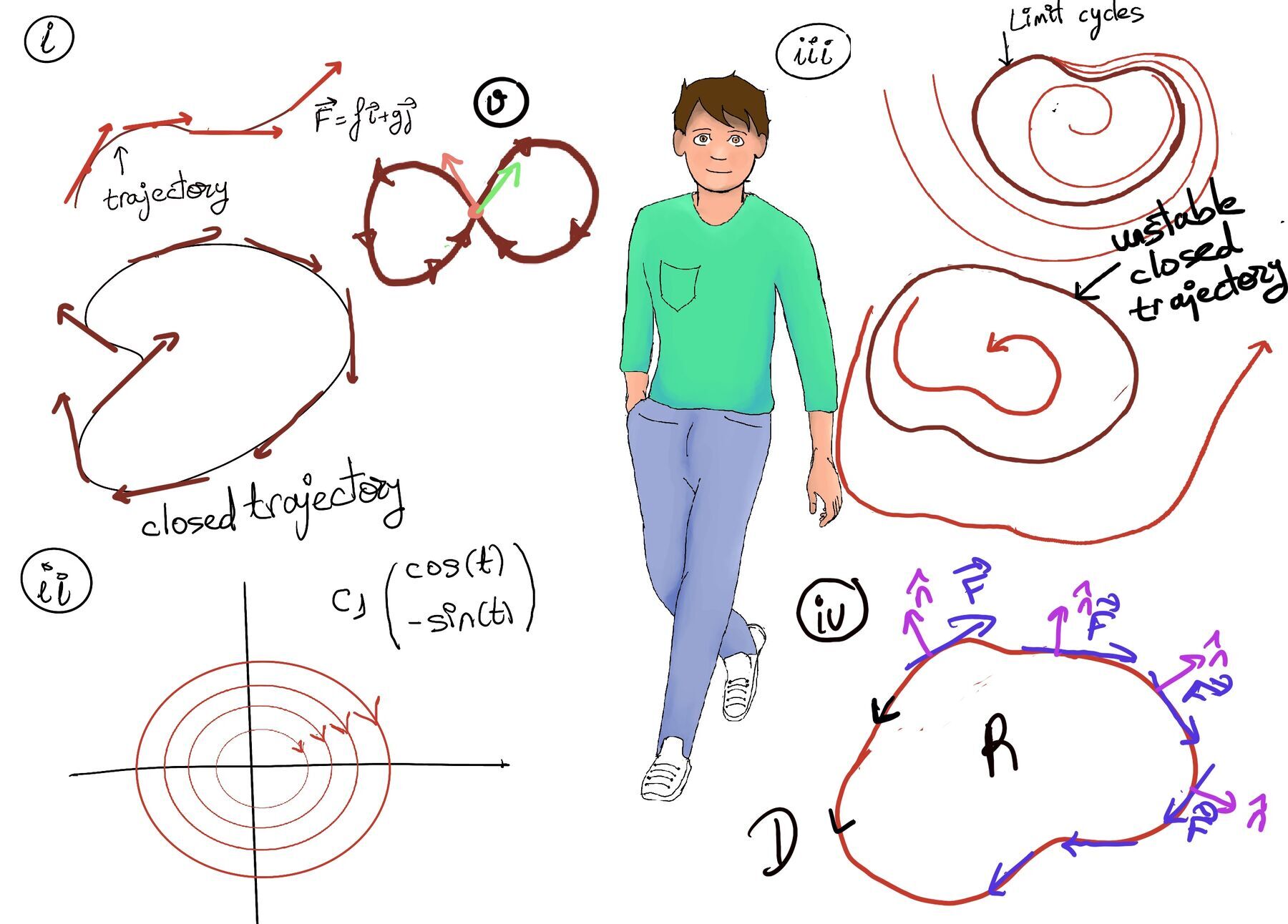
Consider the vector field $\vec{F} = f(x, y)\hat{\mathbf{i}} + g(x, y)\hat{\mathbf{j}}$ governing the system:
$\begin{cases} x' = f(x, y) \\\ y' = g(x, y) \end{cases}$
Since C is a trajectory of the system, the vector field (velocity field) $\vec{F}$ is always perfectly tangent to the curve (the curve is a trajectory, it is supposed to be going in the direction given by the vector field) at every single point along C. Therefore, the outward-pointing unit normal vector and the vector field are perpendicular, i.e., their dot product is zero everywhere along the curve: $\vec{F}·\hat{\mathbf{n}} = 0$.
Now, consider the flux integral of the vector field $\vec{F}$ across the boundary C. It is given by:
$\oint_{C} \vec{F}·\hat{\mathbf{n}}ds$ where:
As we have previously stated, since $\vec{F}$ is tangent to C, $\vec{F}·\hat{\mathbf{n}} = 0$. Therefore, the net flux across the closed trajectory C is exactly zero: $\oint_{C} \vec{F}·\hat{\mathbf{n}}ds = 0$
By Green’s Theorem, the outward flux integral over a closed curve C can be converted (or is mathematically equivalent) to a double integral of the divergence over the region R enclosed by C: $\oint_{C} \vec{F}·\hat{\mathbf{n}}dS = \int\int_{R} div(\vec{F})dA$, where:
Since we established the flux across C is zero, we have: $\int\int_{R} div(\vec{F})dA = 0$
However, we have already assumed that:
If a continuous function is strictly positive (or strictly negative) over a region with a non-zero area R, the definite integral of that function over the region must also be strictly positive (or strictly negative). It is mathematically impossible for the integral to equal zero. $\iint_{R} \text{div}(\vec{F}) \, dA \neq 0$
This directly contradicts our earlier finding that the integral must equal zero. Therefore, our initial assumption —that a closed trajectory $C$ exists entirely within $D$— must be false. Hence, under these conditions, there are no closed trajectories (limit cycles) within the region $D$. $\blacksquare$
The Critical point criterion is a fundamental geometric rule closely related to the Poincaré-Bendixson theorem and Poincaré Index Theory. It establishes a strict geographical requirement for closed trajectories:
If a closed trajectory C exists within a region D in the xy-plane, then there must be at least one critical point (also known as an equilibrium point) strictly inside the region enclosed by that closed trajectory C.
A critical point is a state $(x_0, y_0)$ where the system’s dynamic “pause”; in other words, the velocity vector vanishes. Formally, for an autonomous system:
$\begin{cases} x' = f(x, y) \\\ y' = g(x, y) \end{cases}$
a critical point is a solution $(x_0, y_0)$ satisfying both $f(x_0, y_0) = 0$ and $g(x_0, y_0) = 0$.
Contrapositive Logic. The contrapositive of a statement “If A, then B” ($A \implies B$) is the logically equivalent statement “If not B, then not A” ($\neg B \implies \neg A$). Applying this to the critical point criterion gives us a highly useful diagnostic tool:
This means that if you can identify a region D in the plane that contains no critical points, then you can definitively conclude that no closed trajectories (limit cycles) exist within D.
Consider the following non-linear autonomous system:
$\begin{cases} x' = x^2 + y^2 + 1 \\\ y' = x^2 -y^2 \end{cases}$
To investigate whether limit cycles exist, we can first try to apply Bendixson’s Criterion. It states that that if the divergence of the vector field is continuous and does not change sign (i.e., it is either strictly positive or strictly negative) in a simply connected region D, then there are no closed trajectories (and hence no limit cycles) lying entirely within D.
Given the vector field $\vec{F} = f(x, y)\hat{\mathbf{i}}+g(x, y)\hat{\mathbf{j}}$ where $f(x, y) = x^2 + y^2 + 1$ and $g(x, y) = x^2 -y^2$. The divergence of the vector field $\vec{F}$ is given by: $\text{div}(\vec{F}) = \frac{\partial f}{\partial x} + \frac{\partial g}{\partial y} = 2x - 2y$.
Analyzing the Divergence. Set the divergence equal to zero: $2x - 2y = 0 \implies x = y$. This tells us that the divergence is exactly zero along the diagonal line $y = x$.
Signs of the Divergence
Applying Bendixson’s Criterion
In regions where the divergence is strictly positive or strictly negative and continuous, Bendixson’s Criterion tells us that no closed trajectories can exist entirely within those regions.
Next, we use the critical point criterion to check whether the system has any critical points. The Critical Point Criterion states:
Critical points require $x'$ and $y'$ to be zero simultaneously. Let’s look at the first equation.
Because $x^2 \ge 0$ and $y^2 \ge 0$ for all real numbers, $x^2 + y^2 + 1$ will always be greater than or equal to $1$. It can never equal zero.
Therefore, there are no critical points anywhere in the real plane. By the contrapositive of the Critical Point Criterion, since there are no critical points in the entire system, we can definitively conclude that the system does not have any limit cycles anywhere.
Notice that $x' \ge 1 > 0$ for all $(x, y)$. This implies that every single trajectory must constantly move to the right as time progresses. Because the flow is strictly rightward, a particle can never loop back on itself (which would require $x'$ to briefly become negative to travel leftward). This basic flow analysis alone is sufficient to rule out closed trajectories.

To determine whether limit cycles can exist in the given spring-mass-damper system with non-linear damping, we will apply Bendixson’s Criterion. This criterion helps us identify whether closed trajectories, and hence limit cycles, are possible in a particular region of the phase plane by examining the divergence of the vector field.
The governing equation for this system is: $x'' + c(x)x' + x = 0.$
To analyze this system in the phase plane, we convert it into a system of first-order differential equations by introducing velocity as a new variable $y = x'$. Then, we have:
$\begin{cases} x' = y \\\ y' = -x -c(x)y \end{cases}$
This gives us the vector field $\vec{F} = f(x, y)\hat{\mathbf{i}}+g(x, y)\hat{\mathbf{j}}$ where f(x, y) = y, g(x, y) = -x -c(x)y.
To investigate whether limit cycles exist, we can apply Bendixson’s Criterion. It states that if the divergence of the vector field $\vec{F}$ is continuous and does not change sign (i.e., it is either strictly positive or strictly negative) in a simply connected region D, then there are no closed trajectories (and thus no limit cycles) within D.
The divergence of the vector field $\vec{F}$ is given by: $\text{div}(\vec{F}) = \frac{\partial f}{\partial x} + \frac{\partial g}{\partial y} = 0 + (-c(x)) = -c(x)$
Applying Bendixson’s Criterion:
Since the problem defines the damping coefficient as strictly positive ($c(x) > 0$ for all $x$), we have: $\text{div}(\vec{F}) < 0 \quad \text{for all } x, y$
The divergence is strictly negative for all x and y (assuming c(x) is continuous). Thus:
Physical Intuition: A strictly negative divergence globally indicates that phase space volume is constantly shrinking. Physically, $c(x) > 0$ means the damper is always removing energy from the system (dissipation) regardless of the position $x$. For a limit cycle to exist, a system must have a way to inject or restore energy to maintain a sustained oscillation. Since this system only loses energy, all trajectories must eventually spiral inward and come to rest at the equilibrium point $(0,0)$.

JustToThePoint Copyright © 2011 - 2026 Anawim. ALL RIGHTS RESERVED. Bilingual e-books, articles, and videos to help your child and your entire family succeed, develop a healthy lifestyle, and have a lot of fun. Social Issues, Join us.
This website uses cookies to improve your navigation experience.
By continuing, you are consenting to our
use of cookies, in accordance with our Cookies Policy and
Website Terms and Conditions of use.