
|
 |
 |
|
|
|
|
A learning experience is one of those things that says, ‘You know that thing you just did? Don’t do that, Douglas Adams
The derivative of a function at a specific input value describes the instantaneous rate of change. Geometrically, when the derivative exists, it is the slope of the tangent line to the graph of the function at that point. Algebraically, it represents the ratio of the change in the dependent variable to the change in the independent variable as the change approaches zero.
Definition. A function f(x) is differentiable at a point “a” in its domain, if its domain contains an open interval around “a”, and the following limit exists $f'(a) = L = \lim _{h \to 0}{\frac {f(a+h)-f(a)}{h}}$. More formally, for every positive real number ε, there exists a positive real number δ, such that for every h satisfying 0 < |h| < δ, then the following inequality holds |L-$\frac {f(a+h)-f(a)}{h}$|< ε.
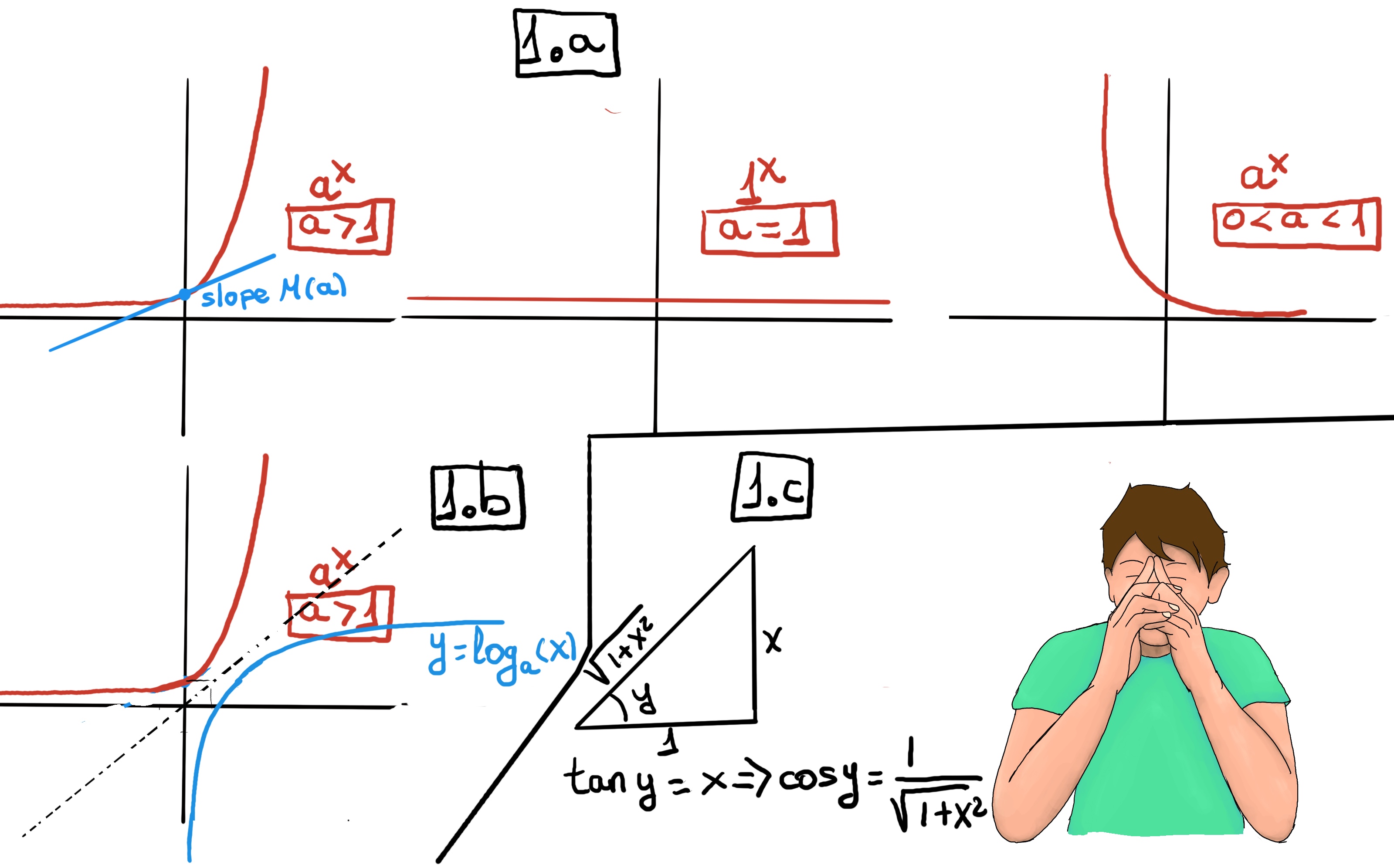
An exponential function is a function of the form f(x) = ax, where “x” is a real variable and “a” is a real positive constant (a > 0), called the base of the function.
Recall that for rational exponents, am/n= $\sqrt[n]{a^{m}}$
Let f(x) = ax, let’s calculate $\frac{d}{dx}a^{x}$
f’(x) = $\frac{d}{dx}a^{x} =~ \lim_{h \to 0} \frac{a^{x+h}-a^{x}}{h} =$[Using the exponential identity axay=ax+y, we factor out ax] $\lim_{h \to 0}a^{x}\frac{a^h-1}{h} = a^{x}·\lim_{h \to 0}\frac{a^h-1}{h}$
Let’s define M(a) = $\lim_{h \to 0}\frac{a^h-1}{h}$. This limit represents the slope of the curve ax at x = 0 since $\frac{d}{dx}a^{x} \vert_{x=0} =~ a^{0}M(a)=~ M(a)$
In conclusion, the derivative of the exponential function is f'(x) = $\frac{d}{dx}a^{x} = M(a)a^{x}$.
Definition. The number e =2.71828182845905…, also known as Euler’s number, is a mathematical constant approximately equal to 2.71828 that can be characterized in several equivalent ways:
Using the general formula $\frac{d}{dx}a^{x} = M(a)a^{x}$, and the fact that M(e) = 1, we obtain $\frac{d}{dx}e^{x} = e^{x}$. The exponential function f(x)=ex is unique because its derivative equals the function itself.
In particular, f(x) = ex, $f'(0)$ = $e^{x}|_{x=0} = e^0 = 1$, as expected.
Let a = 2, f(x) = 2x. Then, for any constant k, f(kx) = 2kx = (2k)x = bx where b = 2k.
$\frac{d}{dx}b^{x} = \frac{d}{dx}f(kx)=$[Differentiate using the chain rule] $kf'(kx)$.
We evaluate at x = 0, $\frac{d}{dx}b^{x}|_{x=0}=kf'(0)$ [Recall the general derivative form for f(x)=2x, f’(x)=M(2)2x] =$k·M(2)·2^0 = k·M(2)$. To obtain slope 1 at the origin, we require $k·M(2)=1 \implies[\text{Solve for k: }] k = \frac{1}{M(2)}$. And therefore the corresponding base is $b = 2^k = 2^{\frac{1}{M(2)}}$. This base is by definition the one whose exponential has derivative 1 at 0. That number is what we call e.
The inverse of ax is the logarithmic function with base a, that is, loga(x) = y $\iff a^y = x$. The logarithm with base e is called the natural logarithm, denoted ln(x), that is, $\ln(x) = y \iff e^y =x$, (figure 1.b.).
Let w = ln(x), we want to calculate $\frac{d}{dx}lnx$.
By definition $w = ln(x) \iff e^w = x$, and differentiating both sides with respect to x, we get: $\frac{d}{dx}e^{w}= \frac{d}{dx} x = 1$
Using the Chain Rule, $\frac{d}{dx}e^{w}=e^{w}\frac{dw}{dx} = $1. Therefore, $\frac{dw}{dx}=\frac{1}{e^w}$ ⇒$\frac{d}{dx}lnx=\frac{1}{x}$
Let’s calculate $\frac{d}{dx}a^{x}$. $\frac{d}{dx}a^{x}=~ \frac{d}{dx}((e^{lna})^x)=~ \frac{d}{dx}e^{xlna}$=[The Chain Rule] $e^{xlna}·lna=a^{x}·lna$
Thus, $\frac{d}{dx}a^{x}=(lna)a^{x}$, and therefore M(a) = ln(a).
For any differentiable function u(x) > 0, $(lnu)'=\frac{d}{dx}ln(u) = \frac{d}{du}ln(u)\frac{du}{dx} =[\text{Previous demonstrated: } \frac{d}{du}(ln(u)) = \frac{1}{u}] \frac{1}{u}u'=\frac{u'}{u}$
Another way of getting the same result regarding $\frac{d}{dx}a^{x}$ is by using the substitution u = ax, so ln(u) = ln(ax) = x·ln(a), and therefore, (ln(u))’ = ln(a),
$(lnu)'=\frac{u'}{u}=ln(a) \implies u'=u·ln(a) \implies \frac{d}{dx}a^{x} = (lna)·a^{x}$
Let’s calculate $\frac{d}{dx} log_a(x)$. By definition, $w = log_a(x) \iff a^w = x$. Differentiating: $\frac{d}{dx} a^w = \frac{d}{dx} x = 1.$
$\frac{d}{dx} a^w = \frac{d}{dw}a^w\frac{dw}{dx} = a^w·ln(a)\frac{dw}{dx}$ = 1 ⇒ $\frac{dw}{dx} = \frac{1}{a^w·ln(a)}$ ⇒[aw = x, w = loga(x)] $\frac{d}{dx}log_a(x) = \frac{1}{x·ln(a)}$
Take logarithms: $ln((1+\frac{1}{n})^{n})$ = $n·ln(1+\frac{1}{n})$ =[Let $\Delta x=\frac{1}{n}$, then] $\frac{1}{\Delta x}ln(1+\Delta x) =$[Recall ln(1) = 0] $\frac{1}{\Delta x}(ln(1+\Delta x)-ln(1))$
And therefore, $lim_{n \to \infin} ln((1+\frac{1}{n})^{n}) = \lim_{\Delta x \to 0} \frac{1}{\Delta x}(ln(1+\Delta x)-ln(1)) = \lim_{\Delta x \to 0} \frac{ln(1+\Delta x)-ln(1)}{\Delta x}$, and this is $\frac{d}{dx} ln(x)|_ {x=1} =~ \frac{1}{x}|_{x=1} = 1$
$\lim_{n \to \infin}(1+\frac{1}{n})^{n} = lim_{n \to \infin}e^{ln((1+\frac{1}{n})^{n})} =$[Power law for limits] $e^{lim_{n \to \infin} ln((1+\frac{1}{n})^{n})}=$ e1 = e.
The number e =2.71828182845905…, also known as Euler’s number, is a mathematical constant approximately equal to 2.71828 that can be characterized in many ways. e could be defined as the limit of (1 + 1⁄n)n as n approaches infinity, e = $\lim_{n \to \infin}(1+\frac{1}{n})^{n}.$
We now justify the power rule for real exponents. Let $r \in \mathbb{R}, x \gt 0$, and u(x)=xr, then u’(x)=rxr-1, ∀r ∈ ℝ.
$x^{r}=[\text{Rewrite}]e^{ln(x^{r})}=e^{r·lnx}$ ⇨ $\frac{d}{dx}x^{r}$=[The chain rule]$\frac{r}{x}e^{rlnx}=\frac{r}{x}x^{r}=rx^{r-1}$
Alternatively, using logarithmic differentiation, let $u=x^{r}, ~ln(u)=rln(x) \implies \frac{u'}{u}=\frac{r}{x} \implies u'=\frac{u}{x}r=\frac{x^r}{x}r = rx^{r-1}$
$\frac{d}{dx}ln(x)·sin(x) =[\text{Using the product rule}] ln(x)·cos(x)+\frac{sin(x)}{x}$
$\frac{d}{dx} log_5x^2 =[\frac{d}{dx}log_a(x) = \frac{1}{x\cdot ln(a)} \text{ and Chain Rule}] \frac{2x}{ln(5)·x^2} = \frac{2}{ln(5)·x}$
$\frac{d}{dx}e^{xtan^{-1}x} =[\text{Using the chain rule and product rule}] e^{xtan^{-1}x}(tan^{-1}x + \frac{x}{1+x^{2}})$
$\frac{d}{dx} 3e^x+10x^3ln(x) =[\text{Using the sum rule and product rule}] 3·e^x+30·x^2·ln(x)+10x^3\frac{1}{x} = 3·e^x+30·x^2·ln(x)+10x^2.$
$\frac{d}{dx} (2x^4+1)^{tan(x)}$.

JustToThePoint Copyright © 2011 - 2026 Anawim. ALL RIGHTS RESERVED. Bilingual e-books, articles, and videos to help your child and your entire family succeed, develop a healthy lifestyle, and have a lot of fun. Social Issues, Join us.
This website uses cookies to improve your navigation experience.
By continuing, you are consenting to our use of cookies, in accordance with our Cookies Policy and Website Terms and Conditions of use.