JustToThePoint English Website Version
JustToThePoint en español

Analyzing and Graphing Rational Functions

And yet despite the look on my face, you’re still talking and thinking that I care, Anonymous

image info

Recall

Definition. A function f is a rule, relationship, or correspondence that assigns to each element x in a set D, x ∈ D (called the domain) exactly one element y in a set E, y ∈ E (called the codomain or range).

  1. If f′(x) > 0 for x just to the left of c and f′(x) < 0 for x just to the right of c, then f(c) is a local maximum.
  2. If f′(x) < 0 for x just to the left of c and f′(x) > 0 for x just to the right of c, then f(c) is a local minimum.
  3. If f′(x) does not change sign at c (stays positive or stays negative), then f(c) is not a local extremum.

Analysis and Plot of some functions

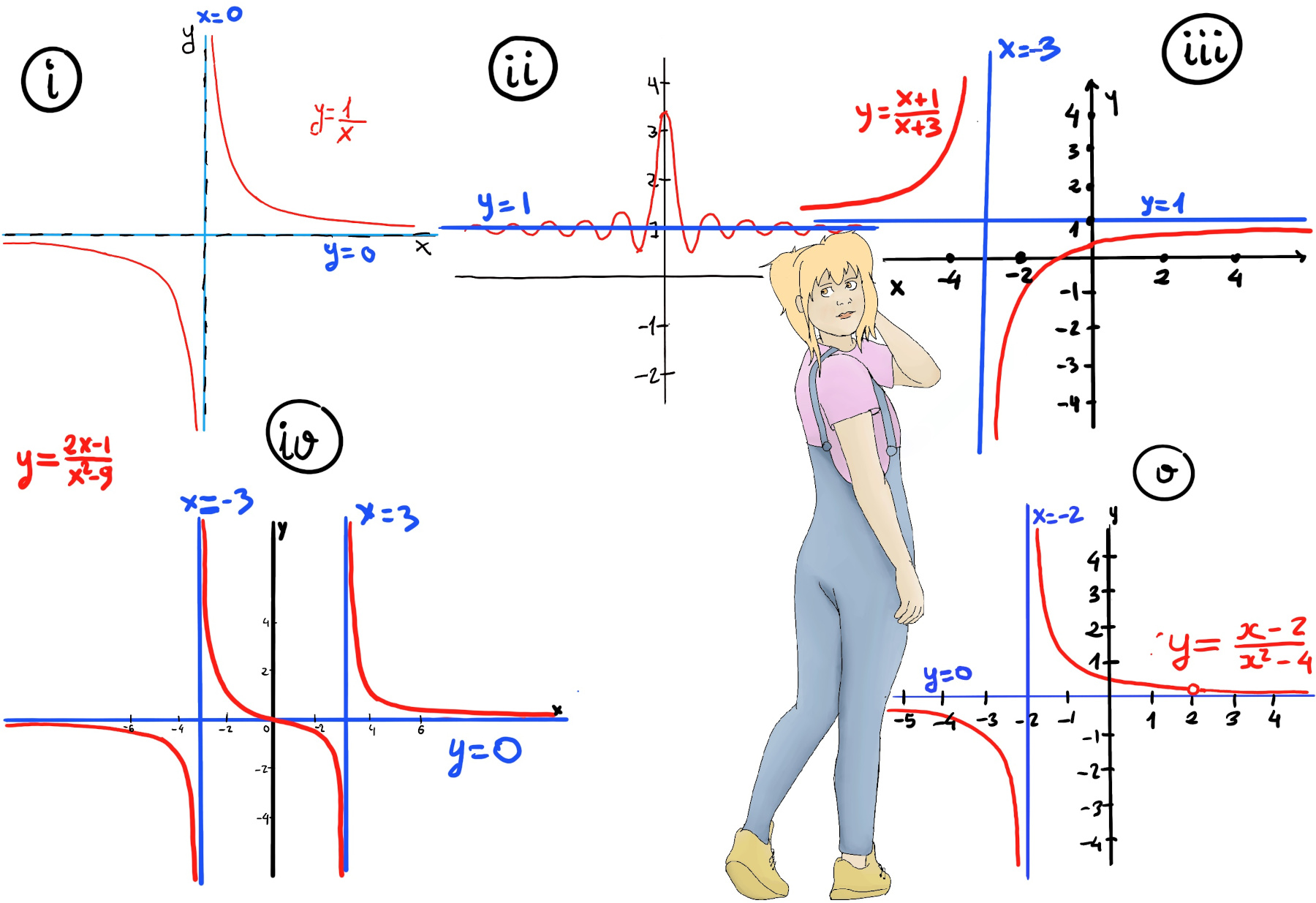
  1. Domain: $\mathbb{R} \setminus \{ -3, 3 \}$
  2. Range: All real numbers $\mathbb{R}$ (since horizontal asymptote is $y=0$ but function crosses it).
  3. x-intercept: Set $2x+1=0 \leadsto x = -\frac{1}{2}$ → $\left(-\frac{1}{2}, 0\right)$. y-intercept: $f(0) = \frac{1}{-9} = -\frac{1}{9} \leadsto \left(0, -\frac{1}{9}\right)$.
  4. Symmetry: None (neither even nor odd).
  5. Asymptotes: $\lim_{x \to -3⁺} \frac{2x+1}{x^2-9} = \frac{-5}{0^-} = +∞, \lim_{x \to -3⁻} \frac{2x+1}{x^2-9} = \frac{-5}{0^+} = -∞$ ⇒ x = -3 is a vertical asymptote. Similarly, $\lim_{x \to 3⁺} \frac{2x+1}{x^2-9} = \frac{7}{0⁺} = +∞, \lim_{x \to 3⁻} \frac{2x+1}{x^2-9} = \frac{7}{0⁻} = -∞$ ⇒ x = 3 is a vertical asymptote, too. Since degree of numerator (1) < degree of denominator (2): $\lim_{x \to +∞} \frac{2x+1}{x^2-9} = \lim_{x \to -∞} \frac{2x+1}{x^2-9} = 0$ ⇒ y = 0 is a horizontal asymptote.

    $\lim\limits_{x \to -\infty} \frac{2x+1}{x^2-9} = 0^-$ (approaches from below). $\lim\limits_{x \to +\infty} \frac{2x+1}{x^2-9} = 0^+$ (approaches from above, $\frac{2x+1}{x^2-9} \sim \frac{2x}{x^2}=\frac{2}{x}$). For any sufficiently large 𝑥 (specifically, 𝑥 > 3), both the numerator (2x + 1) and the denominator ($x^2 -9$) are positive. Since the function is positive for large 𝑥 and the limit is 0, it approaches $0^+$.

  6. Function Behavior Analysis. $f'(x) = \frac{-2(x^2+x+9)}{(x^2-9)^2}$. Numerator: The quadratic $x^2+x+9$ has a discriminant $\Delta = b^2-4ac = 1^2-4(1)(9)=-35 \lt 0$ (no real roots) and the leading coefficient (1) is positive, therefore $x^2+x+9 > 0$, and the numerator is always negative for all real x, so $f'(x) < 0$ everywhere in domain ($(x^2-9)^2 \gt 0$). The function is always decreasing on each interval.
  7. Sign Analysis:
    Interval $2x+1$ $x^2-9$ $f(x)$ Behavior
    $x < -3$ + Negative
    $-3 < x < -\frac{1}{2}$ + Positive
    $-\frac{1}{2} < x < 3$ + Negative
    $x > 3$ + + + Positive
  8. Three distinct branches: (i) Left Branch ($x < -3$): Approaches y = 0 from below as $x \to -\infty$. It is always negative, decreasing, and plunges to $-\infty$ as $x \to -3^-$. (ii) Middle Branch ($-3 < x < 3$): Emerges from $+\infty$ as $x \to -3^+$, decreases continuously, crosses the x-axis at $(-\frac{1}{2}, 0)$, then crosses the y-axis at $(0, -\frac{1}{9})$, and plunges to $-\infty$ as $x \to 3^-$. (iii) Right Branch (x > 3): Emerges from $+\infty$ as $x \to 3^+$. It is always positive, always decreasing, and approaches y = 0 from above as $x \to +\infty$. Image 
  1. For $x \ne \pm 2$, we have: $\frac{x-2}{x^2-4} = \frac{x-2}{(x-2)(x+2)} = \frac{1}{x+2}$
  2. Domain: $\mathbb{R} \setminus \{ -2, 2 \}$.
  3. Range: All real numbers except $0$ ($\mathbb{R} \setminus \{ 0 \}$).
  4. x-intercept: None (numerator zero only at x = 2, which is a hole); y-intercept: $f(0) = \frac{1}{2}$ → $(0, \frac{1}{2})$
  5. Asymptotes and Discontinuities. $\lim_{x \to -2⁺} \frac{x-2}{x^2-4} = \lim_{x \to -2⁺} \frac{1}{x+2} = \frac{1}{0⁺} = +∞, \lim_{x \to -2⁻} \frac{x-2}{x^2-4} = \lim_{x \to -2⁻} \frac{1}{x+2} = \frac{1}{0⁻} = -∞$ ⇒ x = -2 is a vertical asymptote. $\lim_{x \to +∞} \frac{x-2}{x^2-4} = \lim_{x \to -∞} \frac{x-2}{x^2-4} = \lim_{x \to ±∞} \frac{1}{x+2} =0$ ⇒ y = 0 is a horizontal asymptote. Besides, $\lim\limits_{x \to +\infty} f(x) = 0^+$ (approaches from above). $\lim\limits_{x \to -\infty} f(x) = 0^-$ (approaches from below).
  6. $\lim\limits_{x \to 2} f(x) = \frac{1}{4}$. At x = 2 the original function is undefined because the denominator is zero, so 2 is not in the domain. The limit exists and is finite, so f has a removable discontinuity (a hole) at x = 2, located at the point (2, 1/4).
  7. Sign Analysis. $x < -2: f(x) < 0$ (negative). $-2 < x < 2: f(x) > 0$ (positive). $x > 2: f(x) > 0$ (positive).
  8. Derivative: $f'(x) = -\frac{1}{(x+2)^2} < 0, \forall x \in D(f)$. Then, f is strictly decreasing on each interval of its domain.
  9. Second Derivative: $f''(x) = \frac{2}{(x+2)^3}$. $x < -2: f''(x) < 0$, then f concave down. $x > -2: f''(x) > 0$, then f concave up.
  10. Plot: Two main branches with a gap (hole). Left Branch (x < -2): Approaches y = 0 from below as $x \to -\infty$, it is negative, strictly decreasing, and concave down, and plunges to $-\infty$ as $x \to -2^-$. Right Branch (x > -2, except x = 2): Emerges from $+\infty$ as $x \to -2^+$. It is positive, strictly decreasing, and concave up. It passes through $(0, \frac{1}{2})$ and $(1, 1/3)$, and has a hole at $(2, 1/4)$. Then, it continues for x > 2, decreasing toward $0^+$ as $x \to +\infty$ (approaches zero from above).
  1. Domain: ℝ - {1, -1}. f(0) = 0.
  2. x-intercept. $\frac{x^{2}}{1-x^{2}} = 0 \leadsto x^2 = 0 \implies x = 0$, y-intercept, f(0) = 0/1 = 0. (0, 0) is the only intercept.
  3. f(-x)=f(x), so this function is even. Symmetric about y-axis.
  4. $\lim_{x \to \pm\infty}\frac{x^{2}}{1-x^{2}}=-1$, y = -1 is a horizontal asymptote.
  5. $\lim_{x \to 1^{+}}\frac{x^{2}}{1-x^{2}}=\frac{1}{0^{-}} = -\infty, \lim_{x \to 1^{-}}\frac{x^{2}}{1-x^{2}}=\frac{1}{0^{+}} = \infty$. Similarly, $\lim_{x \to -1^{+}}\frac{x^{2}}{1-x^{2}}=\frac{1}{0^{+}} = \infty, \lim_{x \to -1^{-}}\frac{x^{2}}{1-x^{2}}=\frac{1}{0^{-}} = -\infty$, hence x = -1 and x = 1 are vertical asymptotes.
  6. Critical points. $f'(x) = \frac{(2x)(1-x^2) - x^2(-2x)}{(1-x^2)^2} = \frac{2x - 2x^3 + 2x^3}{(1-x^2)^2} = \frac{2x}{(1-x^2)^2}$. $f'(x) = 0 \implies 2x = 0 \implies x = 0.$
  7. Sign analysis. x < 0, f’(x) < 0 (decreasing), x > 0, f’(x) > 0 (increasing).
  8. Local minimum: (0, 0). It is not an absolute minimum. f goes to -∞ near asymptotes.
  9. Concavity analysis: $f''(x) = \frac{2(1-x^2)^2 - 2x \cdot 2(1-x^2)(-2x)}{(1-x^2)^4} = \frac{2(1-x^2) + 8x^2}{(1-x^2)^3} = \frac{2 + 6x^2}{(1-x^2)^3}$. x < -1: $(1-x^2)^3 < 0$, numerator > 0, then f’’(x) < 0 (concave down); -1 < x < 1: $(1-x^2)^3 > 0$, then f’’(x) > 0 (concave up); x > 1: $(1-x^2)^3 < 0$, then f’’(x) < 0 (concave down).
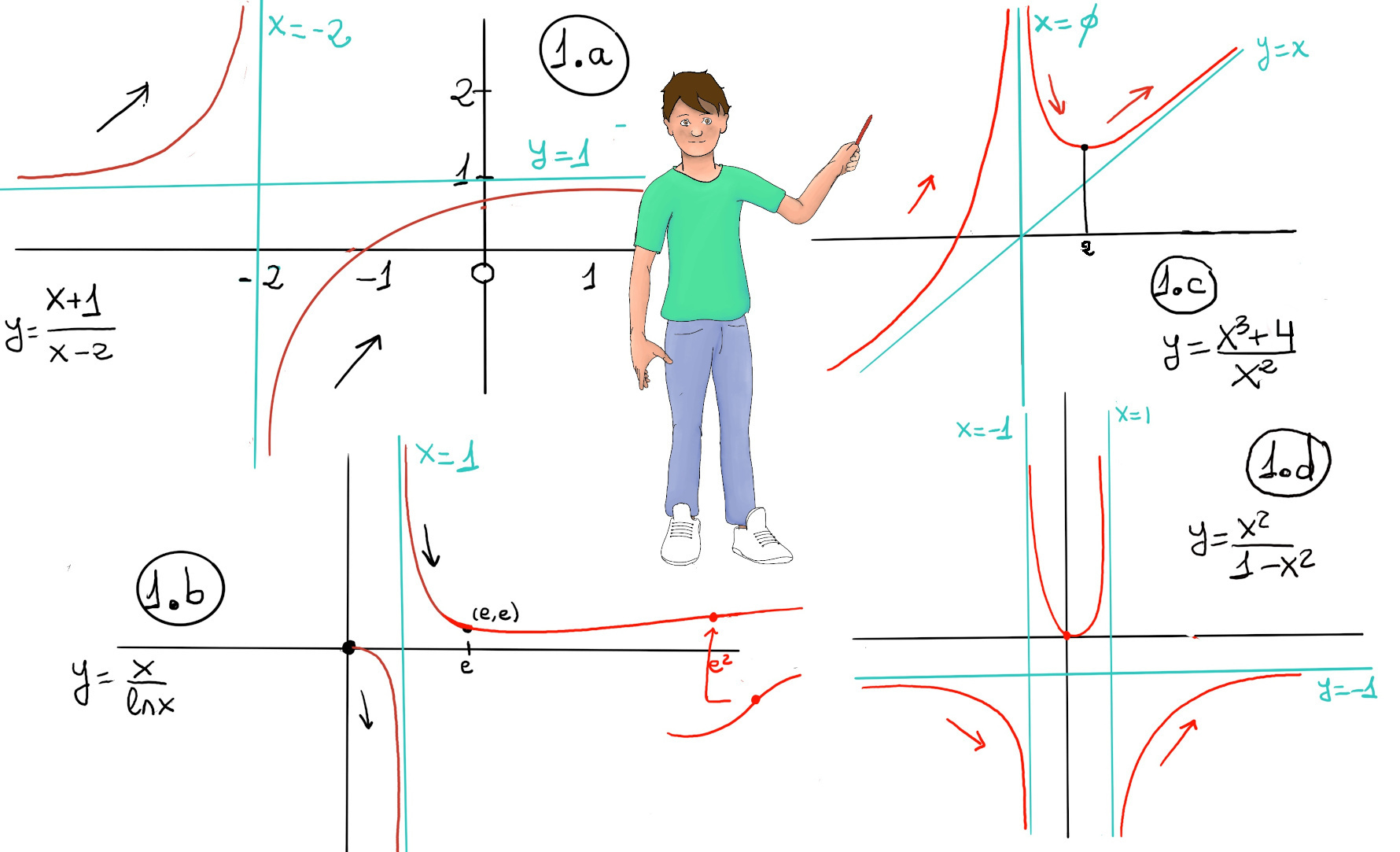
  10. The graph has 4 branches (Figure 1.d.): x < -1, approaches y = -1 from below as x → -∞ and drops (it is always decreasing, concave down) to -∞ at x = -1⁻; −1 < x < 0, drops (it is always decreasing, concave up) from +∞ at x = -1⁺ to 0 at x = 0; 0 < x < 1, rises from 0 at x = 0 to +∞ at x = 1⁻ (increasing, concave up); x > 1, rises from -∞ at x = 1⁺ to -1 as x → ∞ (increasing, concave down).

    $f(x)-L=\frac{x^{2}}{1-x^{2}}-(-1)=\frac{x^{2}}{1-x^{2}}+1=\frac{x^{2}+(1-x^{2})}{1-x^{2}}=\frac{1}{1-x^{2}}$. As $x\rightarrow -\infty, x^{2}$ becomes a very large positive number, making the denominator $1-x^{2}$ a large negative number. Therefore, the fraction $\frac{1}{1-x^{2}}$ is always negative for sufficiently large negative x.
    Image 
  1. Domain = ℝ - {0}. f is not defined at x = 0. Range: All real numbers.
  2. x-intercept: Set numerator = 0, $x^3 + 4 = 0 \implies x^3 = -4 \implies x = -\sqrt[3]{4} \approx -1.5874$, $(-\sqrt[3]{4}, 0)$. y-intercept: None (function undefined at x = 0).
  3. No symmetry (neither even nor odd).
  4. $\lim_{x \to 0}\frac{x^{3}+4}{x^{2}} = \frac{4}{0^{+}} = +\infty$, x = 0 (y-axis) is a vertical asymptote.
  5. Horizontal Asymptotes. None, since $\lim_{x \to \infty}\frac{x^{3}+4}{x^{2}} = \infty, \lim_{x \to -\infty}\frac{x^{3}+4}{x^{2}} = -\infty$.
  6. When a linear asymptote is not parallel to the x- or y-axis, it is called an oblique asymptote. A function f(x) is asymptotic to y = mx + n (m ≠ 0) if: m = $\lim_{x \to \pm\infty} \frac{f(x)}{x} = m, \lim_{x \to \pm\infty} (f(x) -mx) = n.$ m = $\lim_{x \to \pm\infty}\frac{\frac{x^{3}+4}{x^{2}}}{x} = \lim_{x \to \pm\infty}\frac{x^{3}+4}{x^{3}}=1, lim_{x \to \pm\infty} \frac{x^{3}+4}{x^{2}} -x=lim_{x \to \pm\infty} \frac{4}{x^{2}} = 0,$ y =[m = 1, n = 0] x is an oblique asymptote.

    Since $f(x) = x + \frac{4}{x^2}$, $\forall x \ne 0, \frac{4}{x^2} > 0 \implies f(x) \gt x$. The function always lies above its oblique asymptote y = x.

  7. Critical points. Rewrite: $f(x) = x + 4x^{-2} \implies f'(x) = 1 - 8x^{-3} = 1 - \frac{8}{x^3}$. $f'(x) = 0 \implies 1 - \frac{8}{x^3} = 0 \implies x^3 = 8 \implies x = 2$.
  8. Monotonicity. (i) x < 0: $x^3 < 0$, so $\frac{8}{x^3} < 0 \implies f'(x) = 1 - (\text{negative}) > 0$; (ii) 0 < x < 2: $x^3 < 8$, so $\frac{8}{x^3} > 1 \implies f'(x) < 0$; (iii) x > 2: $x^3 > 8$, so $\frac{8}{x^3} < 1 \implies f'(x) > 0$. Increasing on: $(-\infty, 0)$ and $(2, \infty)$. Decreasing on (0, 2).
  9. Local minimum at x = 2: $f(2) = \frac{8+4}{4} = 3$, (2, 3).
  10. Concavity. $f''(x) = 24x^{-4} = \frac{24}{x^4}, f''(x) > 0, \forall x \neq 0 \text{ since } x^4 > 0$. Concave up on: $(-\infty, 0)$ and $(0, \infty)$. No inflection points (never changes concavity).
  11. The plot is shown in Figure 1.c. and consists of two disconnected branches. Left branch (x < 0), starts at $-\infty$ as $x \to -\infty$ above the line y = x, crosses the x-axis at $(-\sqrt[3]{4}, 0)$, increases continuously, approaches $+\infty$ as $x \to 0^-$, and is concave up. Right branch (x > 0), starts at $+\infty$ as $x \to 0^+$, decreases to a local minimum at (2, 3), then increases to $+\infty$ as $x \to \infty$ above the line y = x. It is concave up and never touches the asymptote y = x.

Bibliography

This content is licensed under a Creative Commons Attribution-NonCommercial-ShareAlike 4.0 International License.
  1. NPTEL-NOC IITM, Introduction to Galois Theory.
  2. Algebra, Second Edition, by Michael Artin.
  3. LibreTexts, Calculus. Abstract and Geometric Algebra, Abstract Algebra: Theory and Applications (Judson).
  4. Field and Galois Theory, by Patrick Morandi. Springer.
  5. Michael Penn, and MathMajor.
  6. Contemporary Abstract Algebra, Joseph, A. Gallian.
  7. YouTube’s Andrew Misseldine: Calculus. College Algebra and Abstract Algebra.
  8. MIT OpenCourseWare 18.01 Single Variable Calculus, Fall 2007 and 18.02 Multivariable Calculus, Fall 2007.
  9. Calculus Early Transcendentals: Differential & Multi-Variable Calculus for Social Sciences.
Bitcoin donation

JustToThePoint Copyright © 2011 - 2025 Anawim. ALL RIGHTS RESERVED. Bilingual e-books, articles, and videos to help your child and your entire family succeed, develop a healthy lifestyle, and have a lot of fun. Social Issues, Join us.

This website uses cookies to improve your navigation experience.
By continuing, you are consenting to our use of cookies, in accordance with our Cookies Policy and Website Terms and Conditions of use.